Lesson · Grade 10 · Science
Polymers: Long Chains of Repeating Units
- Grade 10
- Science
- 1 min 51 s
- British Columbia
- BC10-SC-30
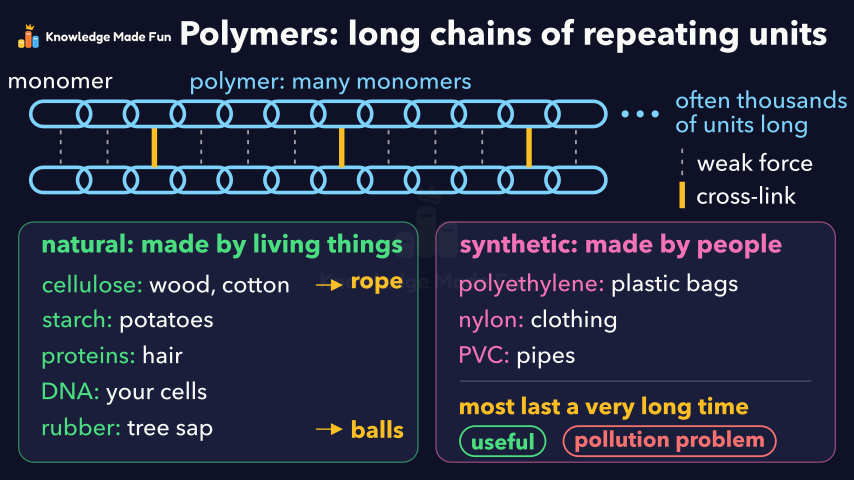
Paper-clip monomers link into a long polymer chain. A second chain then shows how weak forces between longer chains make a material stronger, and how cross-links stop chains sliding. Two cards show that polymers are natural (cellulose, starch, proteins, DNA, rubber, used by Indigenous peoples for thousands of years) as well as synthetic (polyethylene, nylon, PVC), and that most plastics last a very long time, which makes them useful and also a pollution problem.
Anyone can watch two lessons on the website without an account. Signing in is free, no payment and no card, and opens three a day; Plus has no limit.
Loading
In one sentence
The question this lesson answers
What do wood, DNA and a plastic bag have in common?
They are all made of polymers, built from small molecules called monomers. Picture one monomer as a paper clip.
Transcript
What the lesson says
What do wood, DNA and a plastic bag have in common?
They are all made of polymers, built from small molecules called monomers. Picture one monomer as a paper clip.
Monomers join end to end, like paper clips linked into a chain.
Poly means many, so a long chain of many monomers is called a polymer.
In many polymers, the very same unit repeats again and again, often thousands of times in one chain.
Living things make natural polymers: cellulose in wood and cotton, starch in potatoes, proteins in hair, DNA in your cells, and rubber from tree sap.
Indigenous peoples have used them for thousands of years, making rope from plant fibres and balls from rubber.
So not all polymers are plastics made by people.
Synthetic polymers are made by people: polyethylene in plastic bags, nylon in clothing, and PVC in pipes.
In a material, chains lie side by side, held together by weak forces.
Longer chains have more of these forces, so the material is usually stronger.
Some polymers also have cross-links, strong bonds between chains that stop them sliding, so the material holds its shape.
Most plastics break down very slowly, so they last a very long time.
That makes them useful, but it also makes plastic waste a pollution problem.
Polymers are long chains of repeating units called monomers, made by nature and by people.
Curriculum
Where this fits
- British Columbia, Grade 10
Science 10, Chemistry: practical applications and implications of chemical processes, including First Peoples knowledgeBC10-SC-30
Previous: The Fire Triangle: Heat, Fuel and OxygenNext: Preventing corrosion: paint, galvanizing and sacrificial metals
- British Columbia, Grade 11
Chemistry 11, Organic chemistry: applications of organic chemistryBC11-SC-16
Previous: Isomers: Same Formula, Different StructureNext: Fractional Distillation: Separating Crude Oil by Boiling Point
This lesson is also listed in Grade 11.
The outcomes and strands follow the British Columbia curriculum.
Keep going
 1 min 40 s
Acids and bases: the pH scale
Grade 10 · 1 min 40 s 1 min 39 s
Activation energy: the push a reaction needs to start
Grade 10 · 1 min 39 s 1 min 54 s
Atomic Size: Bigger Down a Group, Smaller Across a Period
Grade 9 · 1 min 54 s 1 min 18 s
Atoms rearrange: vinegar and baking soda
Grade 7 · 1 min 18 s 1 min 16 s
Atoms: What Everything Is Made Of
Grade 7 · 1 min 16 s 2 min 3 s
Balancing Chemical Equations
Grade 10 · 2 min 3 s 1 min 54 s
Bohr Diagrams: Electrons in Shells and Valence Electrons
Grade 9 · 1 min 54 s 1 min 45 s
Brownian motion: evidence that molecules exist
Grade 8 · 1 min 45 s
- All Grade 10 Science lessons
- Create a free account to watch three lessons a day, no payment and no card.