Lesson · Grade 11 · Chemistry
Isomers: Same Formula, Different Structure
- Grade 11
- Chemistry
- 1 min 51 s
- British Columbia
- BC11-SC-15
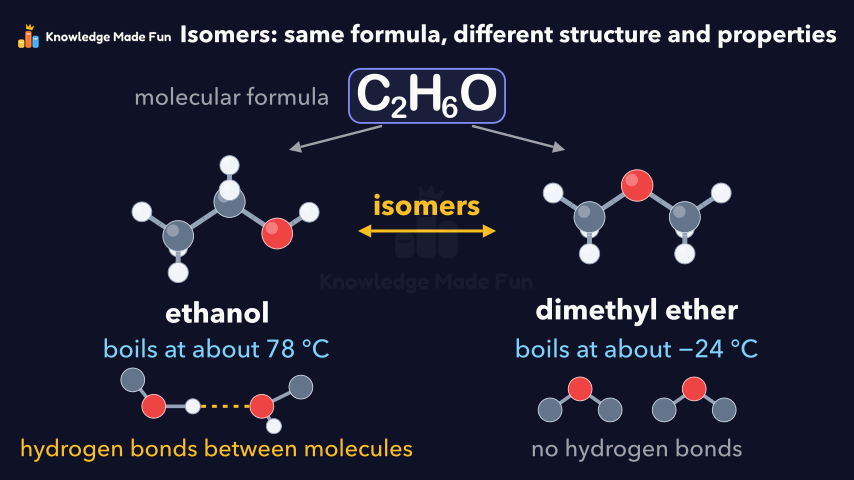
C4H10 forms two molecules: butane, an unbranched chain, and 2-methylpropane, which is branched. Their 3D ball-and-stick models turn and bend to show that only a different order of bonded atoms makes a new isomer, and that the branched one boils lower (about −12 °C against about −1 °C) because it touches its neighbours less. The same diagram then shows that ethanol (about 78 °C) boils far higher than dimethyl ether (about −24 °C) because only ethanol has a hydrogen on oxygen that can form hydrogen bonds.
Anyone can watch two lessons on the website without an account. Signing in is free, no payment and no card, and opens three a day; Plus has no limit.
Loading
In one sentence
The question this lesson answers
Can two different molecules share one molecular formula?
A molecular formula counts the atoms: C four H ten means four carbon atoms and ten hydrogen atoms.
Transcript
What the lesson says
Can two different molecules share one molecular formula?
A molecular formula counts the atoms: C four H ten means four carbon atoms and ten hydrogen atoms.
Join the four carbons in one chain, and you get butane.
Or join three in a chain and put the fourth on the middle one, as a branch: 2-methylpropane.
These are isomers: same molecular formula, different structure. Their atoms are joined in a different order.
Turning a model in three dimensions does not change the molecule.
The butane chain can bend around a single bond, but its carbons still run one, two, three, four: still butane, not a new isomer.
Butane boils at about minus 1 degree Celsius, but 2-methylpropane boils at about minus 12.
Dispersion forces, weak attractions between molecules, grow with contact. Compact 2-methylpropane touches less, so it boils lower.
Another formula, C two H six O, has two isomers: ethanol and dimethyl ether.
Ethanol boils at about 78 degrees Celsius, but dimethyl ether boils at about minus 24.
In ethanol, a hydrogen on oxygen is attracted to the oxygen of the next molecule: a strong hydrogen bond.
Dimethyl ether has no hydrogen on oxygen, so its molecules form no hydrogen bonds, and it boils far lower.
Isomers have the same molecular formula but a different structure, which gives them different properties.
Curriculum
Where this fits
- British Columbia, Grade 11
Chemistry 11, Organic chemistry: organic compoundsBC11-SC-15
Previous: Functional groups: the part that gives a molecule its behaviourNext: Polymers: Long Chains of Repeating Units
The outcomes and strands follow the British Columbia curriculum.
Keep going
 2 min 2 s
Carbon makes four bonds
Grade 11 · 2 min 2 s 1 min 48 s
Fractional Distillation: Separating Crude Oil by Boiling Point
Grade 11 · 1 min 48 s 1 min 59 s
Functional groups: the part that gives a molecule its behaviour
Grade 11 · 1 min 59 s 1 min 48 s
Medicines from Organic Molecules: Shape Fits the Target
Grade 11 · 1 min 48 s 2 min 6 s
Naming Alkanes, Alkenes and Alkynes
Grade 11 · 2 min 6 s 1 min 40 s
Acids and bases: the pH scale
Grade 10 · 1 min 40 s 1 min 39 s
Adaptations Are Inherited, Not Earned in a Lifetime
Grade 11 · 1 min 39 s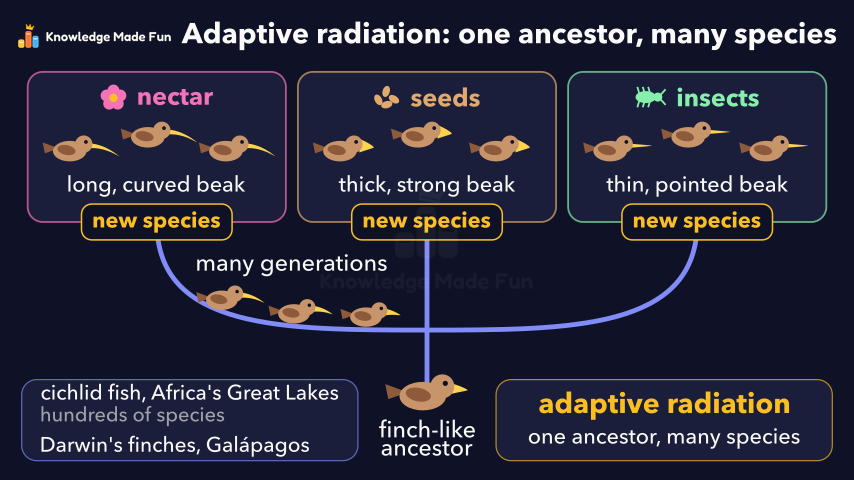 1 min 48 s
Adaptive radiation: one ancestor, many species
Grade 10 · 1 min 48 s
- All Grade 11 Chemistry lessons
- Create a free account to watch three lessons a day, no payment and no card.