Lesson · Grade 10 · Science
Acids and bases: the pH scale
- Grade 10
- Science
- 1 min 40 s
- British Columbia
- BC10-SC-22
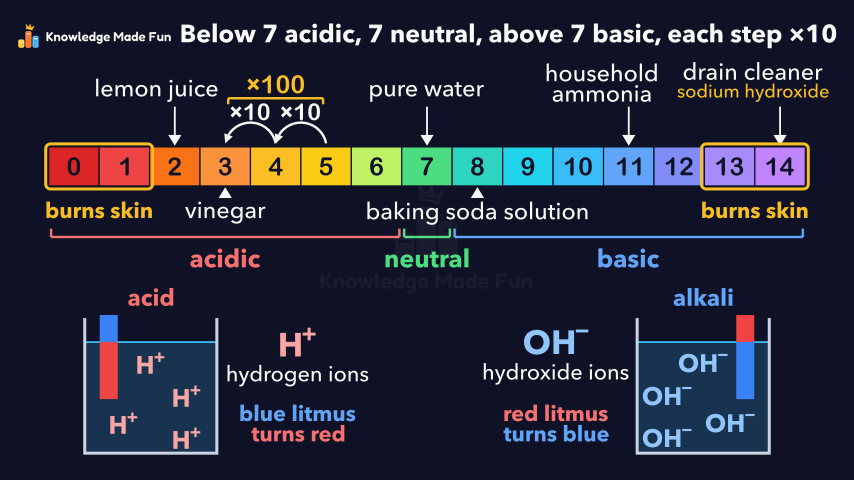
A colour-coded pH scale from 0 to 14 builds up with everyday solutions on it (lemon juice, vinegar, pure water, baking soda solution, household ammonia and drain cleaner). It shows the acidic, neutral and basic parts, the hydrogen and hydroxide ions behind them, and how each step is ten times the hydrogen ion concentration, then shows litmus paper turning red in an acid and blue in an alkali and warns that strong bases burn skin just as strong acids do.
Anyone can watch two lessons on the website without an account. Signing in is free, no payment and no card, and opens three a day; Plus has no limit.
Loading
In one sentence
The question this lesson answers
How do chemists describe how acidic or basic a solution is?
They use the pH scale, which runs from 0 to 14 for most solutions.
Transcript
What the lesson says
How do chemists describe how acidic or basic a solution is?
They use the pH scale, which runs from 0 to 14 for most solutions.
In the middle, pH 7 is neutral, and pure water has a pH of 7.
Below 7 is acidic: vinegar is about pH 3, and lemon juice is about pH 2.
Above 7 is basic: baking soda solution is about pH 8, and household ammonia is about pH 11.
In water, acids release hydrogen ions, written H plus.
A base that dissolves in water is called an alkali, and it produces hydroxide ions, written O H minus.
Each step down the scale means ten times the concentration of hydrogen ions.
So pH 3 has ten times ten, or 100 times, the hydrogen ion concentration of pH 5.
An indicator is a substance that changes colour depending on the pH.
Blue litmus turns red in an acid, and red litmus turns blue in an alkali.
Bases are not harmless: strong bases, like the sodium hydroxide in drain cleaner at about pH 14, burn skin just as strong acids do.
So on the pH scale, below 7 is acidic, 7 is neutral, above 7 is basic, and each step is a factor of ten.
Curriculum
Where this fits
- British Columbia, Grade 10
Science 10, Chemistry: acid-base chemistryBC10-SC-22
Previous: Combustion: where does the fuel go?Next: Neutralization: Acid + Base Makes Salt + Water
- British Columbia, Grade 11
Chemistry 11, Solutions: analysis techniquesBC11-SC-41
Previous: Ion concentrations when two solutions are mixedNext: Testing Water: Dissolved Oxygen, Nitrates and Phosphates
This lesson is also listed in Grade 11.
The outcomes and strands follow the British Columbia curriculum.
Keep going
 1 min 39 s
Activation energy: the push a reaction needs to start
Grade 10 · 1 min 39 s 1 min 54 s
Atomic Size: Bigger Down a Group, Smaller Across a Period
Grade 9 · 1 min 54 s 1 min 18 s
Atoms rearrange: vinegar and baking soda
Grade 7 · 1 min 18 s 1 min 16 s
Atoms: What Everything Is Made Of
Grade 7 · 1 min 16 s 2 min 3 s
Balancing Chemical Equations
Grade 10 · 2 min 3 s 1 min 54 s
Bohr Diagrams: Electrons in Shells and Valence Electrons
Grade 9 · 1 min 54 s 1 min 45 s
Brownian motion: evidence that molecules exist
Grade 8 · 1 min 45 s 1 min 49 s
Changes of State: Why the Temperature Stops Rising
Grade 8 · 1 min 49 s
- All Grade 10 Science lessons
- Create a free account to watch three lessons a day, no payment and no card.