Lesson · Grade 11 · Chemistry
Ion concentrations when two solutions are mixed
- Grade 11
- Chemistry
- 2 min 41 s
- British Columbia
- BC11-SC-40
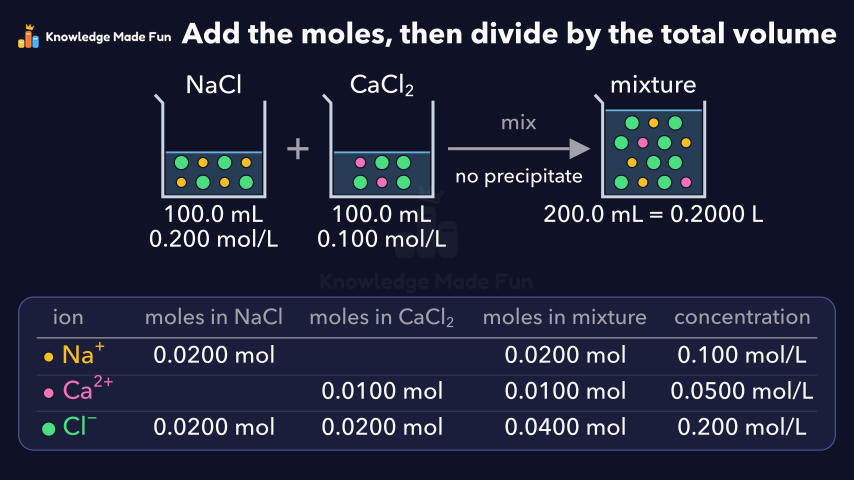
Two beakers, 100.0 mL of 0.200 mol/L NaCl and 100.0 mL of 0.100 mol/L CaCl₂, split into ions drawn as dots and pour into one 200.0 mL mixture, while a table under them fills in the moles of each ion and then each concentration: Na⁺ 0.100, Ca²⁺ 0.0500 and Cl⁻ 0.200 mol/L. It shows why simply adding the chloride concentrations to get 0.400 mol/L is wrong, because the volume doubles too, and ends on the recap: add the moles, then divide by the total volume.
Anyone can watch two lessons on the website without an account. Signing in is free, no payment and no card, and opens three a day; Plus has no limit.
Loading
In one sentence
The question this lesson answers
When two salt solutions are mixed, what is the concentration of each ion?
We mix 100.0 millilitres of sodium chloride at 0.200 moles per litre with 100.0 millilitres of calcium chloride at 0.100 moles per litre.
Transcript
What the lesson says
When two salt solutions are mixed, what is the concentration of each ion?
We mix 100.0 millilitres of sodium chloride at 0.200 moles per litre with 100.0 millilitres of calcium chloride at 0.100 moles per litre.
Concentration is how many moles are dissolved in each litre of solution.
In water, each salt splits into ions, which are charged particles.
Calcium chloride gives two chloride ions for every calcium ion.
Step one: moles equal concentration times volume in litres, and 100.0 millilitres is 0.1000 litres.
Sodium chloride: 0.200 times 0.1000 litres gives 0.0200 moles of each ion.
Calcium chloride: 0.100 times 0.1000 gives 0.0100 moles of calcium ions, and twice that of chloride, 0.0200 moles.
Now mix them. No precipitate, meaning no solid, forms, so every ion stays dissolved.
Mixing does not change the moles, but chloride comes from both solutions: 0.0200 plus 0.0200 is 0.0400.
For dilute solutions like these, we can add the volumes: 200.0 millilitres, or 0.2000 litres.
Step two: divide by the total volume. Sodium: 0.0200 divided by 0.2000 is 0.100 moles per litre.
In the same way, calcium is 0.0500 and chloride is 0.200 moles per litre.
Each solution has 0.200 moles per litre of chloride, so adding them to get 0.400 is a common mistake.
The chloride moles doubled, but so did the volume, so chloride stays at 0.200 moles per litre.
To find each ion's concentration, add its moles, then divide by the total volume.
Curriculum
Where this fits
- British Columbia, Grade 11
Chemistry 11, Solutions: stoichiometric calculations in aqueous solutionsBC11-SC-40
Previous: Dilution: More Solvent, Same Moles of SoluteNext: Acids and bases: the pH scale
The outcomes and strands follow the British Columbia curriculum.
Keep going
 2 min 10 s
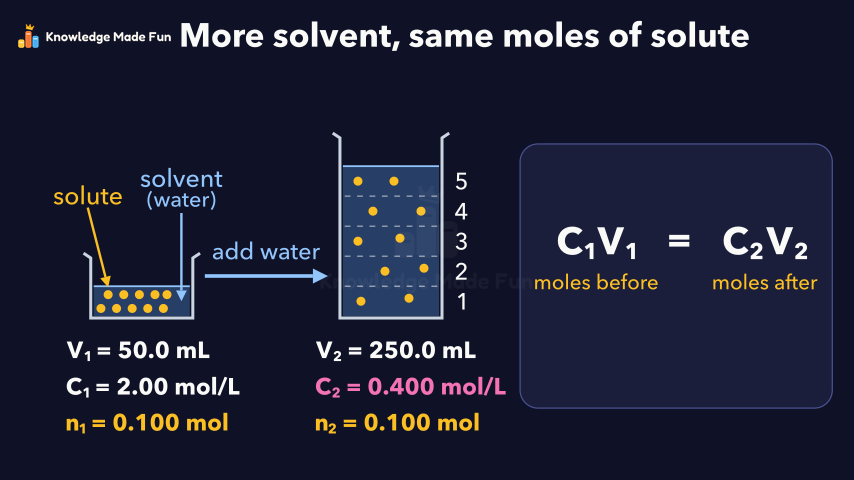
Dilution: More Solvent, Same Moles of Solute
Grade 11 · 2 min 10 s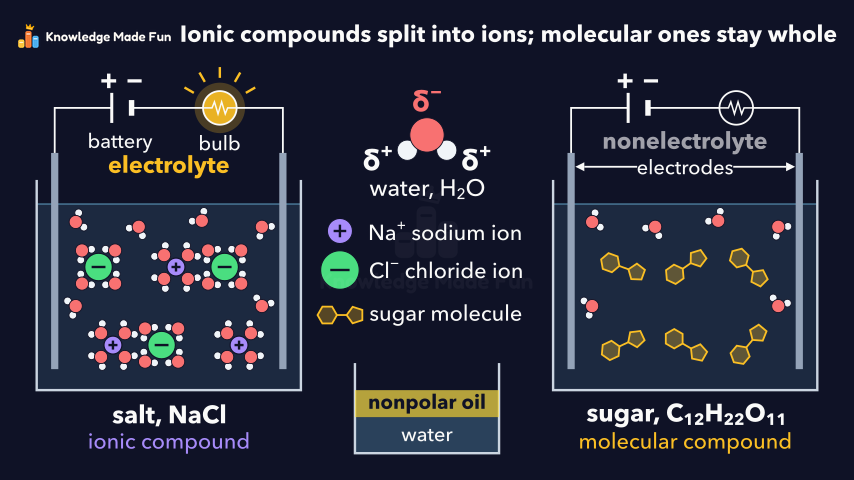 1 min 51 s
Ionic compounds split into ions; molecular ones stay whole
Grade 11 · 1 min 51 s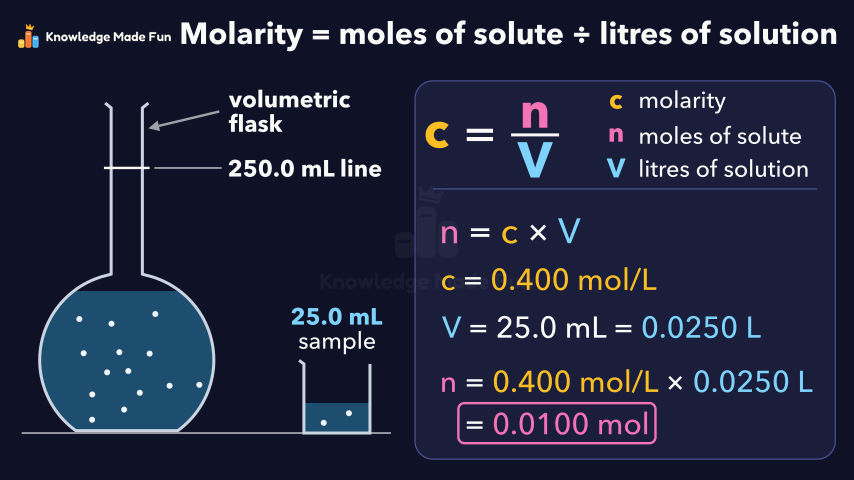 2 min 19 s
Molarity: moles of solute per litre of solution
Grade 11 · 2 min 19 s 1 min 52 s
Testing Water: Dissolved Oxygen, Nitrates and Phosphates
Grade 11 · 1 min 52 s 1 min 56 s
Writing Dissociation Equations
Grade 11 · 1 min 56 s 1 min 40 s
Acids and bases: the pH scale
Grade 10 · 1 min 40 s 1 min 39 s
Adaptations Are Inherited, Not Earned in a Lifetime
Grade 11 · 1 min 39 s 1 min 48 s
Adaptive radiation: one ancestor, many species
Grade 10 · 1 min 48 s
- All Grade 11 Chemistry lessons
- Create a free account to watch three lessons a day, no payment and no card.