Lesson · Grade 11 · Chemistry
Testing Water: Dissolved Oxygen, Nitrates and Phosphates
- Grade 11
- Chemistry
- 1 min 52 s
- British Columbia
- BC11-SC-42
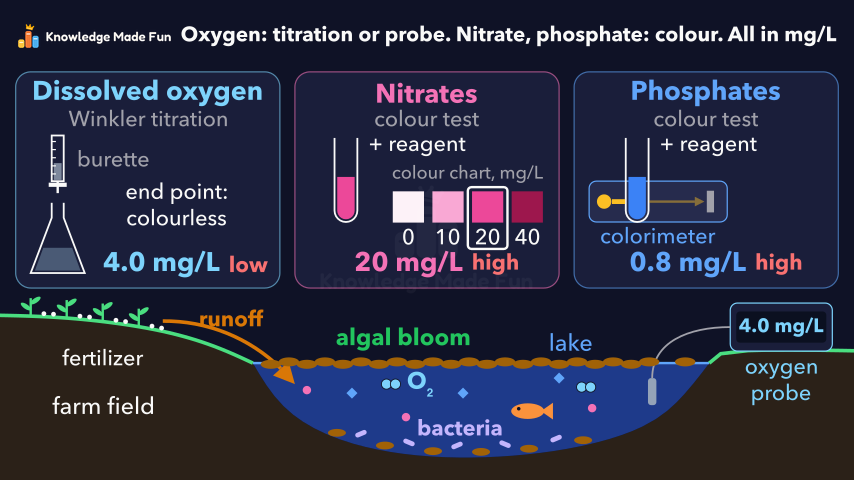
One water sample from a lake beside a farm field is tested three ways: dissolved oxygen by the Winkler titration (fix the oxygen, release iodine, titrate with sodium thiosulfate to the starch end point) and by an oxygen probe, nitrate with a colour chart, and phosphate with a colorimeter, with every result in mg/L. Fertilizer runoff, an algal bloom and the bacteria that decay it then explain why the sample has high nitrate and phosphate but low oxygen, and the video ends on a one-line recap of the three tests.
Anyone can watch two lessons on the website without an account. Signing in is free, no payment and no card, and opens three a day; Plus has no limit.
Loading
In one sentence
The question this lesson answers
Is this lake healthy? Scientists test its water for dissolved oxygen, nitrates and phosphates.
Dissolved oxygen is oxygen gas dissolved in water. Fish need it for respiration.
Transcript
What the lesson says
Is this lake healthy? Scientists test its water for dissolved oxygen, nitrates and phosphates.
Dissolved oxygen is oxygen gas dissolved in water. Fish need it for respiration.
In the Winkler method, manganese sulfate and alkaline iodide fix the oxygen, locking it into a brown solid.
Acid then releases iodine, in proportion to the oxygen.
In a titration, sodium thiosulfate of known concentration is added from a burette until the iodine is used up.
Starch turns the iodine blue, and the end point is when the blue disappears.
From the volume used, we get 4.0 milligrams of oxygen per litre.
An oxygen probe is quicker: its meter reads the oxygen directly.
Nitrate and phosphate tests add a reagent: a chemical that reacts with them to make a colour.
The deeper the colour, the more nitrate. A chart gives 20 milligrams per litre.
The phosphate reagent turns the sample blue.
A colorimeter measures how much light the sample absorbs: 0.8 milligrams per litre.
Rain washes some fertilizer into the lake. This runoff adds nitrates and phosphates.
These nutrients make algae grow fast: an algal bloom.
When the algae die, bacteria decompose them and use up dissolved oxygen.
So this lake is not healthy: high nitrate and phosphate, and oxygen low enough to stress many fish.
Oxygen by titration or probe, nitrate and phosphate by colour, all in milligrams per litre.
Curriculum
Where this fits
- British Columbia, Grade 11
Chemistry 11, Solutions: analysis techniquesBC11-SC-42
The outcomes and strands follow the British Columbia curriculum.
Keep going
 2 min 10 s
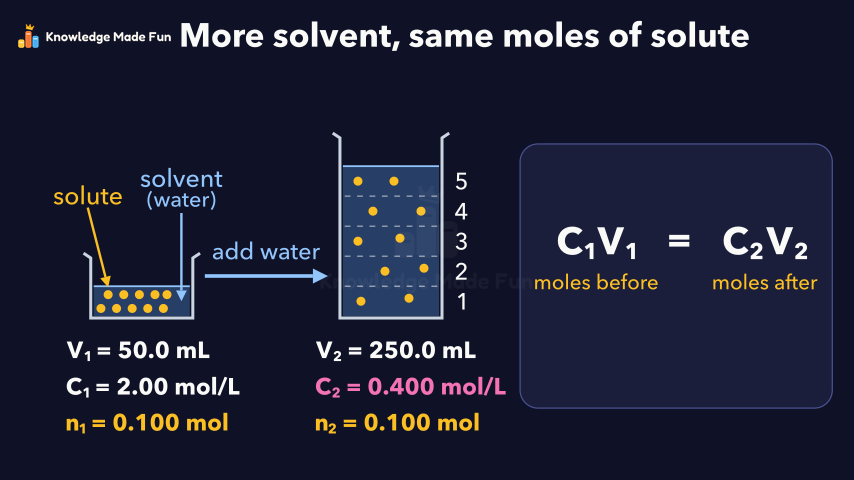
Dilution: More Solvent, Same Moles of Solute
Grade 11 · 2 min 10 s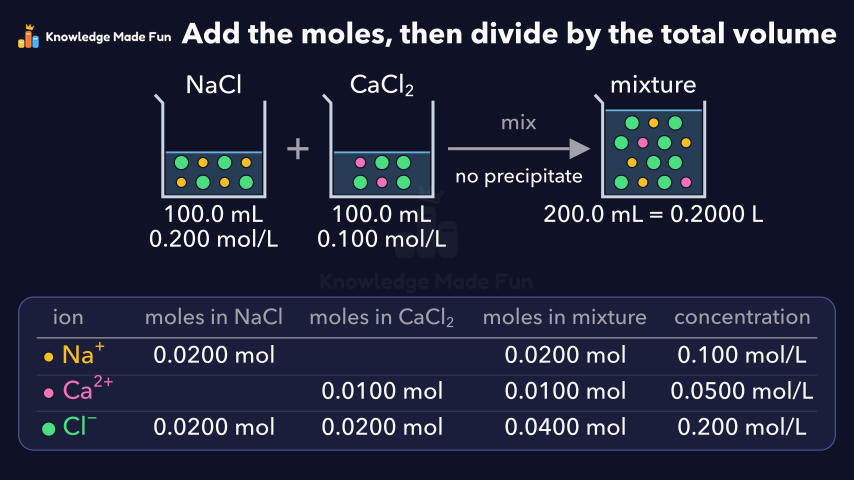 2 min 41 s
Ion concentrations when two solutions are mixed
Grade 11 · 2 min 41 s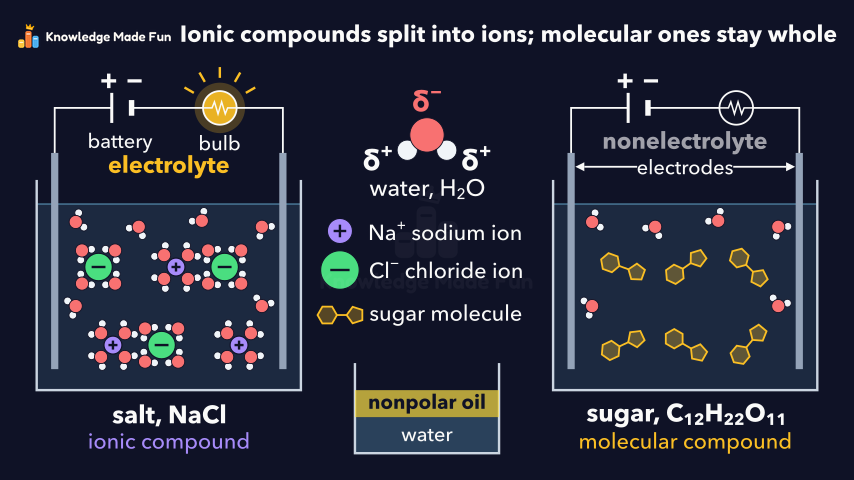 1 min 51 s
Ionic compounds split into ions; molecular ones stay whole
Grade 11 · 1 min 51 s 2 min 19 s
Molarity: moles of solute per litre of solution
Grade 11 · 2 min 19 s 1 min 56 s
Writing Dissociation Equations
Grade 11 · 1 min 56 s 1 min 40 s
Acids and bases: the pH scale
Grade 10 · 1 min 40 s 1 min 39 s
Adaptations Are Inherited, Not Earned in a Lifetime
Grade 11 · 1 min 39 s 1 min 48 s
Adaptive radiation: one ancestor, many species
Grade 10 · 1 min 48 s
- All Grade 11 Chemistry lessons
- Create a free account to watch three lessons a day, no payment and no card.