Lesson · Grade 10 · Science
Activation energy: the push a reaction needs to start
- Grade 10
- Science
- 1 min 39 s
- British Columbia
- BC10-SC-27
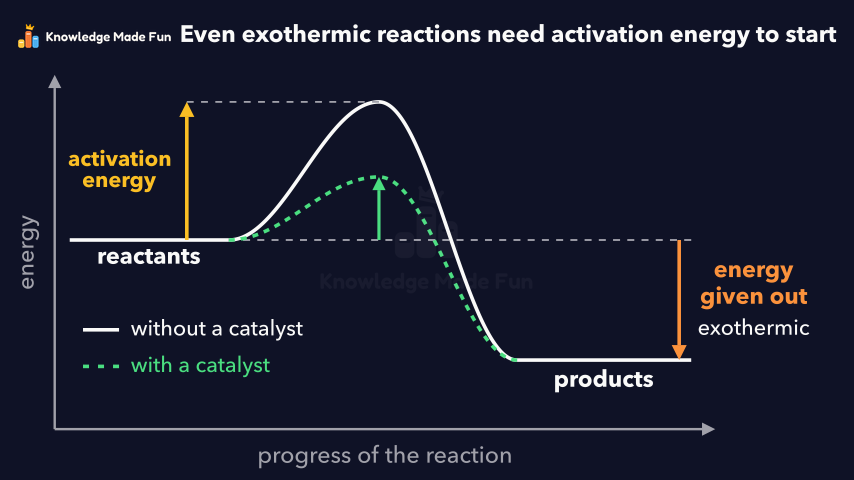
An energy diagram builds up step by step: wood and oxygen on the left, carbon dioxide and water lower down on the right, and the energy given out that makes burning exothermic, followed by the hill in between whose height is the activation energy. A ball for the particles rolls back at room temperature until a match flame pushes it over, and a dashed lower hill shows how a catalyst, such as an enzyme or a car's catalytic converter, lowers the activation energy without being used up.
Anyone can watch two lessons on the website without an account. Signing in is free, no payment and no card, and opens three a day; Plus has no limit.
Loading
In one sentence
The question this lesson answers
Burning wood gives out lots of energy. So why doesn't a log burst into flames by itself?
Here is an energy diagram, with energy up the side and the progress of the reaction along the bottom.
Transcript
What the lesson says
Burning wood gives out lots of energy. So why doesn't a log burst into flames by itself?
Here is an energy diagram, with energy up the side and the progress of the reaction along the bottom.
On the left are the reactants, the substances we start with: wood and oxygen.
On the right are the products, the new substances made: mainly carbon dioxide and water.
The products have less energy. The difference is given out as heat and light: we call this exothermic.
So shouldn't an exothermic reaction start by itself? Yet wood can sit in air for years without burning.
In between is an energy hill: bonds must start to break before new ones form, and that takes energy.
The hill's height above the reactants is the activation energy, the minimum energy needed to start.
For wood the hill is high: at room temperature, almost no particles have enough energy to get over it.
A match gives the push: friction heats its head until it lights, and the flame heats the wood over the hill.
A catalyst lowers the hill by giving the reaction a different route, and it is not used up.
Enzymes in your body are catalysts, and so are the metals in a car's catalytic converter.
Even an exothermic reaction needs a push over the hill to start: its activation energy.
Curriculum
Where this fits
- British Columbia, Grade 10
Science 10, Chemistry: energy change during chemical reactionsBC10-SC-27
Previous: Exothermic and Endothermic ReactionsNext: Why You Must Never Mix Cleaners
The outcomes and strands follow the British Columbia curriculum.
Keep going
 1 min 40 s
Acids and bases: the pH scale
Grade 10 · 1 min 40 s 1 min 54 s
Atomic Size: Bigger Down a Group, Smaller Across a Period
Grade 9 · 1 min 54 s 1 min 18 s
Atoms rearrange: vinegar and baking soda
Grade 7 · 1 min 18 s 1 min 16 s
Atoms: What Everything Is Made Of
Grade 7 · 1 min 16 s 2 min 3 s
Balancing Chemical Equations
Grade 10 · 2 min 3 s 1 min 54 s
Bohr Diagrams: Electrons in Shells and Valence Electrons
Grade 9 · 1 min 54 s 1 min 45 s
Brownian motion: evidence that molecules exist
Grade 8 · 1 min 45 s 1 min 49 s
Changes of State: Why the Temperature Stops Rising
Grade 8 · 1 min 49 s
- All Grade 10 Science lessons
- Create a free account to watch three lessons a day, no payment and no card.