Lesson · Grade 10 · Science
Why You Must Never Mix Cleaners
- Grade 10
- Science
- 1 min 44 s
- British Columbia
- BC10-SC-28
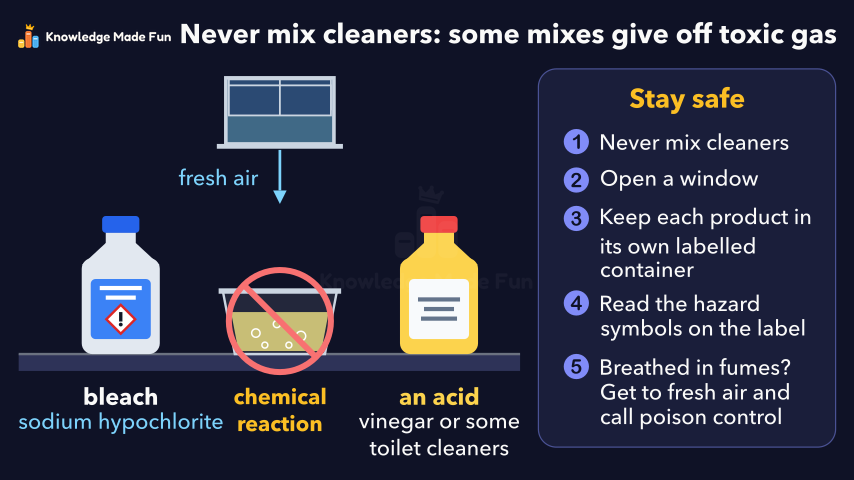
A labelled diagram of bleach, a second cleaner and a bucket shows that bleach mixed with ammonia releases toxic chloramine gases, and bleach mixed with an acid such as vinegar or some toilet cleaners releases toxic chlorine gas, so mixing never makes a stronger cleaner. The same diagram then shows five safety rules: never mix cleaners, open a window, keep products in their own labelled containers, read the hazard symbols, and after breathing in fumes get to fresh air and call poison control.
Concept: Household chemical safety: why some cleaners must never be mixed
Anyone can watch two lessons on the website without an account. Signing in is free, no payment and no card, and opens three a day; Plus has no limit.
Loading
In one sentence
The question this lesson answers
Many people think that mixing two cleaners makes a stronger cleaner. Is that true?
Start with bleach. Household bleach is a solution of a chemical called sodium hypochlorite.
Transcript
What the lesson says
Many people think that mixing two cleaners makes a stronger cleaner. Is that true?
Start with bleach. Household bleach is a solution of a chemical called sodium hypochlorite.
Some glass cleaners contain a different chemical, called ammonia.
If the two are mixed, they react. In a chemical reaction, the starting chemicals change into new substances.
Here, the new substances include a group of gases called chloramines, which escape into the air.
Chloramines are toxic, which means poisonous. Breathing them in harms the lungs.
Bleach must not be mixed with an acid either, such as vinegar or some toilet cleaners.
When bleach and an acid are mixed, the reaction gives off chlorine gas, a yellow-green gas that is also toxic and harms the lungs.
So mixing does not make a stronger cleaner. The chemicals use each other up and give off a toxic gas instead.
To stay safe, first of all, never mix cleaners.
Next, open a window while you clean, so fresh air carries away any fumes, the gases a product gives off.
Keep each product in its own labelled container, so no one mixes them up by mistake.
Read the hazard symbols on the label. These small pictures warn how a product can harm you.
If someone breathes in fumes, get them to fresh air and call poison control for advice.
Remember: never mix cleaners, because some mixes give off a toxic gas.
Curriculum
Where this fits
- British Columbia, Grade 10
Science 10, Chemistry: practical applications and implications of chemical processes, including First Peoples knowledgeBC10-SC-28
Previous: Activation energy: the push a reaction needs to startNext: The Fire Triangle: Heat, Fuel and Oxygen
- British Columbia, Grade 11
Science For Citizens 11, Safety: personal safety and awarenessBC11-SC-268
This lesson is also listed in Grade 11.
The outcomes and strands follow the British Columbia curriculum.
Keep going
 1 min 40 s
Acids and bases: the pH scale
Grade 10 · 1 min 40 s 1 min 39 s
Activation energy: the push a reaction needs to start
Grade 10 · 1 min 39 s 1 min 54 s
Atomic Size: Bigger Down a Group, Smaller Across a Period
Grade 9 · 1 min 54 s 1 min 18 s
Atoms rearrange: vinegar and baking soda
Grade 7 · 1 min 18 s 1 min 16 s
Atoms: What Everything Is Made Of
Grade 7 · 1 min 16 s 2 min 3 s
Balancing Chemical Equations
Grade 10 · 2 min 3 s 1 min 54 s
Bohr Diagrams: Electrons in Shells and Valence Electrons
Grade 9 · 1 min 54 s 1 min 45 s
Brownian motion: evidence that molecules exist
Grade 8 · 1 min 45 s
- All Grade 10 Science lessons
- Create a free account to watch three lessons a day, no payment and no card.