Lesson · Grade 7 · Science
Atoms rearrange: vinegar and baking soda
- Grade 7
- Science
- 1 min 18 s
- British Columbia
- BC7-SC-18
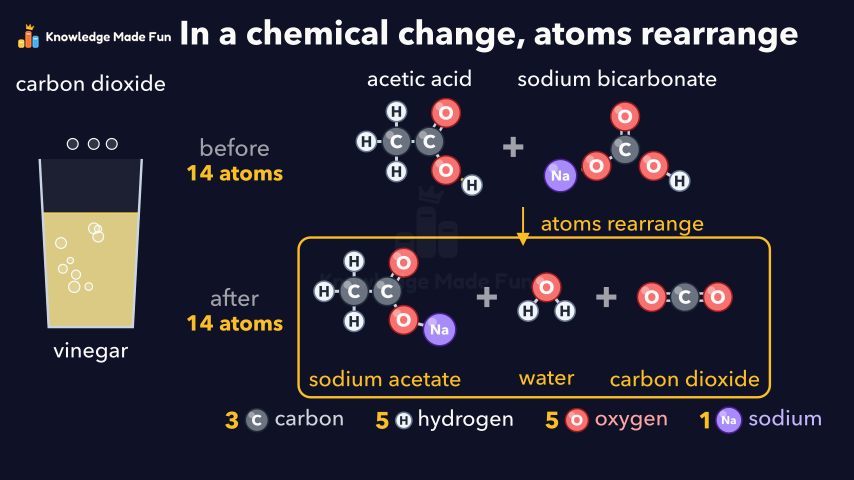
A glass of vinegar fizzes when baking soda drops in, and a ball-and-stick diagram shows why: one molecule of acetic acid and one unit of sodium bicarbonate break some of their joins, and copies of their atoms travel down to join up again as sodium acetate, water and carbon dioxide, with the carbon dioxide escaping as the bubbles. Counting the atoms by element shows the same 3 carbon, 5 hydrogen, 5 oxygen and 1 sodium (14 atoms) before and after, so the recap is that in a chemical change atoms are not made or lost, they just rearrange into new substances.
Anyone can watch two lessons on the website without an account. Signing in is free, no payment and no card, and opens three a day; Plus has no limit.
Loading
In one sentence
The question this lesson answers
Drop baking soda into vinegar and it fizzes. Why does that happen?
Vinegar is mostly water. The part that reacts is acetic acid. Here is one molecule of it.
Transcript
What the lesson says
Drop baking soda into vinegar and it fizzes. Why does that happen?
Vinegar is mostly water. The part that reacts is acetic acid. Here is one molecule of it.
Baking soda is sodium bicarbonate. Here is one unit of it.
Each ball is an atom: carbon, hydrogen, oxygen or sodium. Each stick is a join between two atoms.
Mix them together, and some of the joins break.
Then the atoms rearrange. They move apart, and join up again in new ways.
That makes three new substances: sodium acetate, water, and carbon dioxide gas.
The carbon dioxide escapes as bubbles. That is the fizz.
Now count the atoms. Three carbon, five hydrogen, five oxygen and one sodium.
It is the same count before and after. No atoms are made, and none are lost.
New substances were made, so this is a chemical change.
In a chemical change, no atoms are made or lost. They just rearrange into new substances.
Curriculum
Where this fits
- British Columbia, Grade 7
Science, Chemistry: chemical changesBC7-SC-18
Previous: Physical change or chemical change?Next: Why Iron Rusts
The outcomes and strands follow the British Columbia curriculum.
Keep going
 1 min 40 s
Acids and bases: the pH scale
Grade 10 · 1 min 40 s 1 min 39 s
Activation energy: the push a reaction needs to start
Grade 10 · 1 min 39 s 1 min 54 s
Atomic Size: Bigger Down a Group, Smaller Across a Period
Grade 9 · 1 min 54 s 1 min 16 s
Atoms: What Everything Is Made Of
Grade 7 · 1 min 16 s 2 min 3 s
Balancing Chemical Equations
Grade 10 · 2 min 3 s 1 min 54 s
Bohr Diagrams: Electrons in Shells and Valence Electrons
Grade 9 · 1 min 54 s 1 min 45 s
Brownian motion: evidence that molecules exist
Grade 8 · 1 min 45 s 1 min 49 s
Changes of State: Why the Temperature Stops Rising
Grade 8 · 1 min 49 s
- All Grade 7 Science lessons
- Create a free account to watch three lessons a day, no payment and no card.