Lesson · Grade 10 · Science
Balancing Chemical Equations
- Grade 10
- Science
- 2 min 3 s
- British Columbia
- BC10-SC-25
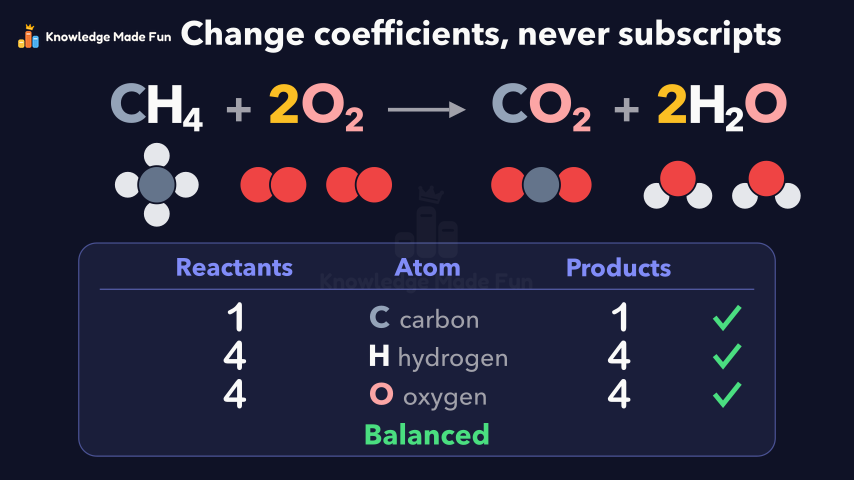
Hydrogen and oxygen making water is written as an equation, a tally of atoms on each side shows it is unbalanced, and the video shows why changing H2O to H2O2 is wrong (it makes hydrogen peroxide) before coefficients balance it as 2H2 + O2 → 2H2O. The same tally then balances methane burning, CH4 + 2O2 → CO2 + 2H2O, to show that atoms and mass stay the same on both sides.
Anyone can watch two lessons on the website without an account. Signing in is free, no payment and no card, and opens three a day; Plus has no limit.
Loading
In one sentence
The question this lesson answers
Hydrogen burns in oxygen to make water. How do we write it as a chemical equation?
Hydrogen is H two, oxygen is O two, and water is H two O.
Transcript
What the lesson says
Hydrogen burns in oxygen to make water. How do we write it as a chemical equation?
Hydrogen is H two, oxygen is O two, and water is H two O.
Reactants, what we start with, go left of the arrow. Products, what is made, go right.
The small 2 is a subscript. It counts the atoms of that element in one molecule.
Atoms are never created or destroyed, so the total mass stays the same: the law of conservation of mass.
So each kind of atom must have the same count on both sides.
Hydrogen: 2 on the left, 2 on the right. Oxygen: 2 on the left, only 1 on the right.
One oxygen atom cannot just vanish, so this equation is unbalanced.
Could we just write H two O two? No. That is hydrogen peroxide, not water.
Never change a subscript. Change only the coefficient, the big number in front.
2 H two O means two water molecules. Oxygen now matches, but hydrogen is 4 on the right.
So write 2 in front of H two. Now every atom matches: it is balanced.
Now methane, C H four, burns in oxygen to make carbon dioxide and water.
Left and right: carbon 1 and 1, hydrogen 4 and 2, oxygen 2 and 3, so it is unbalanced.
A 2 in front of H two O balances hydrogen, but makes oxygen 4 on the right.
A 2 in front of O two gives 4 oxygen atoms on the left. Now it is balanced.
Change only the coefficients, never the subscripts, so atoms and mass stay the same on both sides.
Curriculum
Where this fits
- British Columbia, Grade 10
Science 10, Chemistry: law of conservation of massBC10-SC-25
Previous: Conservation of Mass: Atoms Rearrange but Are Never LostNext: Exothermic and Endothermic Reactions
- British Columbia, Grade 11
Chemistry 11, Reactions: reactionsBC11-SC-24
This lesson is also listed in Grade 11.
The outcomes and strands follow the British Columbia curriculum.
Keep going
 1 min 40 s
Acids and bases: the pH scale
Grade 10 · 1 min 40 s 1 min 39 s
Activation energy: the push a reaction needs to start
Grade 10 · 1 min 39 s 1 min 54 s
Atomic Size: Bigger Down a Group, Smaller Across a Period
Grade 9 · 1 min 54 s 1 min 18 s
Atoms rearrange: vinegar and baking soda
Grade 7 · 1 min 18 s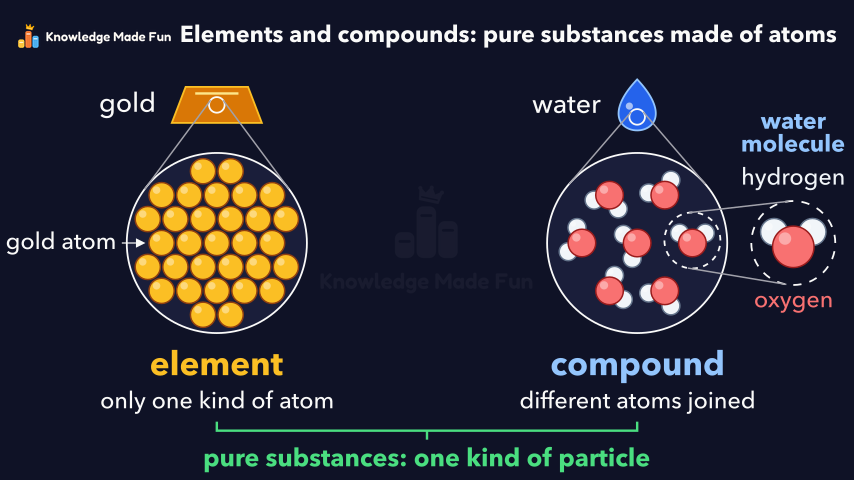 1 min 16 s
Atoms: What Everything Is Made Of
Grade 7 · 1 min 16 s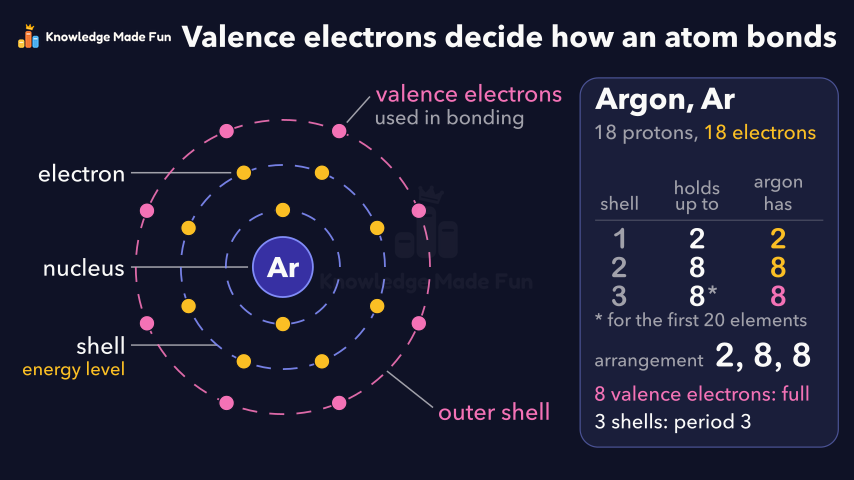 1 min 54 s
Bohr Diagrams: Electrons in Shells and Valence Electrons
Grade 9 · 1 min 54 s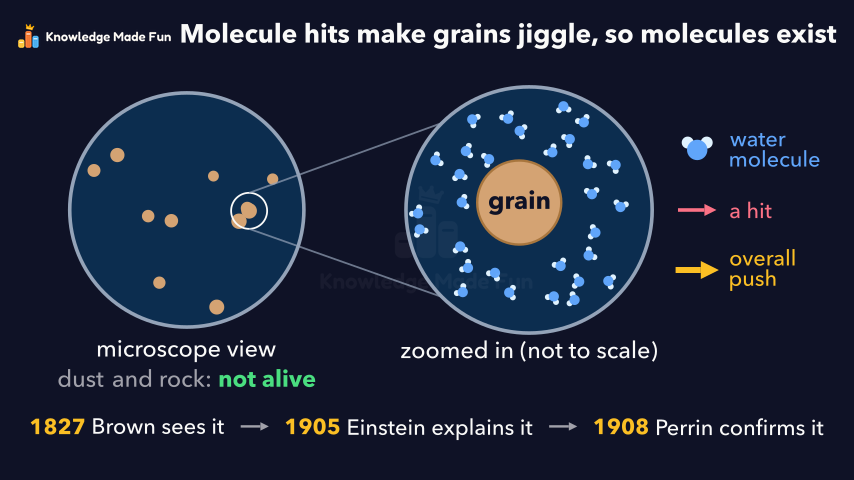 1 min 45 s
Brownian motion: evidence that molecules exist
Grade 8 · 1 min 45 s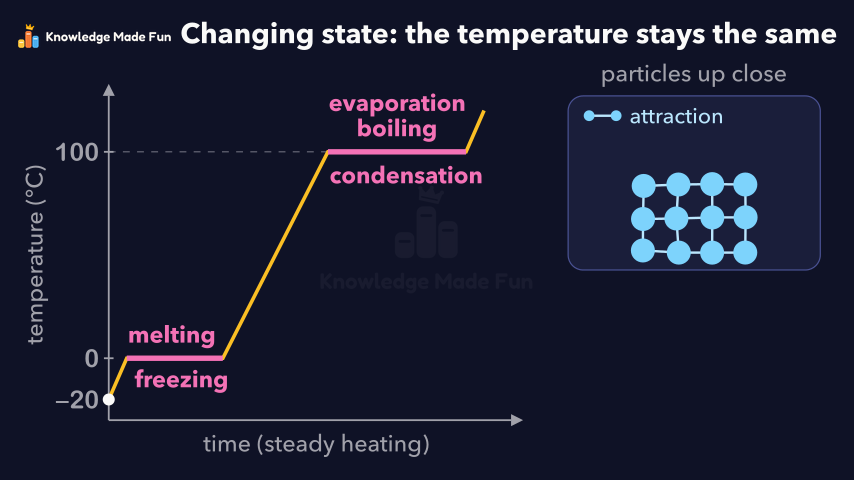 1 min 49 s
Changes of State: Why the Temperature Stops Rising
Grade 8 · 1 min 49 s
- All Grade 10 Science lessons
- Create a free account to watch three lessons a day, no payment and no card.