Lesson · Grade 11 · Chemistry
Reaction types and predicting their products
- Grade 11
- Chemistry
- 1 min 57 s
- British Columbia
- BC11-SC-25
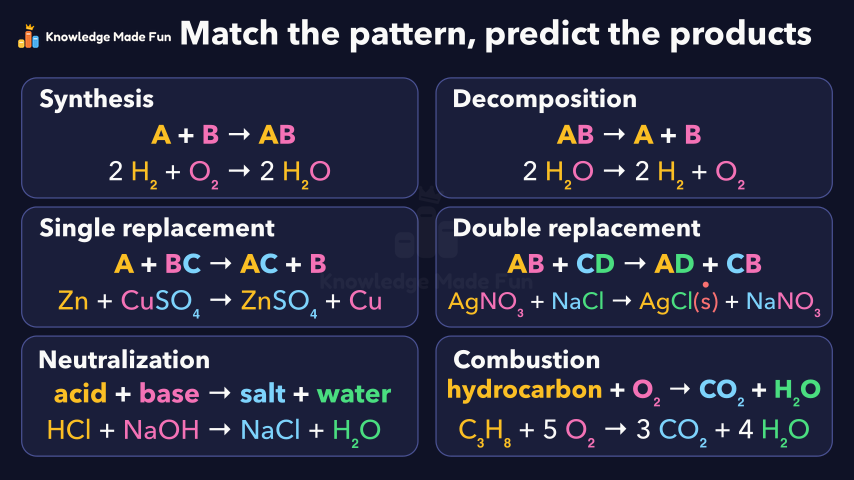
A chart of six cards fills in one at a time: synthesis, decomposition, single replacement, double replacement, neutralization and combustion. Each card shows its letter pattern, such as A + B → AB, above one balanced example coloured to match the letters. The reactants appear first and the products follow on the voice's cue, so viewers see how the pattern predicts the products. The video ends on the recap "Match the pattern, predict the products".
Anyone can watch two lessons on the website without an account. Signing in is free, no payment and no card, and opens three a day; Plus has no limit.
Loading
In one sentence
The question this lesson answers
How can we predict what a reaction will make?
Reactants are what we start with. Products are the new substances made.
Transcript
What the lesson says
How can we predict what a reaction will make?
Reactants are what we start with. Products are the new substances made.
Each letter stands for an element or a group of atoms.
Most reactions fit one of six common patterns.
In synthesis, substances combine into one product: A plus B gives AB.
So hydrogen and oxygen combine to make water.
Decomposition is the reverse: one compound breaks down, so AB gives A plus B.
Electricity splits water back into hydrogen and oxygen.
In single replacement, one element takes another's place: A plus BC gives AC plus B.
Zinc is more reactive than copper, so it replaces copper, making zinc sulfate and copper.
In double replacement, two compounds swap partners: AB plus CD gives AD plus CB.
So silver nitrate and sodium chloride make silver chloride and sodium nitrate.
The s in brackets means solid. A solid that forms when solutions mix is a precipitate.
Neutralization is a special double replacement: an acid plus a base gives a salt plus water.
Hydrochloric acid and sodium hydroxide make sodium chloride and water.
In combustion, a fuel burns in oxygen. A hydrocarbon fuel has only carbon and hydrogen.
When a hydrocarbon burns completely, it makes carbon dioxide and water.
So propane and oxygen make carbon dioxide and water.
Match the reactants to a pattern, and the pattern predicts the products.
Curriculum
Where this fits
- British Columbia, Grade 11
Chemistry 11, Reactions: reactionsBC11-SC-25
Previous: Balancing Chemical EquationsNext: Exothermic and endothermic reactions: the sign of ΔH
The outcomes and strands follow the British Columbia curriculum.
Keep going
 1 min 59 s
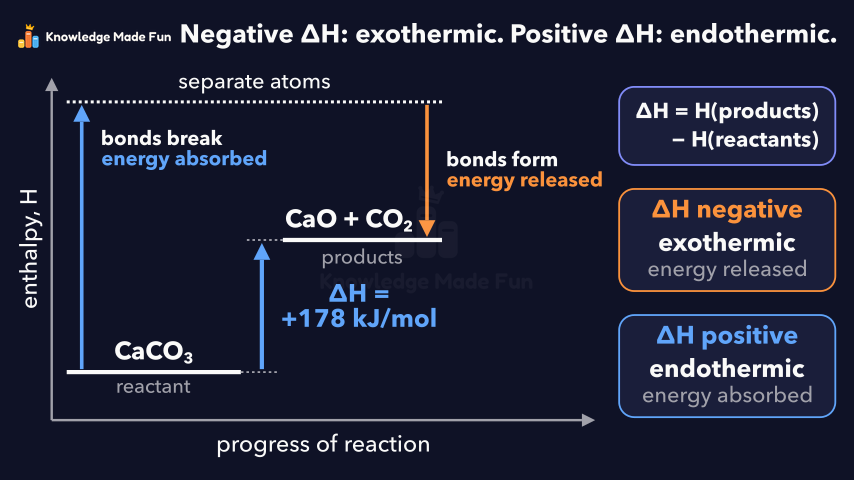
Exothermic and endothermic reactions: the sign of ΔH
Grade 11 · 1 min 59 s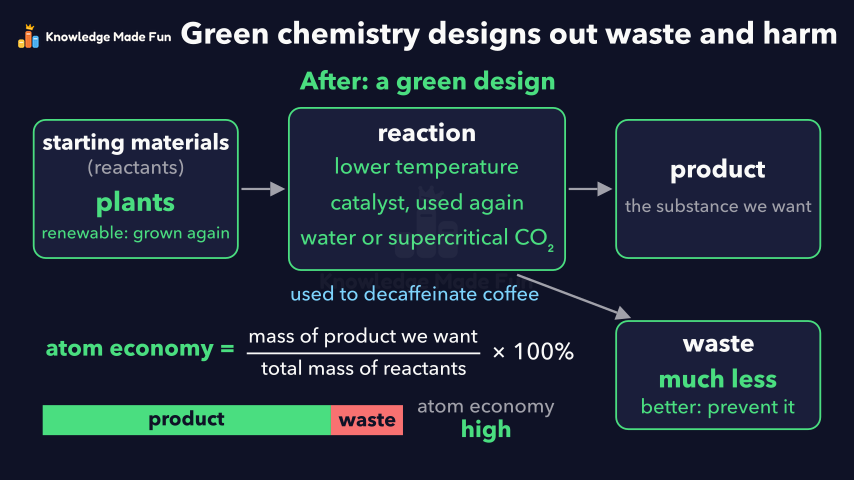 1 min 37 s
Green Chemistry: Designing Out Waste and Harm
Grade 11 · 1 min 37 s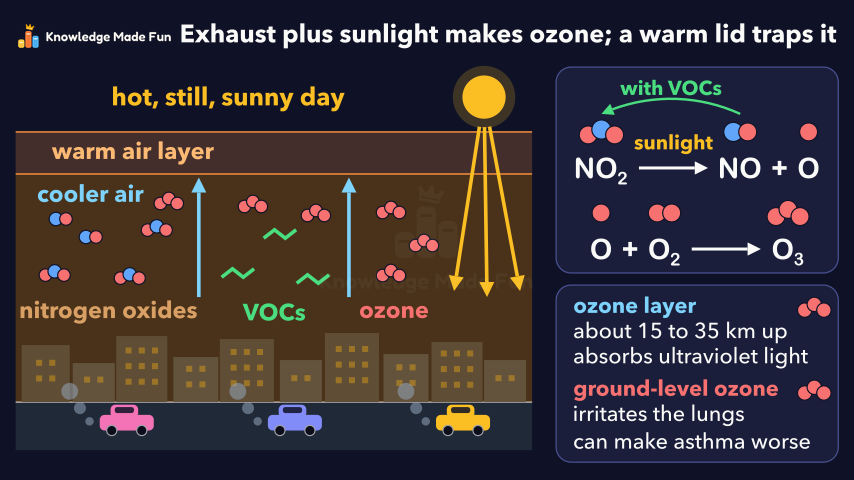 1 min 49 s
Photochemical Smog: How Exhaust and Sunlight Make Ozone
Grade 11 · 1 min 49 s 1 min 47 s
Photosynthesis and Respiration: Two Halves of One Cycle
Grade 8 · 1 min 47 s 1 min 46 s
Pulp and Paper: Freeing Wood Fibres with Chemistry
Grade 11 · 1 min 46 s 1 min 53 s
Smelting: Getting Iron Out of Ore
Grade 11 · 1 min 53 s 1 min 48 s
Why Food Browns When It Cooks
Grade 11 · 1 min 48 s 1 min 40 s
Acids and bases: the pH scale
Grade 10 · 1 min 40 s
- All Grade 11 Chemistry lessons
- Create a free account to watch three lessons a day, no payment and no card.