Lesson · Grade 11 · Chemistry
Photochemical Smog: How Exhaust and Sunlight Make Ozone
- Grade 11
- Chemistry
- 1 min 49 s
- British Columbia
- BC11-SC-32
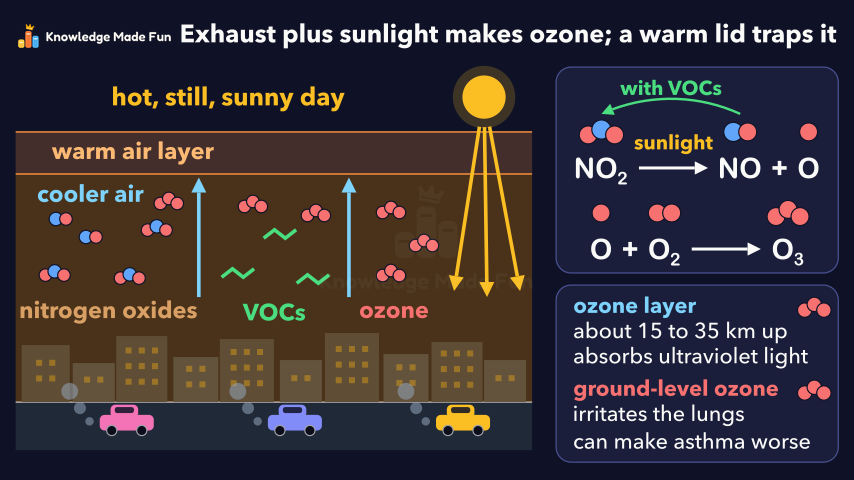
A labelled city cross-section builds up step by step: car exhaust adds nitrogen oxides and VOCs, sunlight splits NO₂ into NO and an oxygen atom, that atom joins O₂ to make ground-level ozone, and NO₂ gives the air its brown haze. A warm-air lid (temperature inversion) then traps the smog, and a side card shows that ozone near the ground harms our lungs while the same gas high up in the ozone layer protects us from ultraviolet light.
Concept: Photochemical smog: exhaust plus sunlight makes ozone
Anyone can watch two lessons on the website without an account. Signing in is free, no payment and no card, and opens three a day; Plus has no limit.
Loading
In one sentence
The question this lesson answers
Why does city air turn hazy and harmful on hot, sunny days?
Picture a city full of traffic on a hot, still, sunny day.
Transcript
What the lesson says
Why does city air turn hazy and harmful on hot, sunny days?
Picture a city full of traffic on a hot, still, sunny day.
Hot car engines make nitrogen and oxygen from the air react, forming nitrogen oxides.
Exhaust also carries unburned hydrocarbons: compounds of hydrogen and carbon from the fuel.
They are volatile organic compounds, or VOCs: carbon compounds that evaporate easily.
Sunlight splits nitrogen dioxide into nitrogen monoxide and a single oxygen atom.
That oxygen atom joins an oxygen molecule, O2, to make ozone, O3.
Reactions involving VOCs turn nitrogen monoxide back into nitrogen dioxide, so ozone keeps building up.
Nitrogen dioxide is a brown gas, so it gives the air a brown haze.
This mix is called photochemical smog, because light drives its reactions.
Usually, warm air near the ground rises and carries pollution away.
In a temperature inversion, a layer of warm air sits above cooler air like a lid.
The cool air cannot rise through it, and with no wind, the smog stays trapped.
Ground-level ozone irritates the lungs and can make asthma worse.
But high up, the same gas forms the ozone layer, about 15 to 35 kilometres up, which absorbs harmful ultraviolet light and protects us.
Exhaust plus sunlight makes ground-level ozone, and a warm-air lid traps it over the city.
Curriculum
Where this fits
- British Columbia, Grade 11
Chemistry 11, Reactions: local and other chemical processesBC11-SC-32
Previous: Photosynthesis and Respiration: Two Halves of One CycleNext: Pulp and Paper: Freeing Wood Fibres with Chemistry
The outcomes and strands follow the British Columbia curriculum.
Keep going
 1 min 59 s
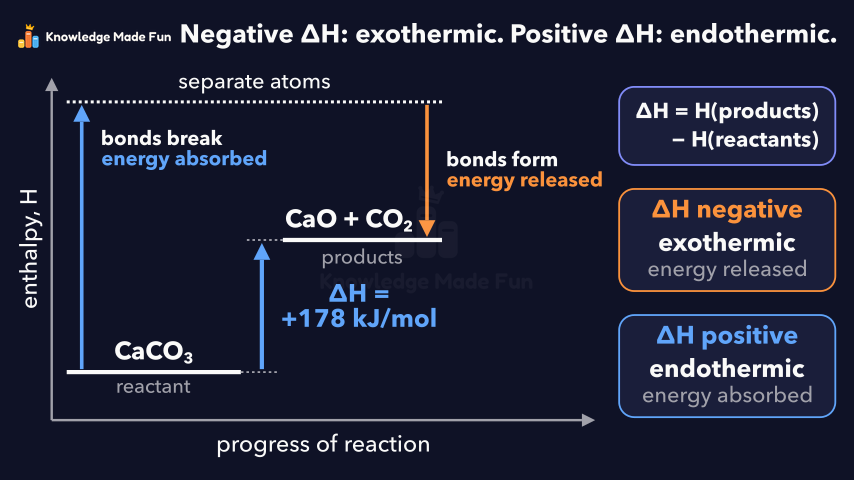
Exothermic and endothermic reactions: the sign of ΔH
Grade 11 · 1 min 59 s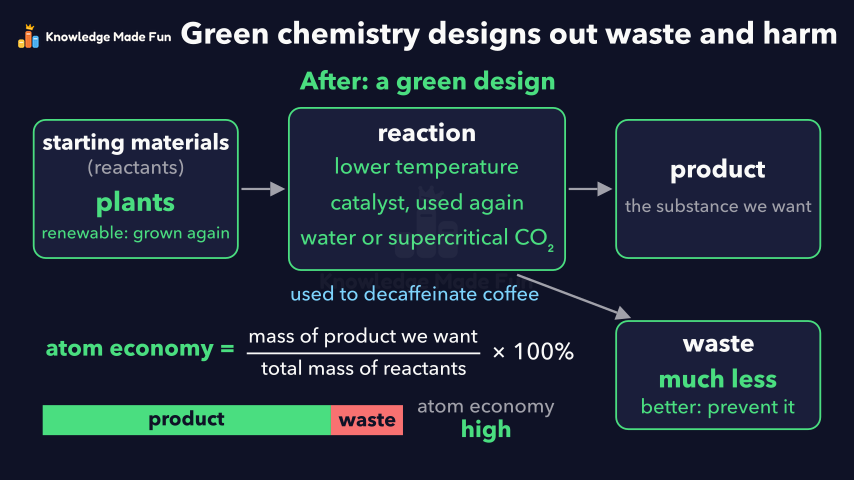 1 min 37 s
Green Chemistry: Designing Out Waste and Harm
Grade 11 · 1 min 37 s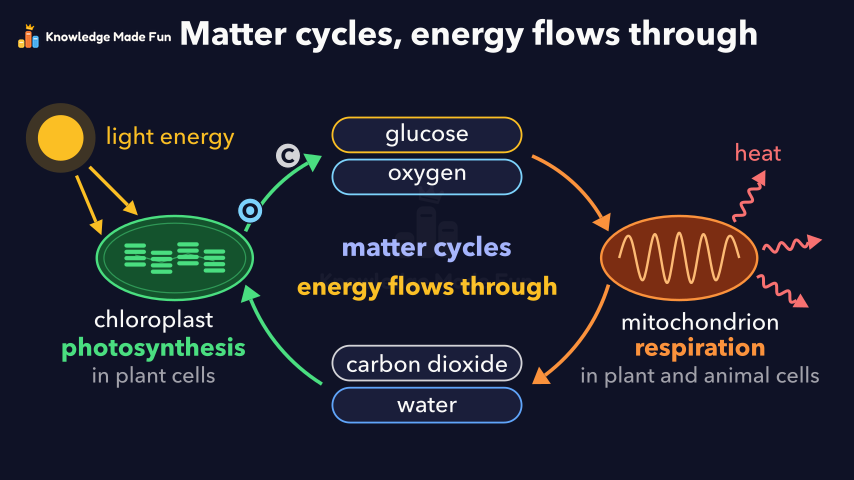 1 min 47 s
Photosynthesis and Respiration: Two Halves of One Cycle
Grade 8 · 1 min 47 s 1 min 46 s
Pulp and Paper: Freeing Wood Fibres with Chemistry
Grade 11 · 1 min 46 s 1 min 57 s
Reaction types and predicting their products
Grade 11 · 1 min 57 s 1 min 53 s
Smelting: Getting Iron Out of Ore
Grade 11 · 1 min 53 s 1 min 48 s
Why Food Browns When It Cooks
Grade 11 · 1 min 48 s 1 min 40 s
Acids and bases: the pH scale
Grade 10 · 1 min 40 s
- All Grade 11 Chemistry lessons
- Create a free account to watch three lessons a day, no payment and no card.