Lesson · Grade 11 · Chemistry
Pulp and Paper: Freeing Wood Fibres with Chemistry
- Grade 11
- Chemistry
- 1 min 46 s
- British Columbia
- BC11-SC-33
In the kraft process, wood chips are cooked in sodium hydroxide and sodium sulfide, which dissolve the lignin that glues the cellulose fibres together. The video then shows how the black liquor is burned for steam and electricity while the chemicals are recovered, how bleaching removes the leftover brown lignin, and why sulfur odours and wastewater are environmental concerns.
Anyone can watch two lessons on the website without an account. Signing in is free, no payment and no card, and opens three a day; Plus has no limit.
Loading
In one sentence
The question this lesson answers
How do we turn solid wood into soft, white paper?
Wood contains long fibres of cellulose, a natural polymer made from glucose.
Transcript
What the lesson says
How do we turn solid wood into soft, white paper?
Wood contains long fibres of cellulose, a natural polymer made from glucose.
Lignin, another natural polymer, glues the fibres together.
One way to make paper is to dissolve the lignin with chemicals and free the fibres.
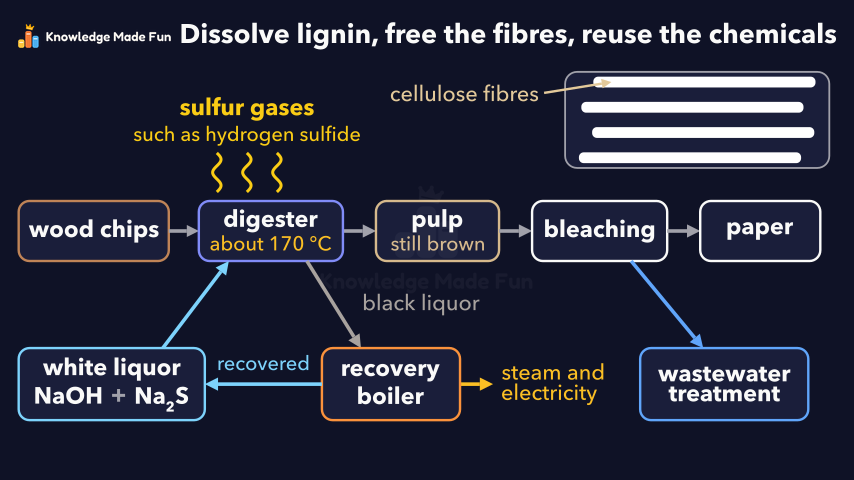
In the kraft process, wood chips go into a digester, a sealed pressure cooker, and cook at about 170 degrees Celsius.
The cooking liquid, called white liquor, is sodium hydroxide and sodium sulfide dissolved in water.
These chemicals break the lignin into small pieces that dissolve, so the fibres come apart.
The freed fibres are called pulp.
The used liquid, now dark with dissolved lignin, is called black liquor.
Black liquor is burned in a recovery boiler, and the heat makes steam and electricity.
The sodium and sulfur compounds left behind are turned back into white liquor and used again.
The pulp is still brown, because a little lignin is left on the fibres.
Bleaching removes most of this leftover lignin, so the pulp turns white.
The white pulp is then pressed and dried into paper.
The kraft process can release sulfur gases, such as hydrogen sulfide, which smell like rotten eggs.
Mills also use lots of water, so the wastewater is cleaned in a treatment plant before it is released.
So the kraft process dissolves lignin to free the fibres, and recovers its chemicals to use again.
Curriculum
Where this fits
- British Columbia, Grade 11
Chemistry 11, Reactions: local and other chemical processesBC11-SC-33
Previous: Photochemical Smog: How Exhaust and Sunlight Make OzoneNext: Why Food Browns When It Cooks
The outcomes and strands follow the British Columbia curriculum.
Keep going
 1 min 59 s
Exothermic and endothermic reactions: the sign of ΔH
Grade 11 · 1 min 59 s 1 min 37 s
Green Chemistry: Designing Out Waste and Harm
Grade 11 · 1 min 37 s 1 min 49 s
Photochemical Smog: How Exhaust and Sunlight Make Ozone
Grade 11 · 1 min 49 s 1 min 47 s
Photosynthesis and Respiration: Two Halves of One Cycle
Grade 8 · 1 min 47 s 1 min 57 s
Reaction types and predicting their products
Grade 11 · 1 min 57 s 1 min 53 s
Smelting: Getting Iron Out of Ore
Grade 11 · 1 min 53 s 1 min 48 s
Why Food Browns When It Cooks
Grade 11 · 1 min 48 s 1 min 40 s
Acids and bases: the pH scale
Grade 10 · 1 min 40 s
- All Grade 11 Chemistry lessons
- Create a free account to watch three lessons a day, no payment and no card.