Lesson · Grade 8 · Science
Brownian motion: evidence that molecules exist
- Grade 8
- Science
- 1 min 45 s
- British Columbia
- BC8-SC-25
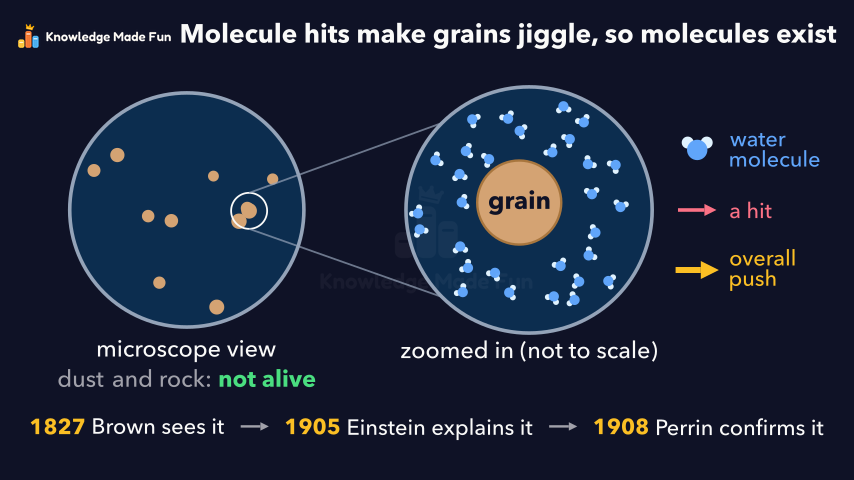
Tiny grains in water jiggle at random under a microscope. Grains of dust and rock jiggle the same way, so they are not alive. Zooming in on one grain shows water molecules hitting it from all sides: more hits on one side give an overall push, and that side keeps changing. A timeline of Brown (1827), Einstein (1905) and Perrin (1908) shows how this convinced most scientists that atoms and molecules exist and supports kinetic molecular theory.
Anyone can watch two lessons on the website without an account. Signing in is free, no payment and no card, and opens three a day; Plus has no limit.
Loading
In one sentence
The question this lesson answers
Molecules are too small to see, even with a light microscope. So how do we know they exist?
Under a light microscope, we can see tiny grains floating in water.
Transcript
What the lesson says
Molecules are too small to see, even with a light microscope. So how do we know they exist?
Under a light microscope, we can see tiny grains floating in water.
Each grain jiggles and wanders at random, and it never stops.
This is called Brownian motion, after Robert Brown, who saw it in 1827.
Brown first saw it in grains from pollen, so he wondered if they were alive.
But grains of dust and rock jiggle the same way, and they are not alive.
So what pushes them? Let's zoom in on one grain. This drawing is not to scale.
Water is made of molecules, tiny groups of joined atoms that are always moving.
They hit the grain from all sides, all the time.
At any moment, more molecules hit one side than the other, so the grain gets an overall push.
Which side gets more hits keeps changing, so the grain jiggles at random.
In 1905, Albert Einstein explained Brownian motion this way and predicted how far grains should wander.
In 1908, Jean Perrin's experiments matched those predictions.
This convinced most scientists that atoms and molecules really exist.
It also supports kinetic molecular theory: matter is made of tiny particles that are always moving.
So grains jiggle because moving molecules hit them unevenly, which is strong evidence that molecules exist.
Curriculum
Where this fits
The outcomes and strands follow the British Columbia curriculum.
Keep going
 1 min 40 s
Acids and bases: the pH scale
Grade 10 · 1 min 40 s 1 min 39 s
Activation energy: the push a reaction needs to start
Grade 10 · 1 min 39 s 1 min 54 s
Atomic Size: Bigger Down a Group, Smaller Across a Period
Grade 9 · 1 min 54 s 1 min 18 s
Atoms rearrange: vinegar and baking soda
Grade 7 · 1 min 18 s 1 min 16 s
Atoms: What Everything Is Made Of
Grade 7 · 1 min 16 s 2 min 3 s
Balancing Chemical Equations
Grade 10 · 2 min 3 s 1 min 54 s
Bohr Diagrams: Electrons in Shells and Valence Electrons
Grade 9 · 1 min 54 s 1 min 49 s
Changes of State: Why the Temperature Stops Rising
Grade 8 · 1 min 49 s
- All Grade 8 Science lessons
- Create a free account to watch three lessons a day, no payment and no card.