Lesson · Grade 8 · Science
Changes of State: Why the Temperature Stops Rising
- Grade 8
- Science
- 1 min 49 s
- British Columbia
- BC8-SC-22
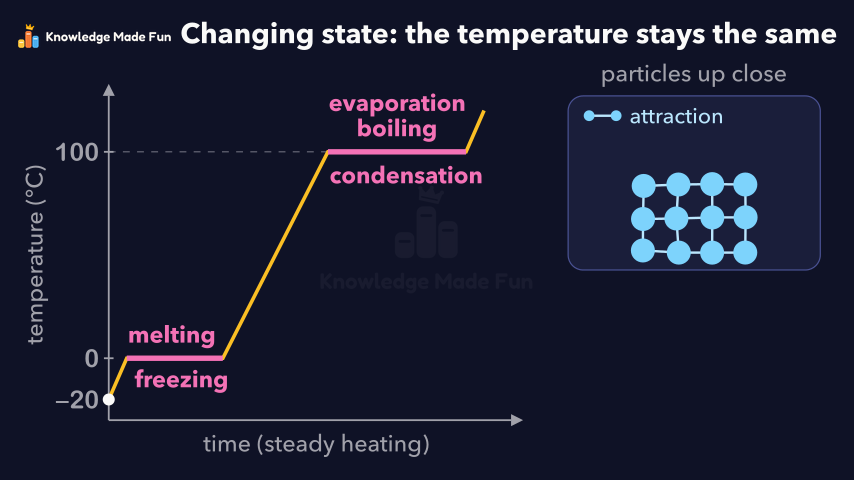
Ice is heated steadily at sea level, and its heating curve builds up beside a close-up of its particles. The temperature climbs to 0 °C, stays flat while the ice melts, climbs to 100 °C and stays flat again while the water boils, because during a change of state the energy loosens the attractions between particles instead of speeding them up. The same diagram then names evaporation, condensation and freezing, shows sublimation with dry ice and deposition with frost, and ends on the recap that the temperature stays the same while a substance changes state.
Concept: Changes of state: why temperature stops rising while ice melts
Anyone can watch two lessons on the website without an account. Signing in is free, no payment and no card, and opens three a day; Plus has no limit.
Loading
In one sentence
The question this lesson answers
Does heating something always raise its temperature?
We heat ice steadily at sea level, starting at minus 20 degrees Celsius.
Transcript
What the lesson says
Does heating something always raise its temperature?
We heat ice steadily at sea level, starting at minus 20 degrees Celsius.
Kinetic molecular theory says matter is made of tiny moving particles. In ice, attractions hold them, so they only vibrate in place.
Temperature measures the particles' average kinetic energy, their energy of motion.
As heat flows in, they vibrate faster and the ice warms up to 0 degrees.
Then the ice melts into a liquid, and though we keep heating, the temperature stops rising.
The energy loosens the attractions instead of speeding the particles up, so they can slide past each other as a liquid.
Then the particles speed up again, and the water warms up to 100 degrees.
At 100 degrees the water boils, and the temperature holds steady again.
The energy pulls the particles far apart, into a gas called water vapour.
Liquid to gas is called evaporation; boiling is evaporation all through the liquid.
Only then does the water vapour heat up.
Cooling runs it backwards: condensation, gas to liquid, at 100 degrees, then freezing at 0 degrees.
Dry ice, solid carbon dioxide, skips the liquid and turns straight into a gas: sublimation.
The reverse, gas straight to solid, is deposition, which is how frost forms.
During a change of state, energy changes the attractions, not the particles' speed, so the temperature stays the same.
Curriculum
Where this fits
- British Columbia, Grade 8
Science, Chemistry: kinetic molecular theory (KMT)BC8-SC-22
Previous: Kinetic molecular theory: particles always on the moveNext: How the model of the atom changed: Dalton to Bohr
The outcomes and strands follow the British Columbia curriculum.
Keep going
 1 min 40 s
Acids and bases: the pH scale
Grade 10 · 1 min 40 s 1 min 39 s
Activation energy: the push a reaction needs to start
Grade 10 · 1 min 39 s 1 min 54 s
Atomic Size: Bigger Down a Group, Smaller Across a Period
Grade 9 · 1 min 54 s 1 min 18 s
Atoms rearrange: vinegar and baking soda
Grade 7 · 1 min 18 s 1 min 16 s
Atoms: What Everything Is Made Of
Grade 7 · 1 min 16 s 2 min 3 s
Balancing Chemical Equations
Grade 10 · 2 min 3 s 1 min 54 s
Bohr Diagrams: Electrons in Shells and Valence Electrons
Grade 9 · 1 min 54 s 1 min 45 s
Brownian motion: evidence that molecules exist
Grade 8 · 1 min 45 s
- All Grade 8 Science lessons
- Create a free account to watch three lessons a day, no payment and no card.