Lesson · Grade 8 · Science
Kinetic molecular theory: particles always on the move
- Grade 8
- Science
- 1 min 40 s
- British Columbia
- BC8-SC-21
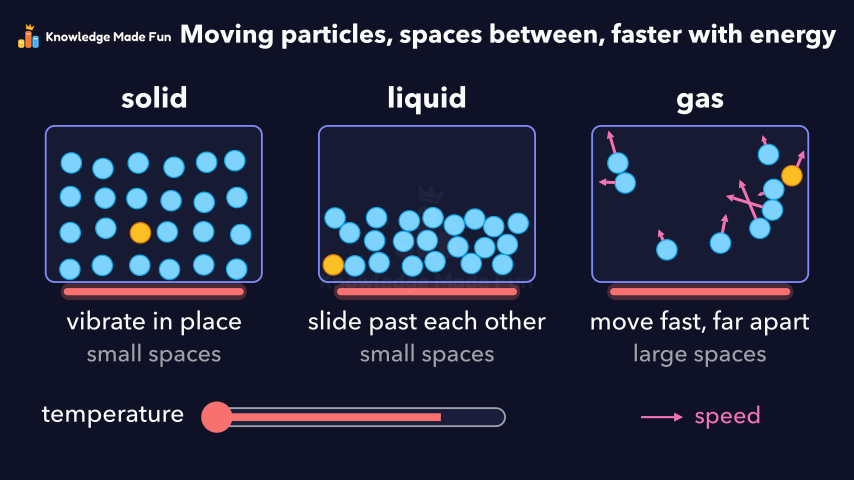
One labelled diagram of three containers builds up step by step. The particles in a solid vibrate in place, in a liquid they slide past each other, and in a gas they move fast and far apart, with small or large spaces between them, and speed arrows and a thermometer show that temperature measures their average kinetic energy. Heating makes every particle move faster, and the solid expands because the spaces between its particles grow while the particles stay the same size.
Anyone can watch two lessons on the website without an account. Signing in is free, no payment and no card, and opens three a day; Plus has no limit.
Loading
In one sentence
The question this lesson answers
What are solids, liquids and gases really made of?
Kinetic molecular theory says that all matter is made of tiny particles, far too small to see.
Transcript
What the lesson says
What are solids, liquids and gases really made of?
Kinetic molecular theory says that all matter is made of tiny particles, far too small to see.
The word kinetic means to do with motion, and these particles are always moving.
In a solid, the particles are packed close together and vibrate in place.
So the particles in a solid do move. Each one just stays in its own place.
In a liquid, the particles are still close together, but they can slide past each other.
In a gas, the particles move fast and are far apart, spreading out to fill their container.
In every state there are spaces between the particles. They are small in solids and liquids, and large in gases.
The energy of motion is called kinetic energy. The faster a particle moves, the more kinetic energy it has.
The particles move at different speeds, so temperature measures their average kinetic energy.
When we add energy, for example by heating, the particles move faster and the temperature rises.
Heating does not make the particles bigger. When most solids are heated, they expand because the spaces between their particles grow.
So all matter is made of particles that are always moving, with spaces between them, and adding energy makes them move faster.
Curriculum
Where this fits
The outcomes and strands follow the British Columbia curriculum.
Keep going
 1 min 40 s
Acids and bases: the pH scale
Grade 10 · 1 min 40 s 1 min 39 s
Activation energy: the push a reaction needs to start
Grade 10 · 1 min 39 s 1 min 54 s
Atomic Size: Bigger Down a Group, Smaller Across a Period
Grade 9 · 1 min 54 s 1 min 18 s
Atoms rearrange: vinegar and baking soda
Grade 7 · 1 min 18 s 1 min 16 s
Atoms: What Everything Is Made Of
Grade 7 · 1 min 16 s 2 min 3 s
Balancing Chemical Equations
Grade 10 · 2 min 3 s 1 min 54 s
Bohr Diagrams: Electrons in Shells and Valence Electrons
Grade 9 · 1 min 54 s 1 min 45 s
Brownian motion: evidence that molecules exist
Grade 8 · 1 min 45 s
- All Grade 8 Science lessons
- Create a free account to watch three lessons a day, no payment and no card.