Lesson · Grade 8 · Science
How the model of the atom changed: Dalton to Bohr
- Grade 8
- Science
- 1 min 49 s
- British Columbia
- BC8-SC-23
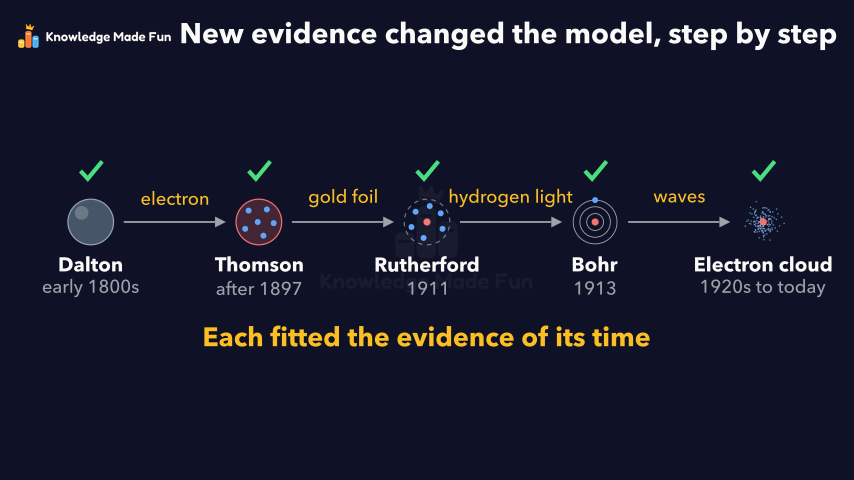
Each atomic model is built step by step, starting with Dalton's solid ball and moving through Thomson's plum pudding, Rutherford's nucleus and Bohr's energy levels to today's electron cloud. Beside each model, a panel shows the evidence that changed it (the electron, the gold foil experiment, hydrogen's few colours of light, electrons acting like waves), and a timeline along the bottom collects every model to show that each one fitted the evidence of its time.
Anyone can watch two lessons on the website without an account. Signing in is free, no payment and no card, and opens three a day; Plus has no limit.
Loading
In one sentence
The question this lesson answers
No one could see an atom. So how did scientists work out what one is like?
They built models: simple pictures that fit the evidence.
Transcript
What the lesson says
No one could see an atom. So how did scientists work out what one is like?
They built models: simple pictures that fit the evidence.
In the early 1800s, John Dalton pictured atoms as solid balls that cannot be split.
That fitted his evidence: elements combine in fixed amounts.
In 1897, J. J. Thomson found the electron, a tiny negative particle inside atoms.
So atoms can be split. He pictured a ball of positive charge dotted with electrons, like plums in a pudding.
Then Rutherford's team fired alpha particles, tiny positive particles, at thin gold foil.
Most went straight through, a few turned aside, and a very few bounced back.
In 1911, Rutherford said electrons surround a tiny, dense, positive centre, the nucleus, in mostly empty space.
But heated hydrogen gives off only a few colours of light, not a full rainbow.
In 1913, Niels Bohr put electrons in fixed energy levels, or shells, around the nucleus.
When hydrogen's one electron drops a level, it gives off light of one colour.
In the 1920s, scientists found electrons also act like waves, with no exact path.
Today's model shows an electron cloud: the denser it is, the more likely an electron is there.
Older models were not useless: each fitted the evidence of its time.
New evidence changed the model: Dalton, Thomson, Rutherford, Bohr, then the cloud.
Curriculum
Where this fits
- British Columbia, Grade 8
Science, Chemistry: atomic theory and modelsBC8-SC-23
Previous: Changes of State: Why the Temperature Stops RisingNext: The Gold Foil Experiment: Discovering the Nucleus
The outcomes and strands follow the British Columbia curriculum.
Keep going
 1 min 40 s
Acids and bases: the pH scale
Grade 10 · 1 min 40 s 1 min 39 s
Activation energy: the push a reaction needs to start
Grade 10 · 1 min 39 s 1 min 54 s
Atomic Size: Bigger Down a Group, Smaller Across a Period
Grade 9 · 1 min 54 s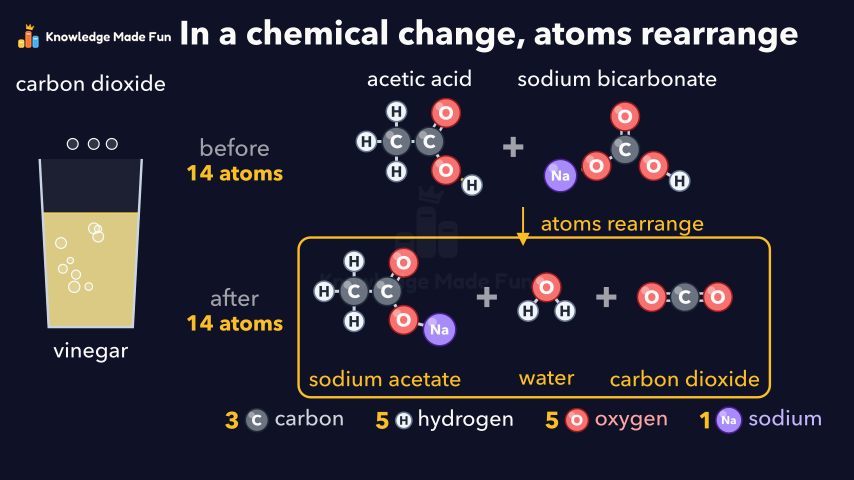 1 min 18 s
Atoms rearrange: vinegar and baking soda
Grade 7 · 1 min 18 s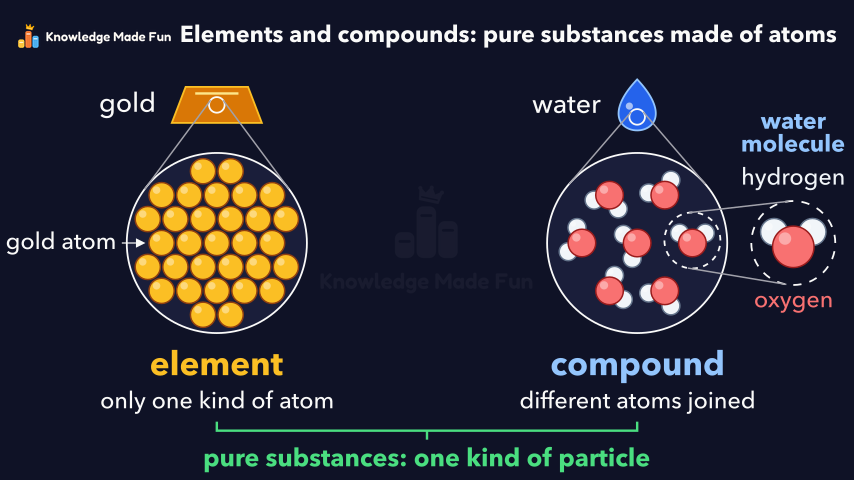 1 min 16 s
Atoms: What Everything Is Made Of
Grade 7 · 1 min 16 s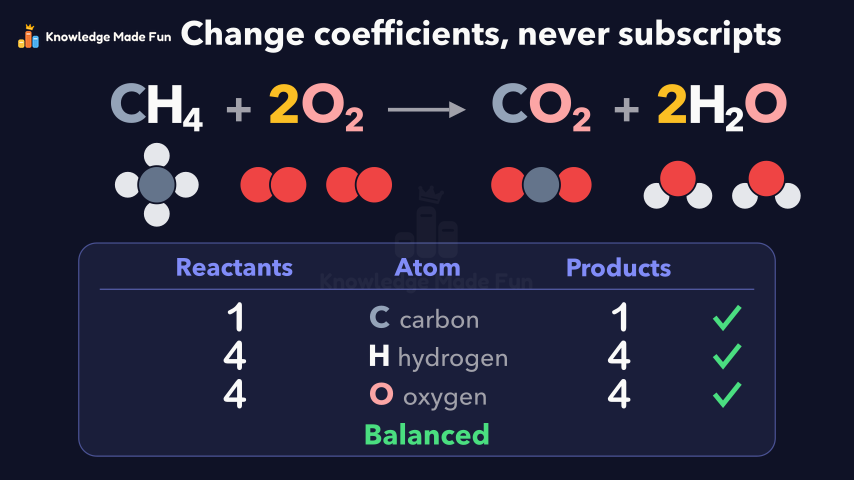 2 min 3 s
Balancing Chemical Equations
Grade 10 · 2 min 3 s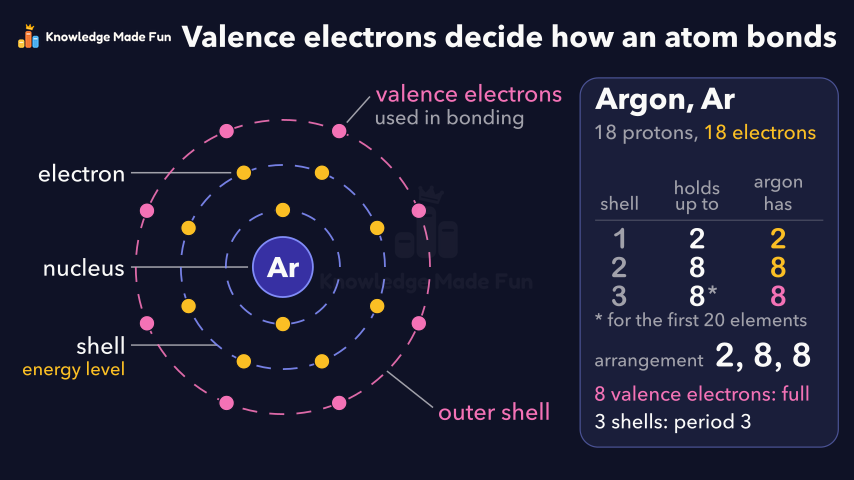 1 min 54 s
Bohr Diagrams: Electrons in Shells and Valence Electrons
Grade 9 · 1 min 54 s 1 min 45 s
Brownian motion: evidence that molecules exist
Grade 8 · 1 min 45 s
- All Grade 8 Science lessons
- Create a free account to watch three lessons a day, no payment and no card.