Lesson · Grade 11 · Chemistry
Fractional Distillation: Separating Crude Oil by Boiling Point
- Grade 11
- Chemistry
- 1 min 48 s
- British Columbia
- BC11-SC-17
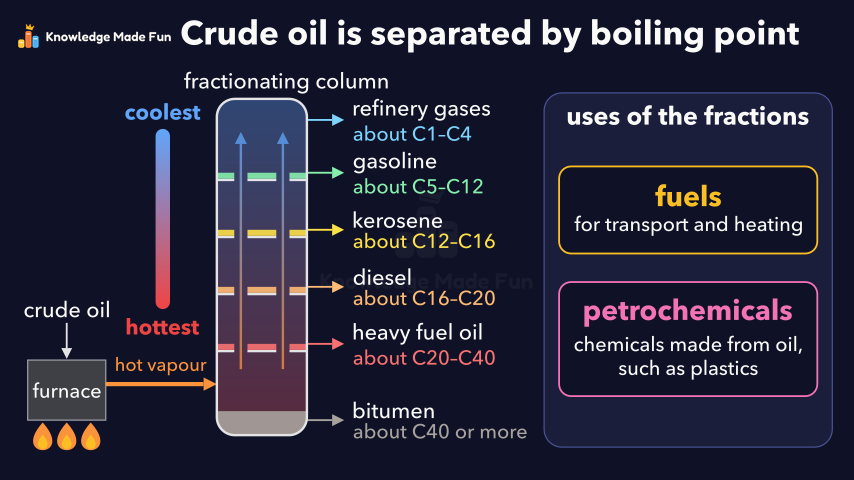
Hot crude oil vapour from a furnace enters near the bottom of a fractionating column that is hottest at the bottom and coolest at the top. As the vapour rises and cools, each fraction condenses on its own tray and is piped out, from refinery gases (about C1–C4) at the top to heavy fuel oil and bitumen at the bottom. A side panel shows that longer chains have stronger dispersion forces and so higher boiling points, and that the fractions become fuels and petrochemicals such as plastics.
Anyone can watch two lessons on the website without an account. Signing in is free, no payment and no card, and opens three a day; Plus has no limit.
Loading
In one sentence
The question this lesson answers
How do refineries turn crude oil into useful fuels?
Crude oil is a mixture of hydrocarbons, compounds of only carbon and hydrogen, with chains of many lengths.
Transcript
What the lesson says
How do refineries turn crude oil into useful fuels?
Crude oil is a mixture of hydrocarbons, compounds of only carbon and hydrogen, with chains of many lengths.
Refineries separate them by boiling point, using fractional distillation in a tall fractionating column.
A furnace boils most of the crude oil, and the hot vapour enters near the bottom of the column.
The column is hottest at the bottom and coolest at the top.
The vapour rises through holes in the trays, shelves across the column, and cools.
Below its boiling point, a hydrocarbon condenses to a liquid on a tray.
Each liquid is piped out as a fraction: hydrocarbons with similar boiling points.
Refinery gases, the smallest molecules with about one to four carbons, boil lowest and leave from the top.
Longer chains condense on the middle trays: gasoline, kerosene and diesel.
Near the bottom, heavy fuel oil condenses, and bitumen, with the longest chains, stays liquid and drains out.
Why do longer chains boil higher? Hydrocarbon molecules attract each other by weak dispersion forces.
Longer chains have more electrons and more contact, so these forces are stronger.
So more energy is needed to pull them apart: a higher boiling point.
The fractions become fuels for transport and heating, and petrochemicals, chemicals made from oil, such as plastics.
Fractional distillation separates crude oil into fractions by boiling point.
Curriculum
Where this fits
- British Columbia, Grade 11
Chemistry 11, Organic chemistry: applications of organic chemistryBC11-SC-17
Previous: Polymers: Long Chains of Repeating UnitsNext: Medicines from Organic Molecules: Shape Fits the Target
- British Columbia, Grade 11
Science For Citizens 11, Science at work: practical applications of science in the workplaceBC11-SC-288
Previous: Dilution: More Solvent, Same Moles of SoluteNext: Ohm's Law: V = I × R
The outcomes and strands follow the British Columbia curriculum.
Keep going
 2 min 2 s
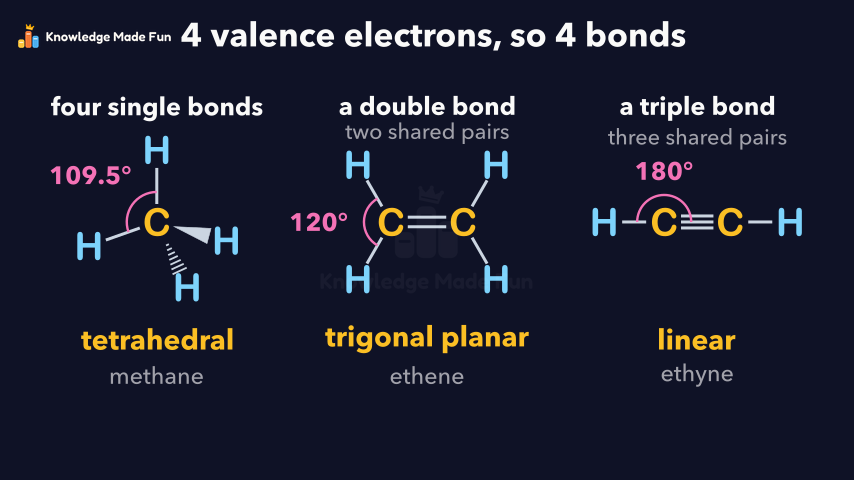
Carbon makes four bonds
Grade 11 · 2 min 2 s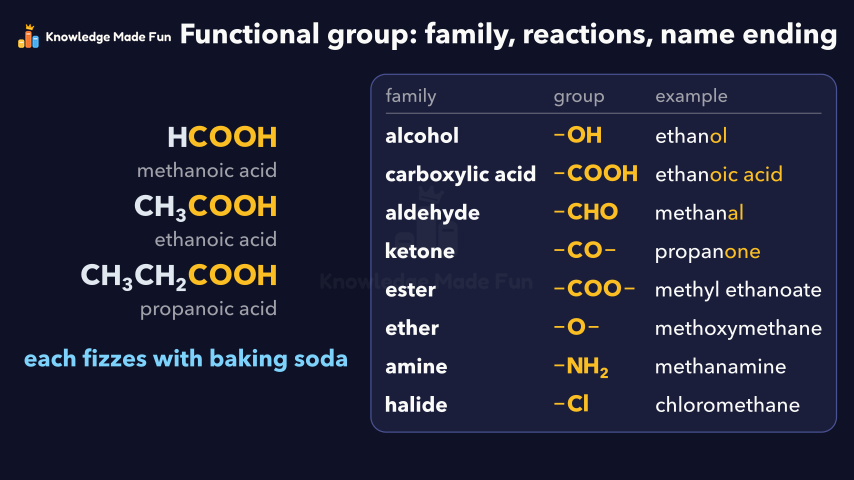 1 min 59 s
Functional groups: the part that gives a molecule its behaviour
Grade 11 · 1 min 59 s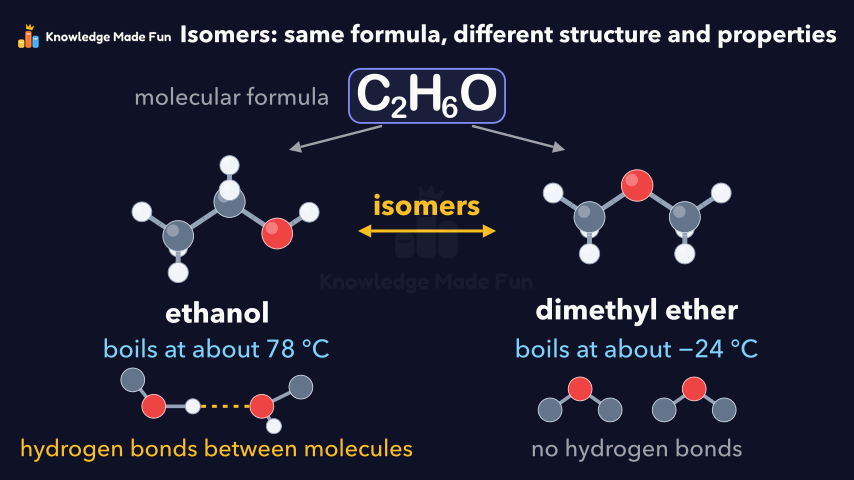 1 min 51 s
Isomers: Same Formula, Different Structure
Grade 11 · 1 min 51 s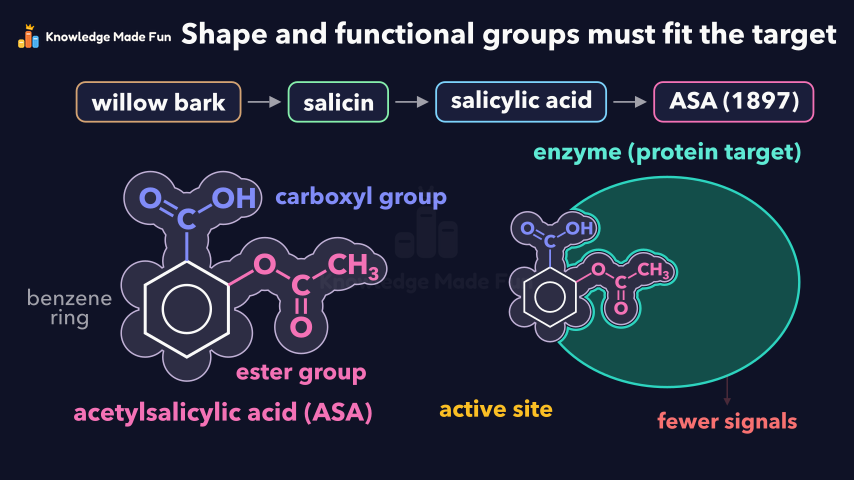 1 min 48 s
Medicines from Organic Molecules: Shape Fits the Target
Grade 11 · 1 min 48 s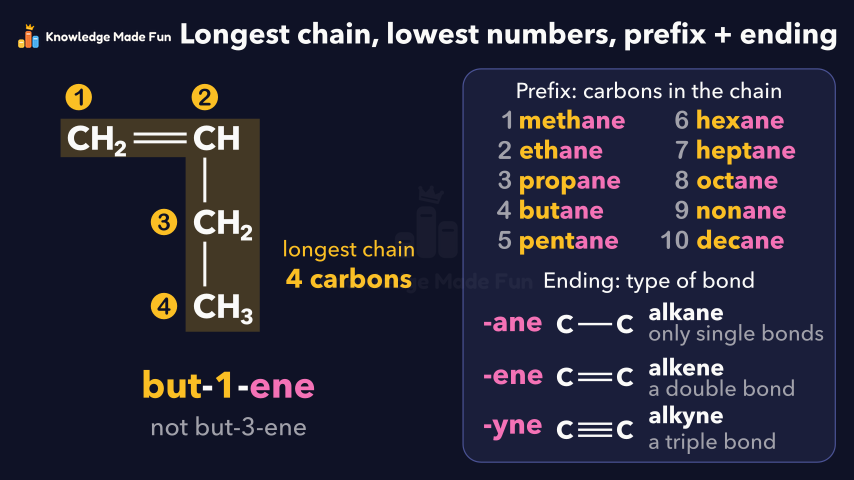 2 min 6 s
Naming Alkanes, Alkenes and Alkynes
Grade 11 · 2 min 6 s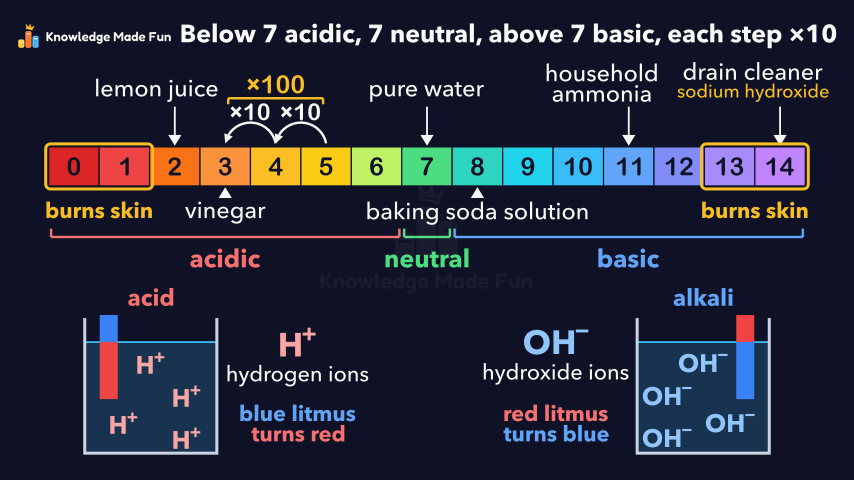 1 min 40 s
Acids and bases: the pH scale
Grade 10 · 1 min 40 s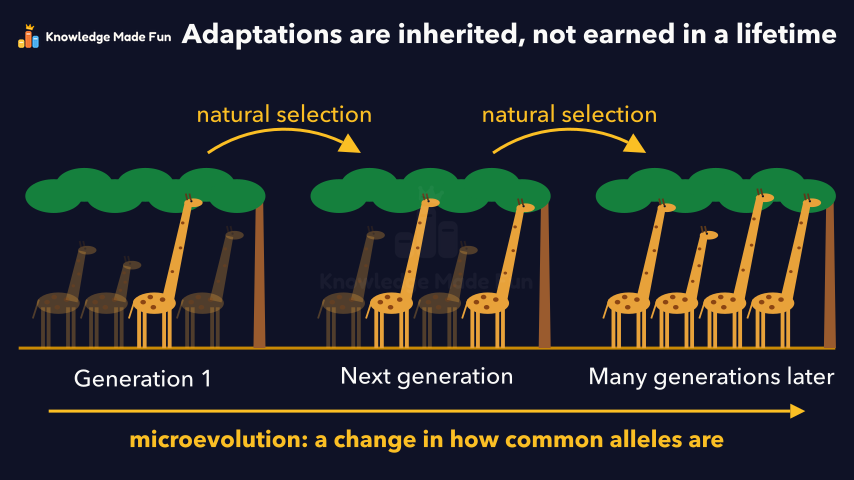 1 min 39 s
Adaptations Are Inherited, Not Earned in a Lifetime
Grade 11 · 1 min 39 s 1 min 48 s
Adaptive radiation: one ancestor, many species
Grade 10 · 1 min 48 s
- All Grade 11 Chemistry lessons
- Create a free account to watch three lessons a day, no payment and no card.