Lesson · Grade 11 · Chemistry
Carbon makes four bonds
- Grade 11
- Chemistry
- 2 min 2 s
- British Columbia
- BC11-SC-12
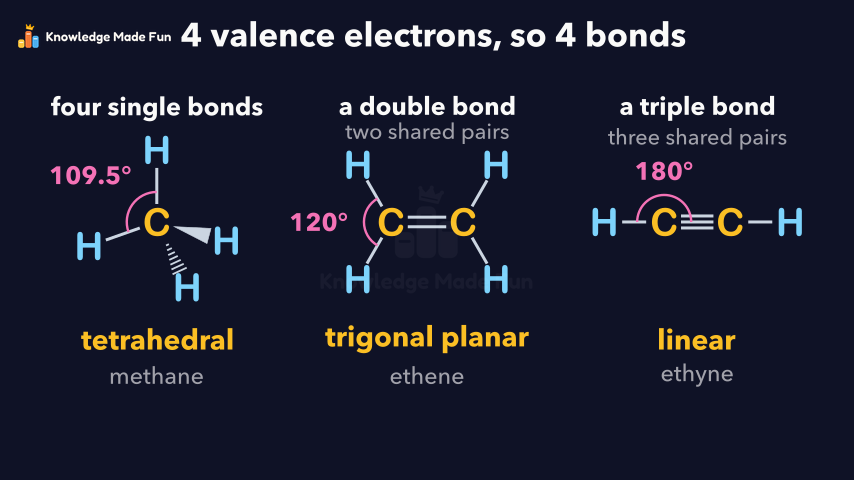
A carbon atom shows its four valence electrons, shares them with four hydrogen atoms to make methane, and then grows into a table of methane, ethane and propane written as structural, condensed and skeletal formulas. Methane then leaves the table to show the shapes around carbon: tetrahedral at 109.5° with four single bonds, trigonal planar at about 120° with a double bond (ethene), and linear at 180° with a triple bond (ethyne).
Concept: Organic compounds: carbon makes four bonds
Anyone can watch two lessons on the website without an account. Signing in is free, no payment and no card, and opens three a day; Plus has no limit.
Loading
In one sentence
The question this lesson answers
Carbon forms chains, branched chains and rings. Why can it make so many compounds?
A carbon atom has four valence electrons, the electrons in its outer shell.
Transcript
What the lesson says
Carbon forms chains, branched chains and rings. Why can it make so many compounds?
A carbon atom has four valence electrons, the electrons in its outer shell.
Each one pairs with an electron from another atom. A shared pair is a covalent bond.
Each pair is drawn as a line. Four bonds to hydrogen make methane, C H 4.
Carbon can also bond to carbon. Two carbons make ethane, C 2 H 6.
Three carbons in a chain make propane, C 3 H 8.
Every carbon still has four bonds. Count them on the middle carbon: one, two, three, four.
These are structural formulas: they show every atom and every bond.
A condensed formula lists each carbon with its hydrogens. Propane is C H 3, C H 2, C H 3.
A skeletal formula draws the carbon chain as lines. Each end or corner is a carbon, and hydrogens on carbon are left out.
Methane has no chain, so it is still written C H 4.
Structural formulas are flat, but bonds are electron pairs that repel, so they spread as far apart as possible.
Four single bonds point to the corners of a triangular pyramid: a tetrahedral shape, 109.5 degrees apart.
A double bond is two shared pairs. In ethene, each carbon is trigonal planar: flat, about 120 degrees apart.
A triple bond is three shared pairs. In ethyne, each carbon is linear: 180 degrees apart.
Single, double or triple, carbon makes four bonds because it has four valence electrons.
Curriculum
Where this fits
- British Columbia, Grade 11
Chemistry 11, Organic chemistry: organic compoundsBC11-SC-12
The outcomes and strands follow the British Columbia curriculum.
Keep going
 1 min 48 s
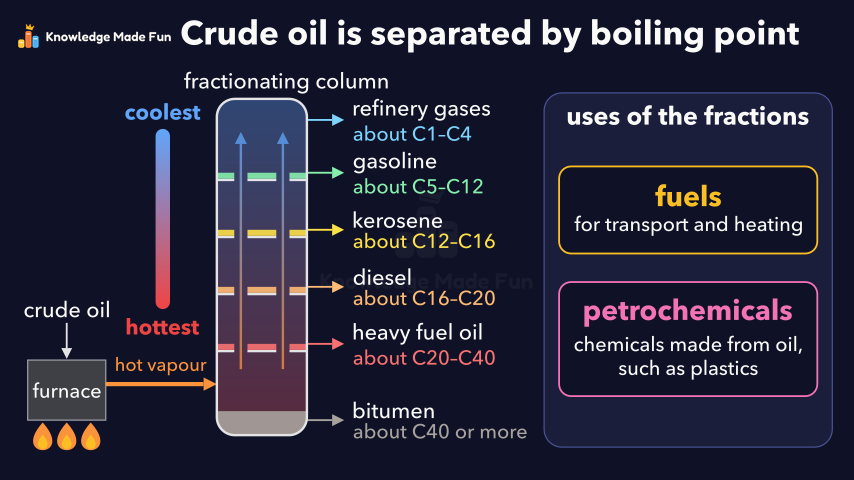
Fractional Distillation: Separating Crude Oil by Boiling Point
Grade 11 · 1 min 48 s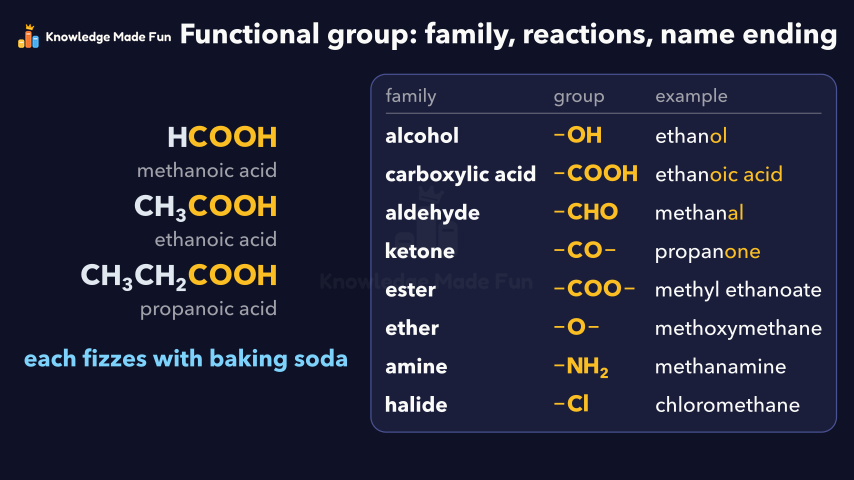 1 min 59 s
Functional groups: the part that gives a molecule its behaviour
Grade 11 · 1 min 59 s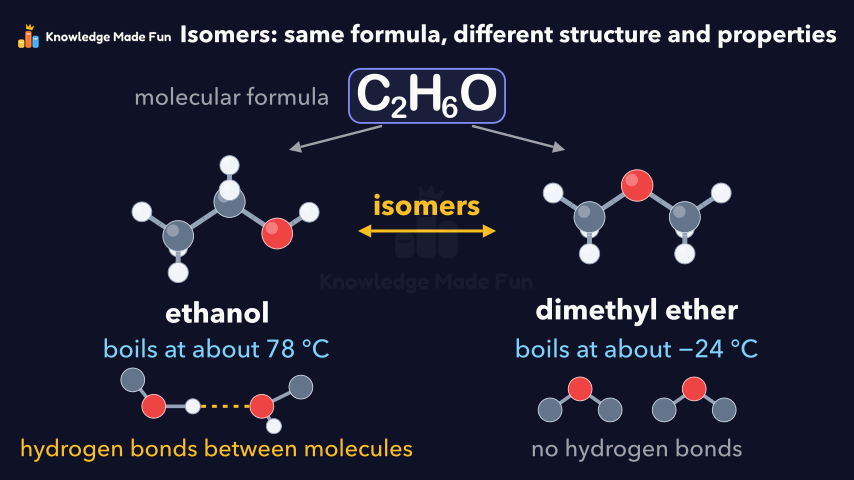 1 min 51 s
Isomers: Same Formula, Different Structure
Grade 11 · 1 min 51 s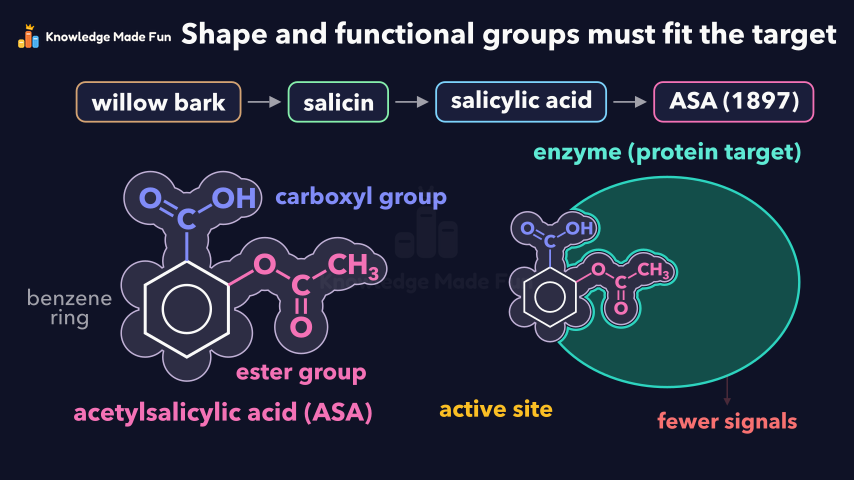 1 min 48 s
Medicines from Organic Molecules: Shape Fits the Target
Grade 11 · 1 min 48 s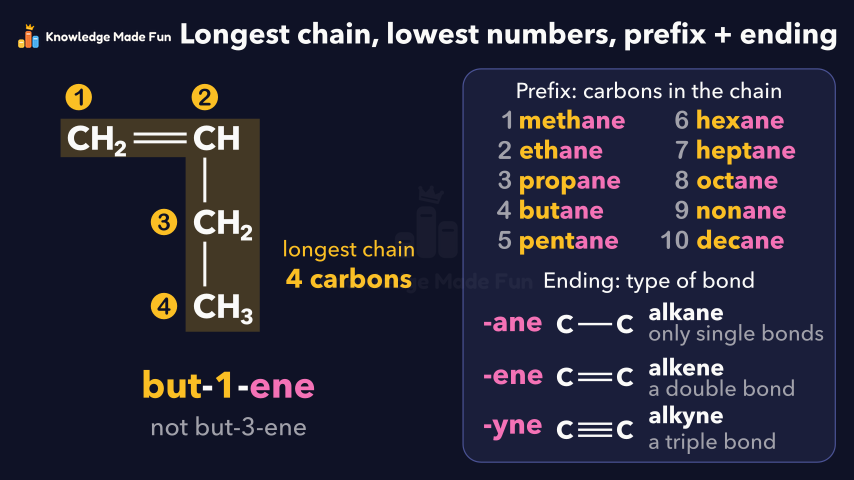 2 min 6 s
Naming Alkanes, Alkenes and Alkynes
Grade 11 · 2 min 6 s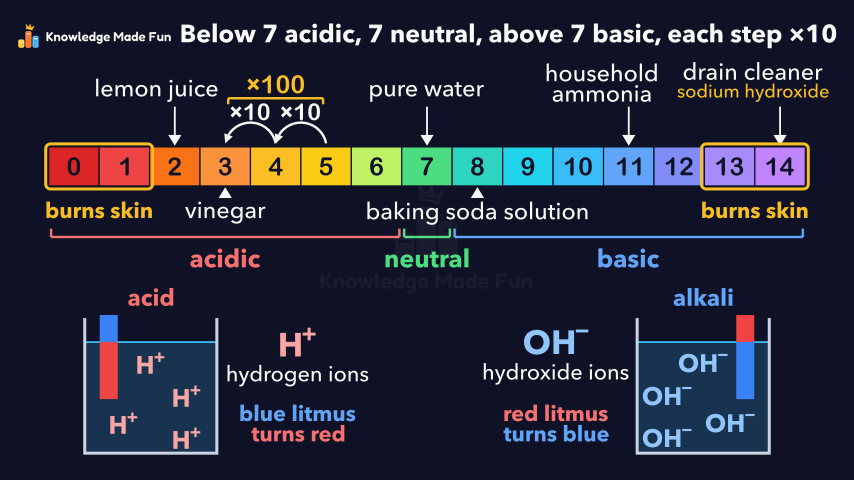 1 min 40 s
Acids and bases: the pH scale
Grade 10 · 1 min 40 s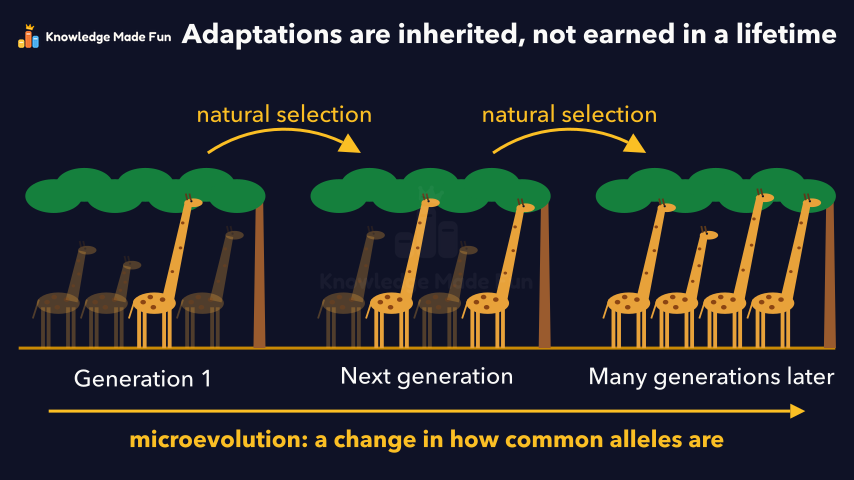 1 min 39 s
Adaptations Are Inherited, Not Earned in a Lifetime
Grade 11 · 1 min 39 s 1 min 48 s
Adaptive radiation: one ancestor, many species
Grade 10 · 1 min 48 s
- All Grade 11 Chemistry lessons
- Create a free account to watch three lessons a day, no payment and no card.