Lesson · Grade 9 · Science
Asexual or Sexual Reproduction: Fast Copies or New Variety
- Grade 9
- Science
- 1 min 53 s
- British Columbia
- BC9-SC-07
Two family trees build up side by side over time: one parent makes clones that double to eight but are all alike, while two parents make gametes by meiosis (half the chromosomes, mixed genes), and these join at fertilization to give fewer offspring, each with a new mix of genes. A new disease then wipes out every clone but only some of the varied offspring, which shows that neither way is simply better, and strawberries (runners and seeds) and aphids (clones in summer, mating in the fall) show that some species use both.
Concept: Sexual or asexual reproduction: speed versus variation
Anyone can watch two lessons on the website without an account. Signing in is free, no payment and no card, and opens three a day; Plus has no limit.
Loading
In one sentence
The question this lesson answers
Living things reproduce asexually or sexually. Is one way simply better?
Asexual reproduction needs only one parent.
Transcript
What the lesson says
Living things reproduce asexually or sexually. Is one way simply better?
Asexual reproduction needs only one parent.
Each offspring is a clone: it has the same genes as its parent, apart from rare mutations.
No mate is needed, so numbers can grow fast: four, then eight.
So the population has very little variety.
Sexual reproduction usually needs two parents.
Each parent makes sex cells, called gametes, by a cell division called meiosis.
Meiosis halves the number of chromosomes and shuffles the genes, so gametes carry different mixes.
At fertilization, two gametes, one from each parent, join to make a fertilized egg.
Each fertilized egg grows into an offspring with a new mix of genes.
This is slower, so there are fewer offspring, but they are varied.
Now a new disease arrives.
All the clones share the same genes, so one disease could wipe them all out.
With variety, some offspring may have genes that help them resist it, so they survive.
So neither way is simply better: fast copies suit steady conditions, and variety helps when things change.
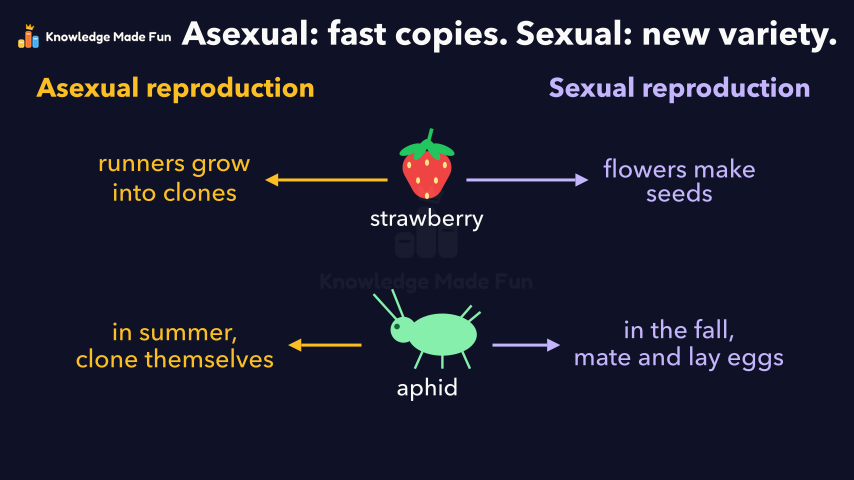
Some species use both. Strawberry plants send out runners that grow into clones, and their flowers make seeds.
Many aphids clone themselves in summer, then mate and lay eggs in the fall.
Asexual reproduction makes fast copies, and sexual reproduction makes new variety.
Curriculum
Where this fits
- British Columbia, Grade 9
Science, Biology: sexual reproduction: meiosisBC9-SC-07
Previous: Mitosis and Meiosis Side by SideNext: Energy flow: how sunlight powers a food chain
- British Columbia, Grade 11
Life Sciences 11, Cells: sexual and asexual reproductionBC11-SC-141
Previous: Binary Fission, Budding and ConjugationNext: Photosynthesis and Respiration: Two Halves of One Cycle
This lesson is also listed in Grade 11.
The outcomes and strands follow the British Columbia curriculum.
Keep going
 1 min 54 s
ATP: How Cells Store and Spend Energy
Grade 11 · 1 min 54 s 1 min 55 s
Binary Fission, Budding and Conjugation
Grade 11 · 1 min 55 s 1 min 49 s
Cell Specialization: Same DNA, Different Jobs
Grade 11 · 1 min 49 s 1 min 57 s
Levels of Organization: From Molecules to Ecosystems
Grade 11 · 1 min 57 s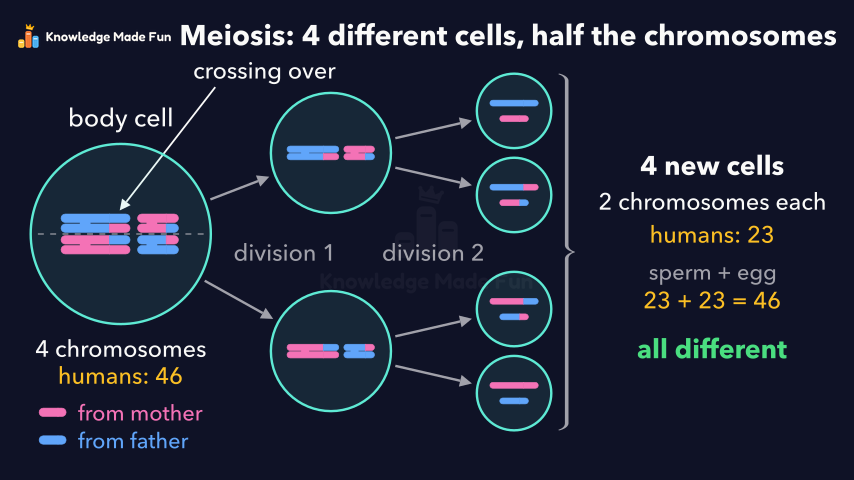 1 min 53 s
Meiosis: Making Sex Cells with Half the Chromosomes
Grade 9 · 1 min 53 s 1 min 22 s
Organelles: The Jobs Inside a Cell
Grade 8 · 1 min 22 s 1 min 55 s
Prokaryotic and eukaryotic cells: is there a nucleus?
Grade 8 · 1 min 55 s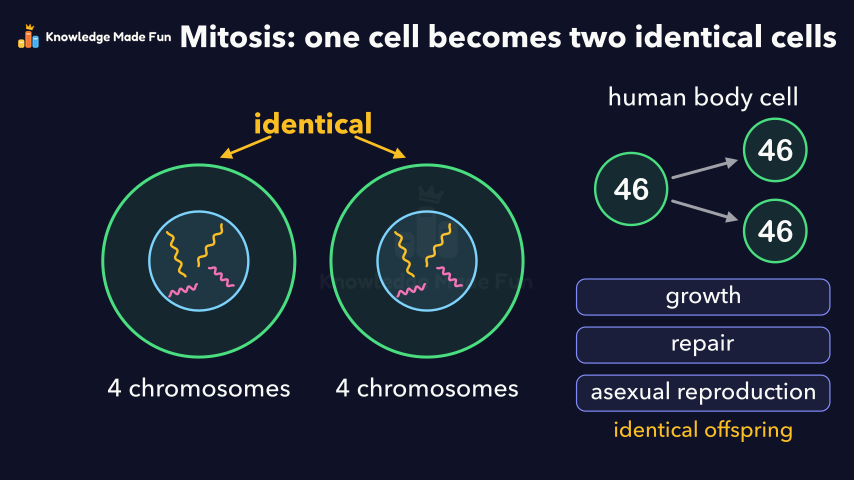 1 min 51 s
The Stages of Mitosis: One Cell Becomes Two
Grade 9 · 1 min 51 s
- All Grade 9 Science lessons
- Create a free account to watch three lessons a day, no payment and no card.