Lesson · Grade 11 · Life Sciences
Cell Specialization: Same DNA, Different Jobs
- Grade 11
- Life Sciences
- 1 min 49 s
- British Columbia
- BC11-SC-137
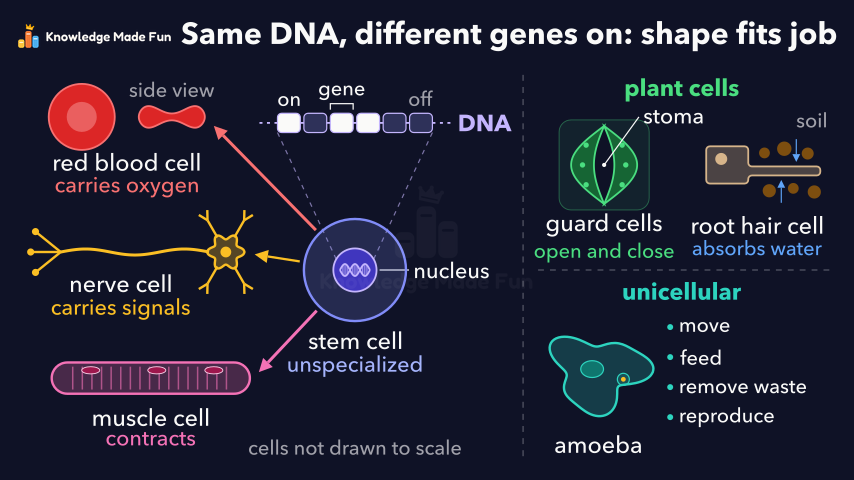
A stem cell's DNA is shown as a strip of genes, and a different set of genes switches on for each kind of cell it becomes. The diagram grows into a red blood cell, a nerve cell, a muscle cell, guard cells and a root hair cell, each shaped for its job, then sets them against an amoeba, whose one cell must do every job.
Anyone can watch two lessons on the website without an account. Signing in is free, no payment and no card, and opens three a day; Plus has no limit.
Loading
In one sentence
The question this lesson answers
Nearly every cell in your body has the same DNA. So how do cells do such different jobs?
Your cells all come from stem cells, which are unspecialized: not yet shaped for one job.
Transcript
What the lesson says
Nearly every cell in your body has the same DNA. So how do cells do such different jobs?
Your cells all come from stem cells, which are unspecialized: not yet shaped for one job.
Its DNA, the full set of instructions, is kept in the nucleus, the cell's control centre.
A gene is a section of DNA with the instructions for making a protein.
To specialize, a cell switches some genes on and keeps the rest switched off.
This is called differentiation, and it gives each cell a shape that fits its job.
A red blood cell is a flexible disc with no nucleus once mature, leaving more room for oxygen.
A nerve cell has long, thin branches that carry electrical signals around the body.
A muscle cell is a long fibre whose protein strands slide together, so it contracts, or shortens.
Stem cells can still become many types. Your body keeps some, for example to make new blood cells.
In a plant leaf, two guard cells open and close a pore, called a stoma, to let gases in and out.
A root hair cell grows a long, thin hair into the soil, giving a large surface area to absorb water.
Compare an amoeba. It is unicellular, just one cell, so that cell must move, feed, remove waste and reproduce.
You are multicellular: your many cells share the work, so each type can specialize.
Same DNA, different genes switched on, so each cell's shape fits its job.
Curriculum
Where this fits
- British Columbia, Grade 11
Life Sciences 11, Cells: cell structure and functionBC11-SC-137
Previous: Organelles: The Jobs Inside a CellNext: The Stages of Mitosis: One Cell Becomes Two
The outcomes and strands follow the British Columbia curriculum.
Keep going
 1 min 53 s
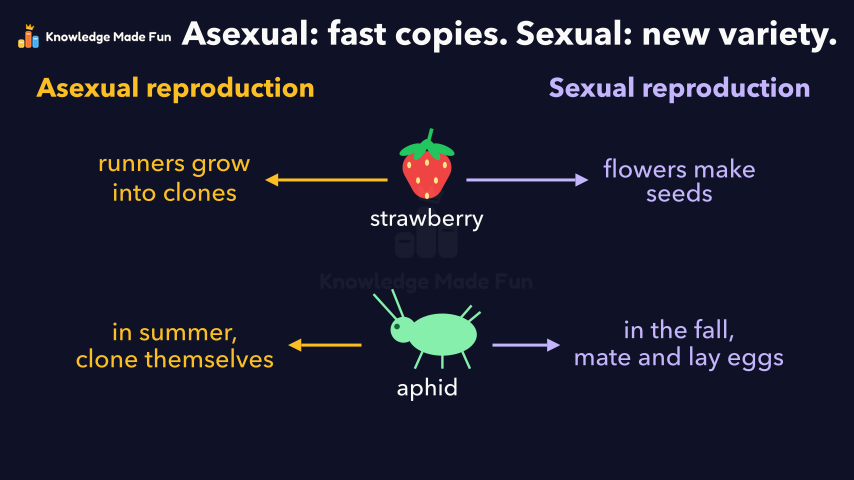
Asexual or Sexual Reproduction: Fast Copies or New Variety
Grade 9 · 1 min 53 s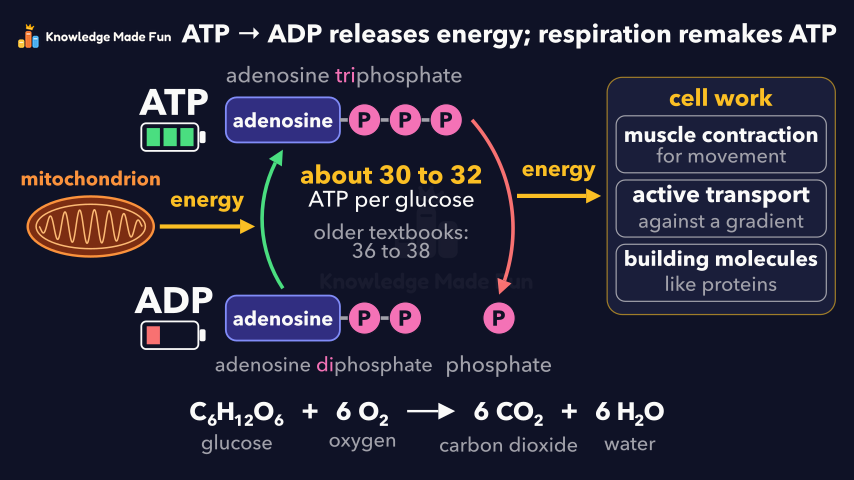 1 min 54 s
ATP: How Cells Store and Spend Energy
Grade 11 · 1 min 54 s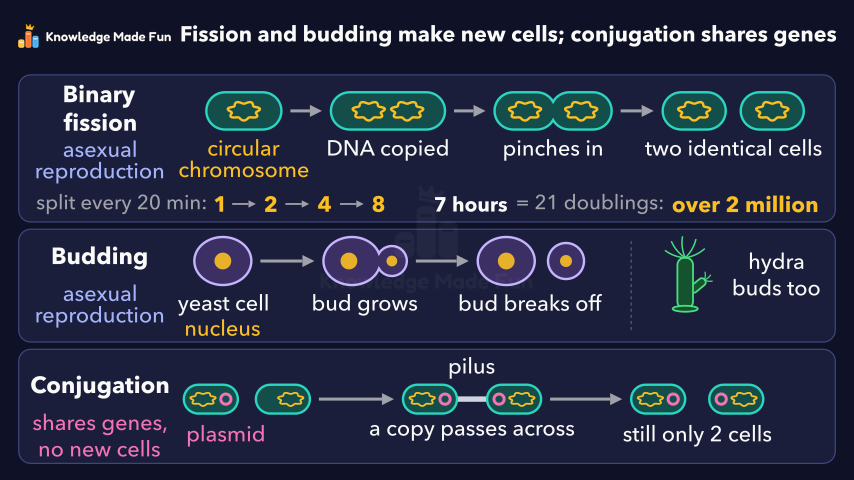 1 min 55 s
Binary Fission, Budding and Conjugation
Grade 11 · 1 min 55 s 1 min 57 s
Levels of Organization: From Molecules to Ecosystems
Grade 11 · 1 min 57 s 1 min 53 s
Meiosis: Making Sex Cells with Half the Chromosomes
Grade 9 · 1 min 53 s 1 min 22 s
Organelles: The Jobs Inside a Cell
Grade 8 · 1 min 22 s 1 min 55 s
Prokaryotic and eukaryotic cells: is there a nucleus?
Grade 8 · 1 min 55 s 1 min 51 s
The Stages of Mitosis: One Cell Becomes Two
Grade 9 · 1 min 51 s
- All Grade 11 Life Sciences lessons
- Create a free account to watch three lessons a day, no payment and no card.