Lesson · Grade 8 · Science
Prokaryotic and eukaryotic cells: is there a nucleus?
- Grade 8
- Science
- 1 min 55 s
- British Columbia
- BC8-SC-04
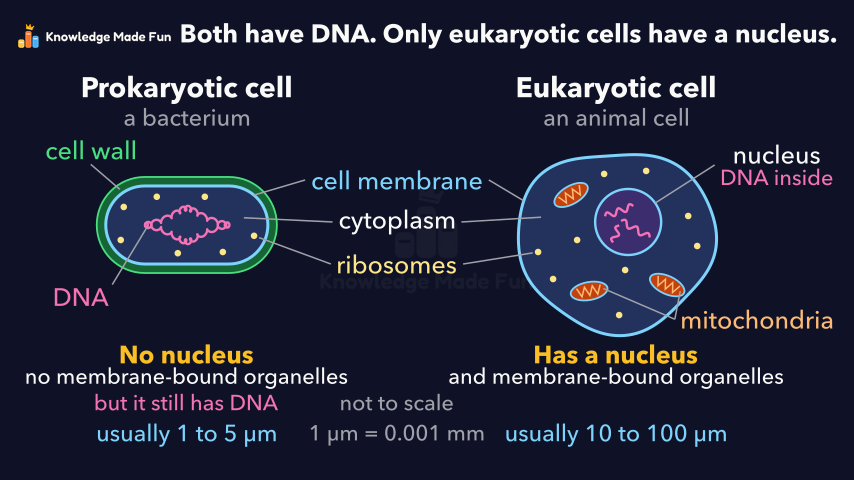
A labelled bacterium and animal cell build up side by side: first what both have (cell membrane, cytoplasm, ribosomes), then the bacterium's cell wall and its DNA loose in the cytoplasm, then the animal cell's nucleus and mitochondria, both wrapped in membranes. The video gives the answer (only eukaryotic cells have a nucleus), corrects the idea that a cell with no nucleus has no DNA, and compares the usual sizes (1 to 5 µm against 10 to 100 µm).
Concept: Prokaryotic and eukaryotic cells
Anyone can watch two lessons on the website without an account. Signing in is free, no payment and no card, and opens three a day; Plus has no limit.
Loading
In one sentence
The question this lesson answers
Cell theory says all living things are made of cells. But does every cell have a nucleus?
There are two types of cell: prokaryotic and eukaryotic.
Transcript
What the lesson says
Cell theory says all living things are made of cells. But does every cell have a nucleus?
There are two types of cell: prokaryotic and eukaryotic.
Prokaryotes are bacteria and archaea, each made of just one cell. Here is a bacterium.
Animals, plants and fungi are made of eukaryotic cells. Here is an animal cell.
Both cells have a cell membrane, a thin layer that controls what goes in and out.
Both are filled with cytoplasm, a jelly-like substance where many reactions happen.
Both also have ribosomes, tiny parts that make proteins.
Only the bacterium has a cell wall, a stiff outer layer that supports the cell.
The key difference: the bacterium's DNA, its genetic code, lies loose in the cytoplasm.
The animal cell keeps its DNA inside a nucleus, which has its own membrane.
Organelles are cell parts with their own jobs. Mitochondria release energy. Like the nucleus, they are membrane-bound.
So not every cell has a nucleus. Prokaryotic cells have no nucleus and no membrane-bound organelles. Eukaryotic cells have both.
But no nucleus does not mean no DNA. The bacterium still has its DNA.
Prokaryotic cells are usually 1 to 5 micrometres. A micrometre is a thousandth of a millimetre.
Eukaryotic cells are usually 10 to 100 micrometres, so this drawing is not to scale.
Both types of cell have DNA, but only eukaryotic cells keep it in a nucleus.
Curriculum
Where this fits
- British Columbia, Grade 8
Science, Biology: cell theory and types of cellsBC8-SC-04
Previous: Cell theory: three ideas about cellsNext: Plant and Animal Cells: What They Share and How They Differ
- British Columbia, Grade 11
Life Sciences 11, Cells: cell structure and functionBC11-SC-135
Previous: Levels of Organization: From Molecules to EcosystemsNext: Organelles: The Jobs Inside a Cell
This lesson is also listed in Grade 11.
The outcomes and strands follow the British Columbia curriculum.
Keep going
 1 min 53 s
Asexual or Sexual Reproduction: Fast Copies or New Variety
Grade 9 · 1 min 53 s 1 min 54 s
ATP: How Cells Store and Spend Energy
Grade 11 · 1 min 54 s 1 min 55 s
Binary Fission, Budding and Conjugation
Grade 11 · 1 min 55 s 1 min 49 s
Cell Specialization: Same DNA, Different Jobs
Grade 11 · 1 min 49 s 1 min 57 s
Levels of Organization: From Molecules to Ecosystems
Grade 11 · 1 min 57 s 1 min 53 s
Meiosis: Making Sex Cells with Half the Chromosomes
Grade 9 · 1 min 53 s 1 min 22 s
Organelles: The Jobs Inside a Cell
Grade 8 · 1 min 22 s 1 min 51 s
The Stages of Mitosis: One Cell Becomes Two
Grade 9 · 1 min 51 s
- All Grade 8 Science lessons
- Create a free account to watch three lessons a day, no payment and no card.