Lesson · Grade 8 · Science
Plant and Animal Cells: What They Share and How They Differ
- Grade 8
- Science
- 1 min 41 s
- British Columbia
- BC8-SC-05
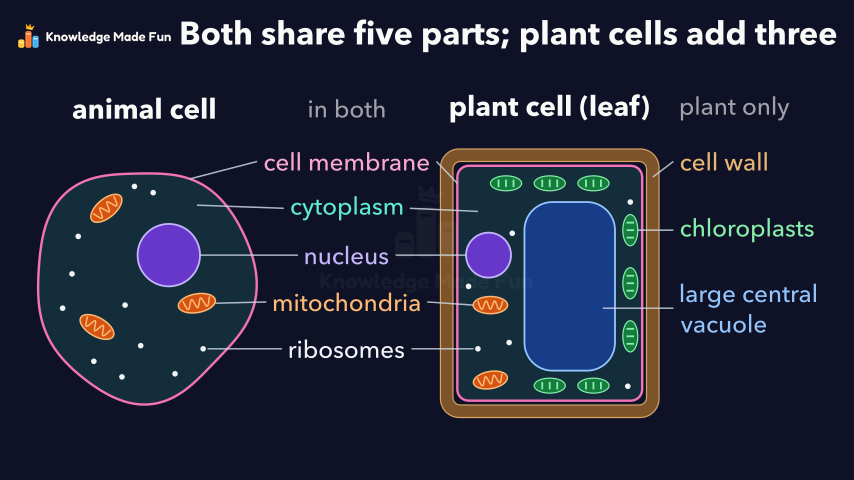
An animal cell and a leaf cell are drawn side by side and labelled one part at a time. They share five parts (cell membrane, cytoplasm, nucleus, mitochondria and ribosomes), and only the plant cell has a cell wall, chloroplasts and a large central vacuole. The video then corrects the common mistake that plant cells have no mitochondria, since they respire day and night, and ends on a one-line recap.
Anyone can watch two lessons on the website without an account. Signing in is free, no payment and no card, and opens three a day; Plus has no limit.
Loading
In one sentence
The question this lesson answers
Cell theory says that all living things are made of cells.
Here is an animal cell, and a plant cell from a leaf. How are they alike, and how are they different?
Transcript
What the lesson says
Cell theory says that all living things are made of cells.
Here is an animal cell, and a plant cell from a leaf. How are they alike, and how are they different?
Both cells have a cell membrane, a thin layer that controls what enters and leaves the cell.
Inside is the cytoplasm, a jelly-like fluid where most chemical reactions happen.
Both have a nucleus, which holds DNA, the genetic instructions, and controls what the cell does.
Both have mitochondria, where respiration releases energy from glucose, a sugar the cell uses as food.
And both have ribosomes, tiny dots that make proteins.
So both cells share five parts: the cell membrane, cytoplasm, nucleus, mitochondria and ribosomes.
Only the plant cell has a cell wall, a stiff layer of tough cellulose fibres outside the membrane.
The plant cell also has chloroplasts, where photosynthesis uses light to make glucose. Root cells usually have none.
And it has a large central vacuole, a sac of watery cell sap that keeps the cell firm.
A common mistake is to think that plant cells have no mitochondria.
In fact, plant cells respire day and night to release energy from glucose, so they need mitochondria too.
Both cells share five parts, and plant cells add a cell wall, chloroplasts and a large central vacuole.
Curriculum
Where this fits
- British Columbia, Grade 8
Science, Biology: cell theory and types of cellsBC8-SC-05
Previous: Prokaryotic and eukaryotic cells: is there a nucleus?Next: Organelles: The Jobs Inside a Cell
The outcomes and strands follow the British Columbia curriculum.
Keep going
 1 min 3 s
A Sunflower's Life Cycle: Seed, Sprout, Flower, Seed
Kindergarten · 1 min 3 s 1 min 48 s
Adaptive radiation: one ancestor, many species
Grade 10 · 1 min 48 s 52 s
Animal Bodies That Help Them Live: Feet, Teeth and Fur
Kindergarten · 52 s 1 min 3 s
Animal senses beyond ours: echolocation, ultraviolet light, heat and magnetism
Grade 4 · 1 min 3 s 1 min 44 s
Antibodies and Memory Cells: The Body's Targeted Defence
Grade 8 · 1 min 44 s 1 min 44 s
Artificial selection: people choose the traits
Grade 10 · 1 min 44 s 1 min 4 s
Biodiversity: The Variety of Living Things
Grade 3 · 1 min 4 s 1 min 8 s
Biomes: Sorted by Temperature and Precipitation
Grade 4 · 1 min 8 s
- All Grade 8 Science lessons
- Create a free account to watch three lessons a day, no payment and no card.