Lesson · Grade 9 · Science
Meiosis: Making Sex Cells with Half the Chromosomes
- Grade 9
- Science
- 1 min 53 s
- British Columbia
- BC9-SC-05
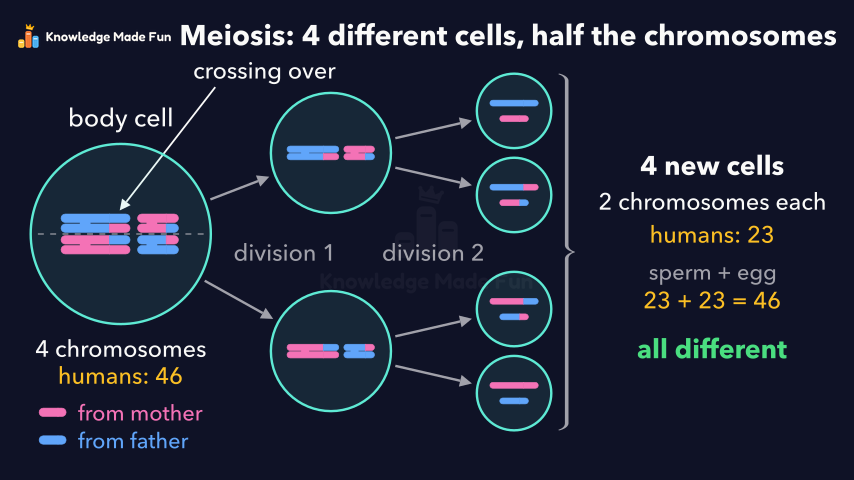
A body cell with two colour-coded pairs of chromosomes (pink from the mother, blue from the father) copies its chromosomes, pairs them up, swaps pieces by crossing over and lines the pairs up at random, then divides twice into four cells with one chromosome from every pair: 4 becomes 2, and in humans 46 becomes 23, which makes 46 again when a sperm and an egg join. The diagram builds from left to right into one labelled tree, shows that the four new cells are all different (unlike mitosis, which makes identical cells), and ends on a one-line recap.
Concept: Meiosis: making cells with half the chromosomes
Anyone can watch two lessons on the website without an account. Signing in is free, no payment and no card, and opens three a day; Plus has no limit.
Loading
In one sentence
The question this lesson answers
Sex cells, or gametes, have half the usual number of chromosomes. How are they made?
Chromosomes are long strands of DNA that carry genes. This body cell has four.
Transcript
What the lesson says
Sex cells, or gametes, have half the usual number of chromosomes. How are they made?
Chromosomes are long strands of DNA that carry genes. This body cell has four.
They come in pairs: in each pair, one came from the mother and one from the father.
Most human body cells have 46 chromosomes, in 23 pairs. Our cell has just 2 pairs.
Meiosis is the cell division that makes sex cells. The cell divides twice.
First, each chromosome copies itself. The two copies stay joined.
Next, the two chromosomes of each pair line up side by side.
They swap matching pieces of DNA. This is called crossing over.
Then the pairs line up across the middle. Which way each pair faces is random.
In the first division, the pairs separate into two new cells.
In the second division, the two copies of each chromosome are pulled apart.
That makes four new cells, each with one chromosome from every pair.
Our cell had 4 chromosomes, and each new cell has 2: half the number.
In humans, a body cell's 46 chromosomes become 23 in a sex cell.
When a sperm and an egg join, 23 plus 23 makes 46 again.
Crossing over and the random line-up of pairs make every sex cell different.
Meiosis does not make identical cells. Mitosis does that, for growth and repair.
Meiosis: one cell divides twice into four different cells, each with half the chromosomes.
Curriculum
Where this fits
- British Columbia, Grade 9
Science, Biology: sexual reproduction: meiosisBC9-SC-05
Previous: Cloning and Grafting: Making Copies of Living ThingsNext: Mitosis and Meiosis Side by Side
- British Columbia, Grade 11
Life Sciences 11, Cells: sexual and asexual reproductionBC11-SC-139
Previous: The Stages of Mitosis: One Cell Becomes TwoNext: Binary Fission, Budding and Conjugation
This lesson is also listed in Grade 11.
The outcomes and strands follow the British Columbia curriculum.
Keep going
 1 min 53 s
Asexual or Sexual Reproduction: Fast Copies or New Variety
Grade 9 · 1 min 53 s 1 min 54 s
ATP: How Cells Store and Spend Energy
Grade 11 · 1 min 54 s 1 min 55 s
Binary Fission, Budding and Conjugation
Grade 11 · 1 min 55 s 1 min 49 s
Cell Specialization: Same DNA, Different Jobs
Grade 11 · 1 min 49 s 1 min 57 s
Levels of Organization: From Molecules to Ecosystems
Grade 11 · 1 min 57 s 1 min 22 s
Organelles: The Jobs Inside a Cell
Grade 8 · 1 min 22 s 1 min 55 s
Prokaryotic and eukaryotic cells: is there a nucleus?
Grade 8 · 1 min 55 s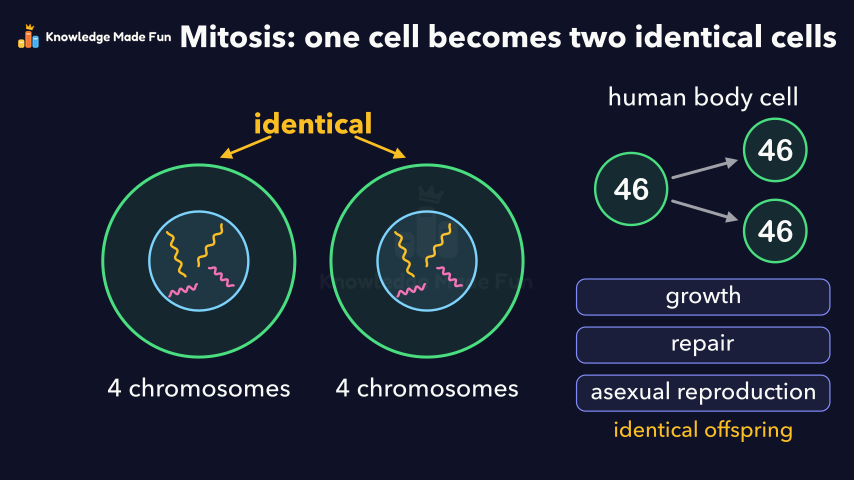 1 min 51 s
The Stages of Mitosis: One Cell Becomes Two
Grade 9 · 1 min 51 s
- All Grade 9 Science lessons
- Create a free account to watch three lessons a day, no payment and no card.