Lesson · Grade 11 · Life Sciences
ATP: How Cells Store and Spend Energy
- Grade 11
- Life Sciences
- 1 min 54 s
- British Columbia
- BC11-SC-143
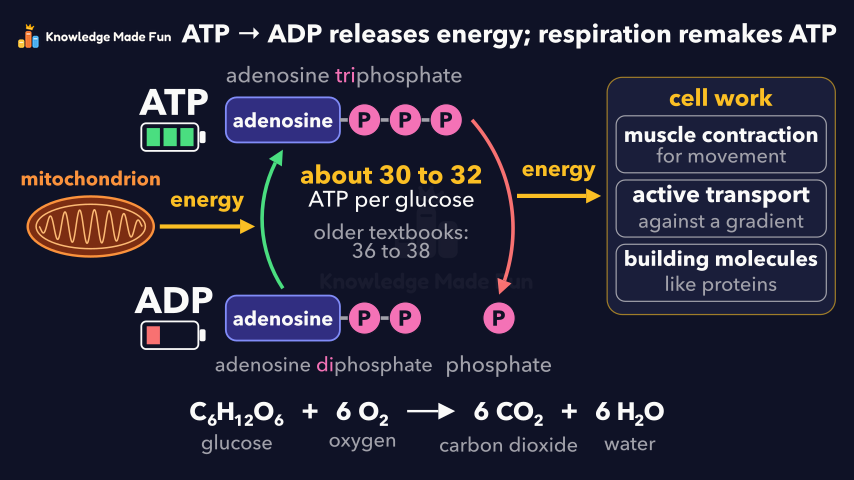
ATP is drawn as adenosine with three phosphates. Splitting off the end phosphate leaves ADP and releases energy for muscle contraction, active transport and building molecules, like a charged battery being used. Respiration in the mitochondria (C₆H₁₂O₆ + 6 O₂ → 6 CO₂ + 6 H₂O) supplies the energy to join the phosphate back on, making about 30 to 32 ATP from each glucose.
Anyone can watch two lessons on the website without an account. Signing in is free, no payment and no card, and opens three a day; Plus has no limit.
Loading
In one sentence
The question this lesson answers
How do cells store energy, and how do they spend it?
Cells keep energy ready to use in a molecule called ATP, which stands for adenosine triphosphate.
Transcript
What the lesson says
How do cells store energy, and how do they spend it?
Cells keep energy ready to use in a molecule called ATP, which stands for adenosine triphosphate.
It is adenosine joined to three phosphate groups; tri means three.
Think of ATP as a charged battery, holding energy the cell can use right away.
To spend it, the cell splits off the end phosphate, leaving ADP and a free phosphate.
ADP is adenosine diphosphate, because di means two.
Splitting off that phosphate releases energy, which the cell can use for work.
It powers work such as muscle contraction for movement, active transport, and building molecules like proteins.
Active transport pumps substances across a membrane against their concentration gradient.
Now ADP is like a run-down battery that needs recharging.
Respiration recharges it: these reactions release energy from glucose, mostly inside the cell's mitochondria.
Aerobic respiration uses oxygen: one glucose and six oxygen molecules make six carbon dioxide and six water molecules.
The energy released joins a phosphate back onto ADP, which makes ATP again.
In aerobic respiration, each glucose gives about 30 to 32 ATP, though older textbooks say 36 to 38.
So energy passes from glucose, then to ATP, and then to the work the cell does.
ATP releases energy as it becomes ADP, and respiration turns ADP back into ATP.
Curriculum
Where this fits
- British Columbia, Grade 11
Life Sciences 11, Cells: energy transformations in cellsBC11-SC-143
Previous: Photosynthesis and Respiration: Two Halves of One Cycle
The outcomes and strands follow the British Columbia curriculum.
Keep going
 1 min 53 s
Asexual or Sexual Reproduction: Fast Copies or New Variety
Grade 9 · 1 min 53 s 1 min 55 s
Binary Fission, Budding and Conjugation
Grade 11 · 1 min 55 s 1 min 49 s
Cell Specialization: Same DNA, Different Jobs
Grade 11 · 1 min 49 s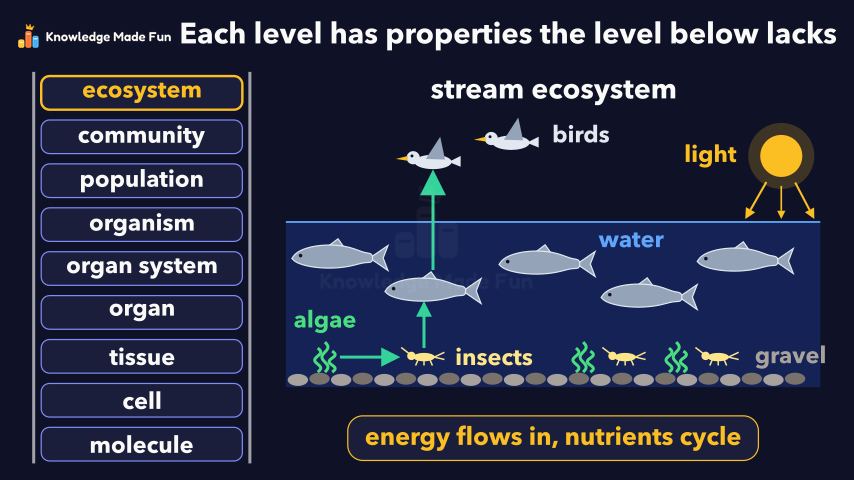 1 min 57 s
Levels of Organization: From Molecules to Ecosystems
Grade 11 · 1 min 57 s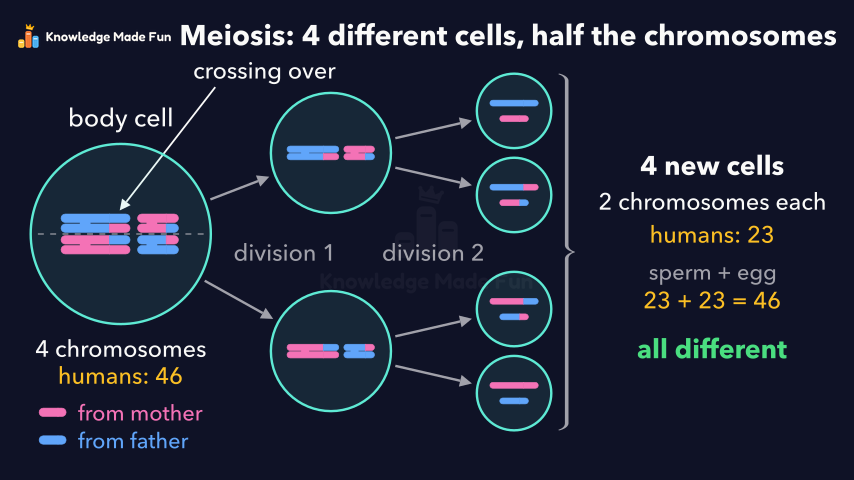 1 min 53 s
Meiosis: Making Sex Cells with Half the Chromosomes
Grade 9 · 1 min 53 s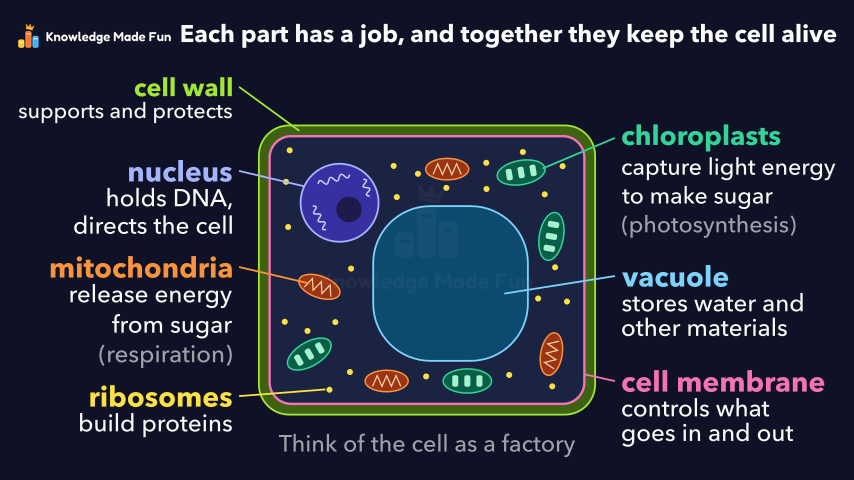 1 min 22 s
Organelles: The Jobs Inside a Cell
Grade 8 · 1 min 22 s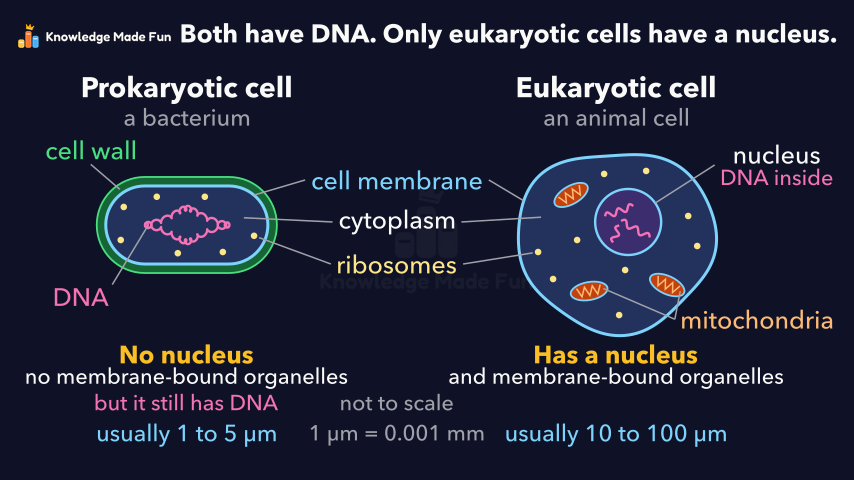 1 min 55 s
Prokaryotic and eukaryotic cells: is there a nucleus?
Grade 8 · 1 min 55 s 1 min 51 s
The Stages of Mitosis: One Cell Becomes Two
Grade 9 · 1 min 51 s
- All Grade 11 Life Sciences lessons
- Create a free account to watch three lessons a day, no payment and no card.