Lesson · Grade 9 · Science
Energy flow: how sunlight powers a food chain
- Grade 9
- Science
- 1 min 55 s
- British Columbia
- BC9-SC-24
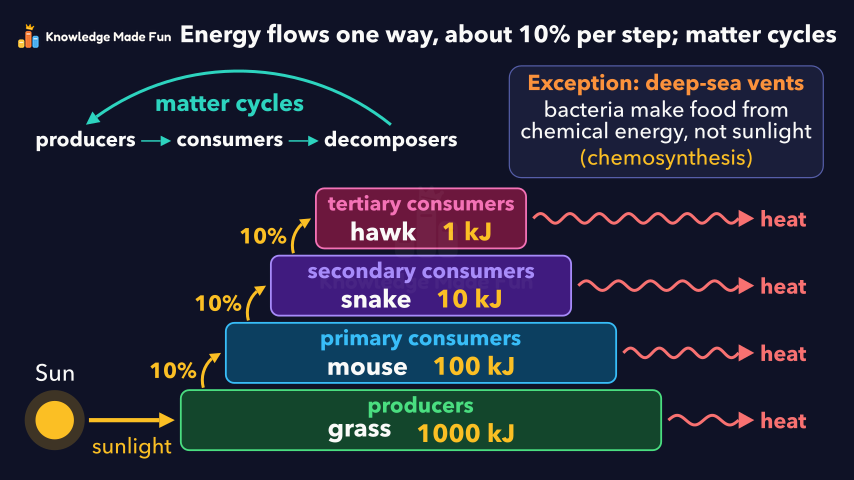
An energy pyramid builds up step by step, from grass to mouse to snake to hawk. Sunlight comes in at the producers, only about 10% of the energy passes up each level (1000, 100, 10, 1 kJ), and the rest leaves as heat, which is why there are few top predators. A matter cycle through decomposers is set beside it to show that energy flows one way and must be resupplied by the Sun while matter cycles, with deep-sea vents as the chemical-energy exception.
Anyone can watch two lessons on the website without an account. Signing in is free, no payment and no card, and opens three a day; Plus has no limit.
Loading
In one sentence
The question this lesson answers
Where does the energy in a food chain come from, and where does it go?
Almost every food chain starts with the Sun. Producers, like grass, capture its light energy by photosynthesis.
Transcript
What the lesson says
Where does the energy in a food chain come from, and where does it go?
Almost every food chain starts with the Sun. Producers, like grass, capture its light energy by photosynthesis.
Consumers get energy by eating: a mouse eats the grass, a snake eats the mouse, and a hawk eats the snake.
Each feeding step is called a trophic level: producers, then primary, secondary and tertiary consumers.
Say the grass stores 1000 kilojoules, or kJ, of energy.
Only about 10 percent of it passes on to the mouse: 100 kilojoules.
The other 90 percent is not passed on. Most of it is used for living, and it ends up lost as heat.
The same happens at every step: only 10 kilojoules reach the snake, and just 1 reaches the hawk.
This is an energy pyramid. With so little energy at the top, there are only a few top predators, like the hawk.
So energy flows one way: in as sunlight, out as heat.
Matter is different: it cycles from producers to consumers to decomposers, which break down dead remains, and back to producers.
A common mistake is to think energy is recycled like matter. It is not: producers cannot use heat, so the Sun must keep supplying energy.
One exception: at deep-sea vents, bacteria make food from chemical energy, not sunlight. This is called chemosynthesis.
In short: energy flows one way from the Sun, about 10 percent at each step, while matter cycles.
Curriculum
Where this fits
- British Columbia, Grade 9
Science, Biology: effects of solar radiation on the cycling of matter and energyBC9-SC-24
Previous: Asexual or Sexual Reproduction: Fast Copies or New VarietyNext: Bioaccumulation and Biomagnification: Toxins Up the Food Chain
The outcomes and strands follow the British Columbia curriculum.
Keep going
 1 min 3 s
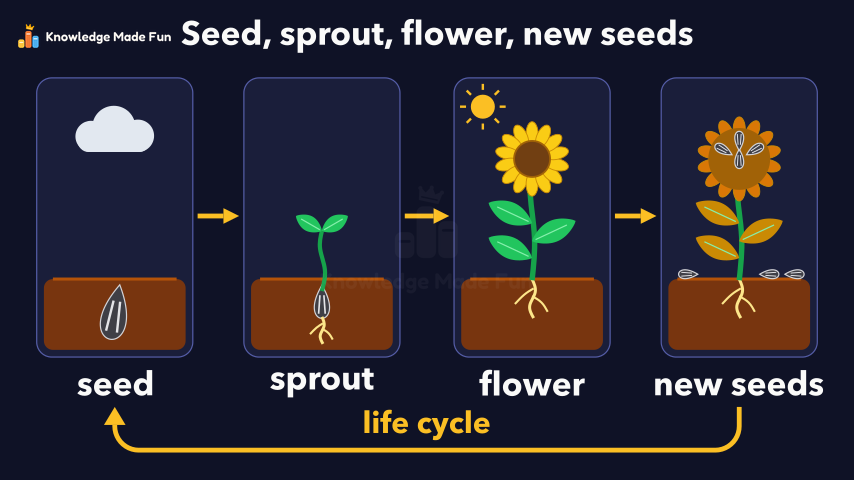
A Sunflower's Life Cycle: Seed, Sprout, Flower, Seed
Kindergarten · 1 min 3 s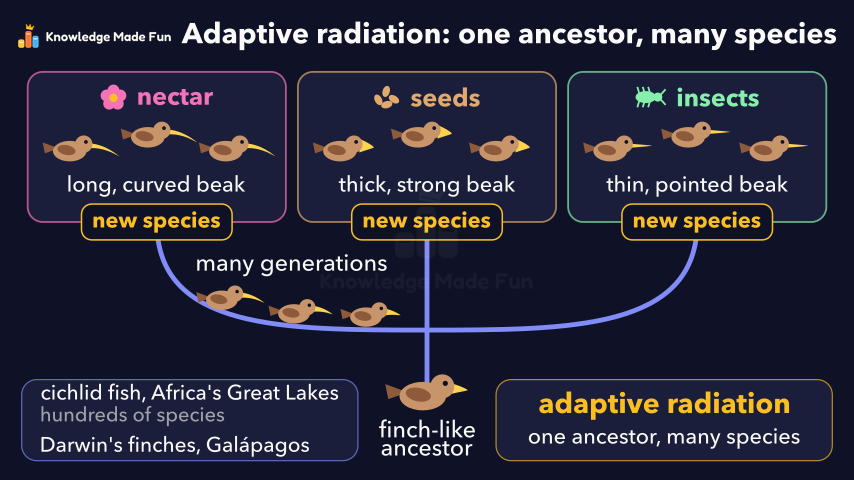 1 min 48 s
Adaptive radiation: one ancestor, many species
Grade 10 · 1 min 48 s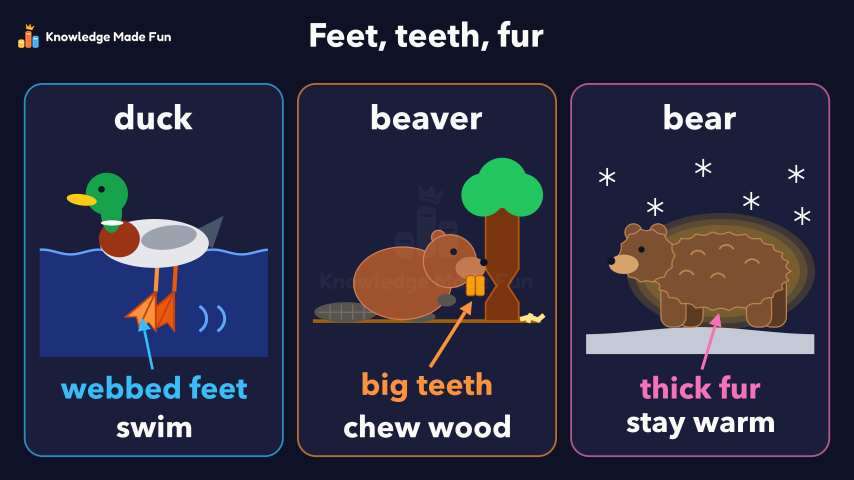 52 s
Animal Bodies That Help Them Live: Feet, Teeth and Fur
Kindergarten · 52 s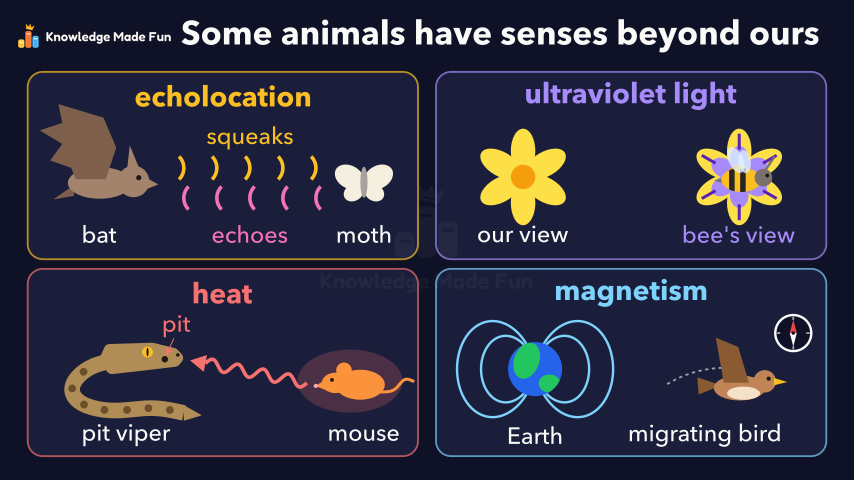 1 min 3 s
Animal senses beyond ours: echolocation, ultraviolet light, heat and magnetism
Grade 4 · 1 min 3 s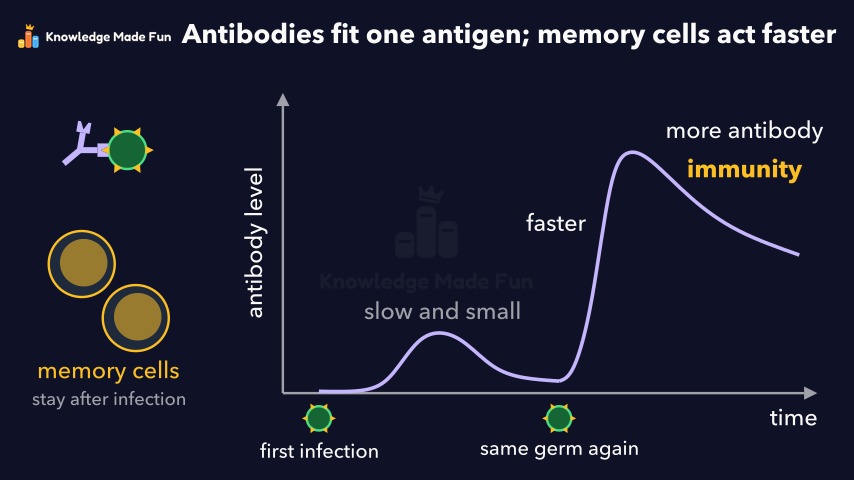 1 min 44 s
Antibodies and Memory Cells: The Body's Targeted Defence
Grade 8 · 1 min 44 s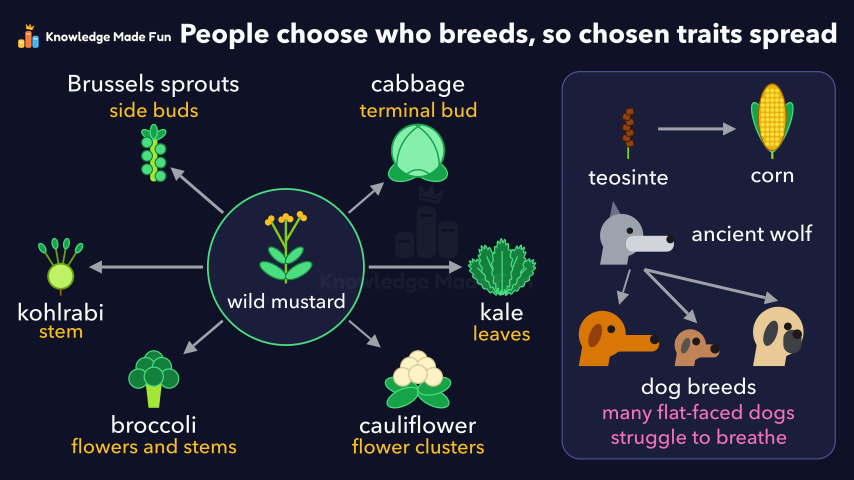 1 min 44 s
Artificial selection: people choose the traits
Grade 10 · 1 min 44 s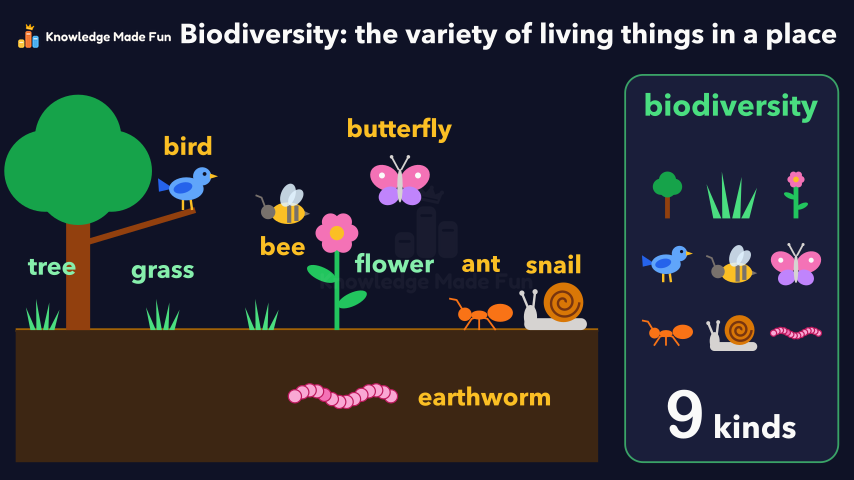 1 min 4 s
Biodiversity: The Variety of Living Things
Grade 3 · 1 min 4 s 1 min 8 s
Biomes: Sorted by Temperature and Precipitation
Grade 4 · 1 min 8 s
- All Grade 9 Science lessons
- Create a free account to watch three lessons a day, no payment and no card.