Lesson · Grade 9 · Science
Bioaccumulation and Biomagnification: Toxins Up the Food Chain
- Grade 9
- Science
- 1 min 47 s
- British Columbia
- BC9-SC-30
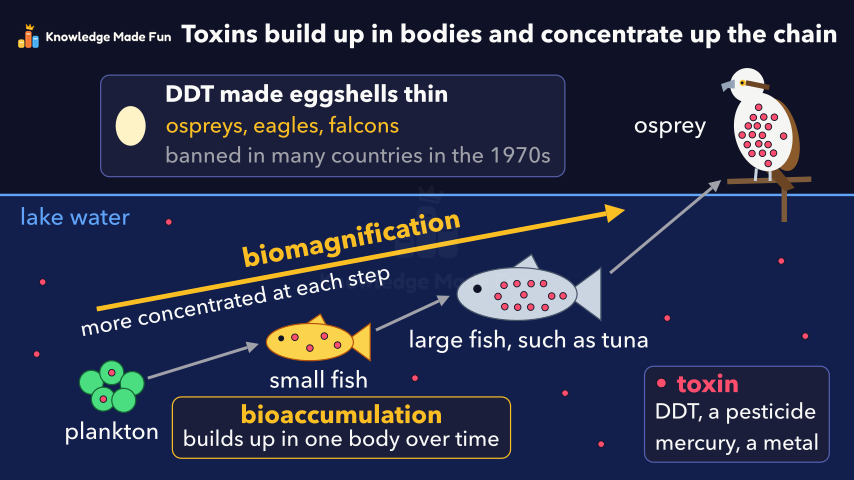
A lake food chain, from plankton to small fish to large fish to an osprey, shows dots of a toxin like DDT or mercury building up inside one fish over its life and becoming more concentrated at every step up the chain. It ends with the real effects: DDT thinned the eggshells of ospreys, eagles and falcons until many countries banned it in the 1970s, and large predatory fish like tuna carry more mercury, so a tiny trace in the water can become a harmful amount at the top.
Concept: Biomagnification: how pollutants build up a food chain
Anyone can watch two lessons on the website without an account. Signing in is free, no payment and no card, and opens three a day; Plus has no limit.
Loading
In one sentence
The question this lesson answers
A lake holds only a tiny trace of a toxin, a poisonous substance. Can that really harm its animals?
Some toxins, like the pesticide DDT and the metal mercury, are hard for bodies to break down or get rid of.
Transcript
What the lesson says
A lake holds only a tiny trace of a toxin, a poisonous substance. Can that really harm its animals?
Some toxins, like the pesticide DDT and the metal mercury, are hard for bodies to break down or get rid of.
Here is a food chain in the lake: plankton, small fish, large fish, and an osprey, a bird that hunts fish.
Plankton, tiny living things that drift in water, take in the toxin from the water.
A small fish eats plankton day after day, and the toxin stays in its body, often stored in fat.
So the toxin builds up over the fish's life. This is called bioaccumulation.
A large fish eats many small fish, and keeps the toxin from all of them.
An osprey eats many large fish, so it collects even more toxin.
So at each step up the food chain, the toxin gets more concentrated, with more in each gram of body. This is called biomagnification.
DDT made the eggshells of ospreys, eagles and falcons so thin that many broke before hatching.
Many countries banned DDT in the 1970s, and these birds have since recovered in many places.
Mercury builds up the same way, so large predatory fish such as tuna carry more mercury than small fish.
So yes, a tiny trace in the water can become a harmful amount at the top of the food chain.
Toxins that bodies cannot easily remove build up in each organism and concentrate up the food chain.
Curriculum
Where this fits
- British Columbia, Grade 9
Science, Biology: matter cycles within biotic and abiotic components of ecosystemsBC9-SC-30
- British Columbia, Grade 11
Environmental Science 11, People and ecosystems: human actions and their impact on ecosystem integrityBC11-SC-126
This lesson is also listed in Grade 11.
The outcomes and strands follow the British Columbia curriculum.
Keep going
 1 min 51 s
A Complete Circuit: Source, Load, Conductors and Switch
Grade 9 · 1 min 51 s 1 min 48 s
AC and DC: Two Ways Current Can Flow
Grade 9 · 1 min 48 s 1 min 40 s
Acids and bases: the pH scale
Grade 10 · 1 min 40 s 1 min 39 s
Adaptations Are Inherited, Not Earned in a Lifetime
Grade 11 · 1 min 39 s 1 min 48 s
Adaptive radiation: one ancestor, many species
Grade 10 · 1 min 48 s 1 min 39 s
Aerobic and anaerobic organisms
Grade 11 · 1 min 39 s 1 min 37 s
Antibiotic resistance: how superbugs evolve
Grade 8 · 1 min 37 s 1 min 35 s
Antibiotics kill bacteria, not viruses
Grade 8 · 1 min 35 s
- All Grade 9 Science lessons
- Create a free account to watch three lessons a day, no payment and no card.