Lesson · Grade 9 · Science
AC and DC: Two Ways Current Can Flow
- Grade 9
- Science
- 1 min 48 s
- British Columbia
- BC9-SC-20
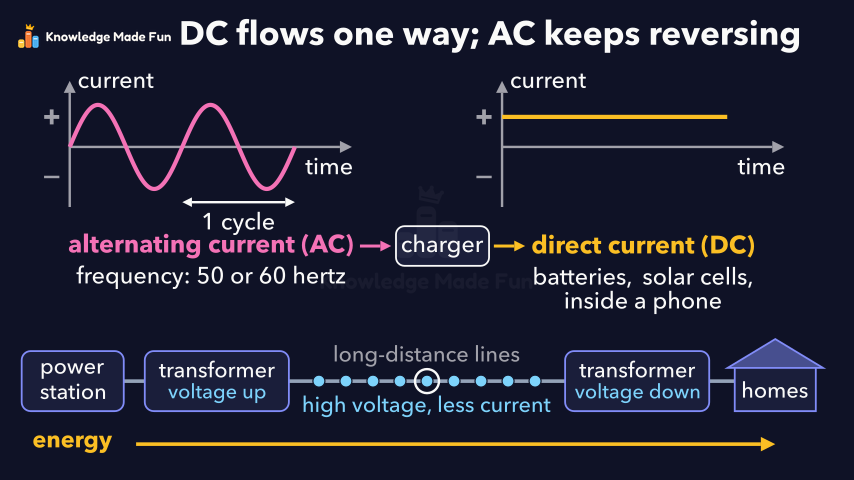
Two graphs of current against time build up step by step: a flat line for direct current from batteries, solar cells and the inside of a phone, and a wave for alternating current, which reverses direction 50 or 60 cycles a second. A power grid drawn below shows that transformers raise the voltage for long-distance lines and lower it for homes, a charger turns AC into DC, and the electrons in the wires only jiggle back and forth in place, while energy is what travels from the power station.
Anyone can watch two lessons on the website without an account. Signing in is free, no payment and no card, and opens three a day; Plus has no limit.
Loading
In one sentence
The question this lesson answers
Current is a flow of electrons around a complete circuit. Does it always flow one way? Let's graph current against time.
Above the time axis, current flows one way. Below it, the other way.
Transcript
What the lesson says
Current is a flow of electrons around a complete circuit. Does it always flow one way? Let's graph current against time.
Above the time axis, current flows one way. Below it, the other way.
Direct current, or DC, flows one way only. A battery's DC is steady, so its graph is a flat line.
Batteries and solar cells supply DC, and the circuits inside a phone run on it.
Alternating current, or AC, keeps reversing direction, so its graph is a wave.
One full back and forth is called a cycle.
Power grid AC does 50 or 60 cycles a second: a frequency of 50 or 60 hertz.
Power grids carry AC from power stations to homes, because its voltage is easy to change.
A transformer raises or lowers voltage, the push that drives current. It only works with a changing current, like AC.
Raising the voltage lets the long lines carry less current, so they lose less energy as heat.
Near homes, transformers lower the voltage to a safer level.
A phone charger turns AC from a wall socket into DC for the phone.
A common myth is that electrons travel all the way from the power station to your home.
In fact, they just jiggle back and forth in about the same place.
What travels along the wires is energy, not electrons.
So direct current flows one way, and alternating current keeps reversing direction.
Curriculum
Where this fits
- British Columbia, Grade 9
Science, Physics: circuits: must be complete for electrons to flowBC9-SC-20
Previous: Short Circuits: Why a Shortcut for Current Is DangerousNext: Ohm's Law: V = I × R
The outcomes and strands follow the British Columbia curriculum.
Keep going
 1 min 51 s
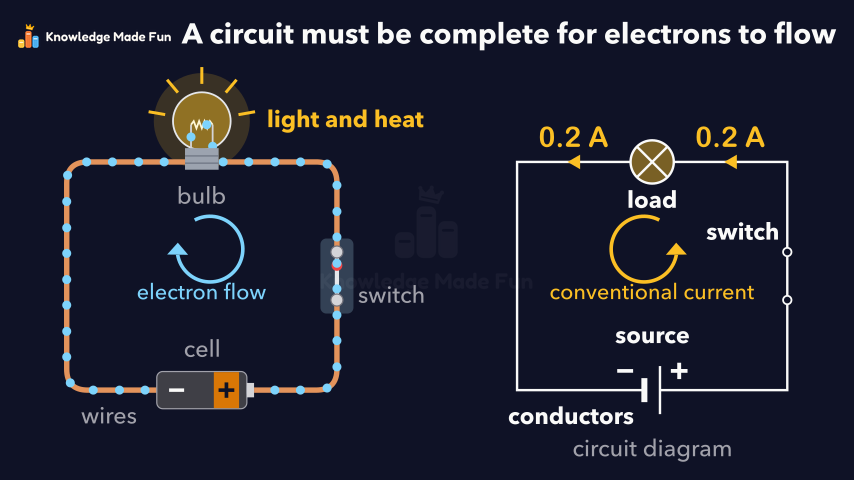
A Complete Circuit: Source, Load, Conductors and Switch
Grade 9 · 1 min 51 s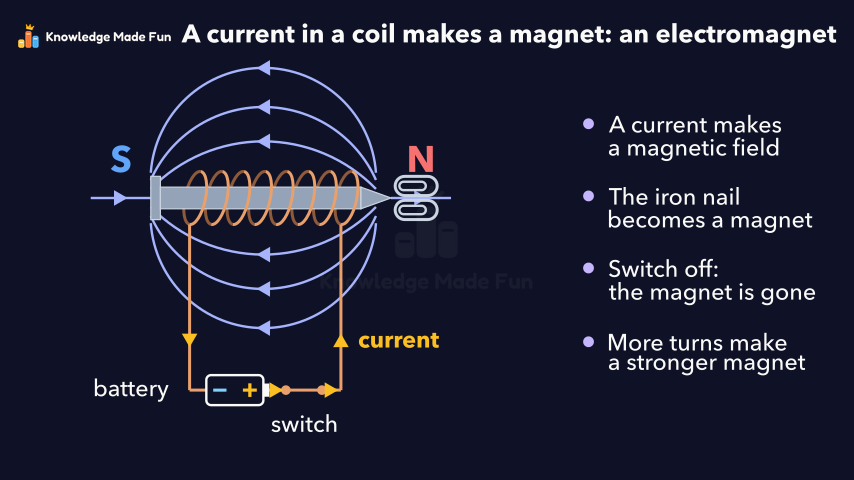 1 min 18 s
A current makes a magnet: the electromagnet
Grade 7 · 1 min 18 s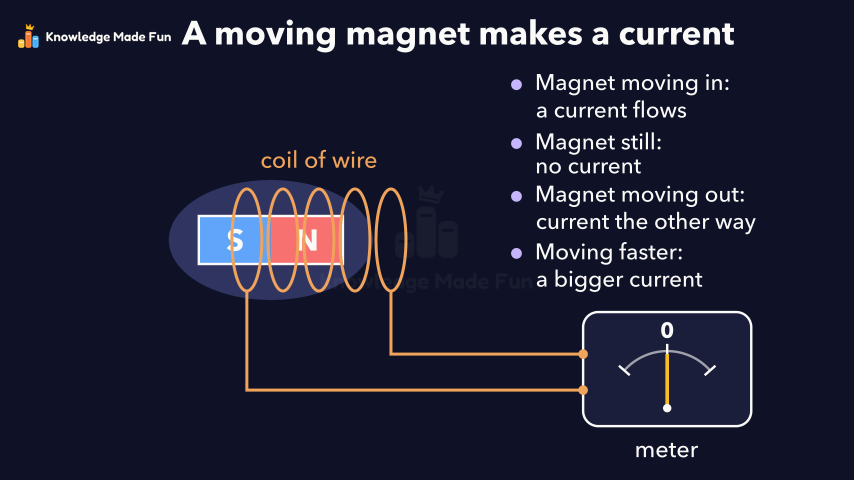 1 min 12 s
A Moving Magnet Makes a Current
Grade 7 · 1 min 12 s 54 s
A Push or a Pull Makes Things Move
Kindergarten · 54 s 1 min 3 s
Air Resistance: Why a Flat Sheet Falls Slower
Grade 2 · 1 min 3 s 1 min 40 s
Alpha, Beta and Gamma Radiation
Grade 10 · 1 min 40 s 1 min 6 s
Balanced and Unbalanced Forces in Sport and Play
Grade 6 · 1 min 6 s 1 min 48 s
Cameras, Microscopes and Telescopes: Tools That Extend Our Sight
Grade 8 · 1 min 48 s
- All Grade 9 Science lessons
- Create a free account to watch three lessons a day, no payment and no card.