Lesson · Grade 8 · Science
Cameras, Microscopes and Telescopes: Tools That Extend Our Sight
- Grade 8
- Science
- 1 min 48 s
- British Columbia
- BC8-SC-38
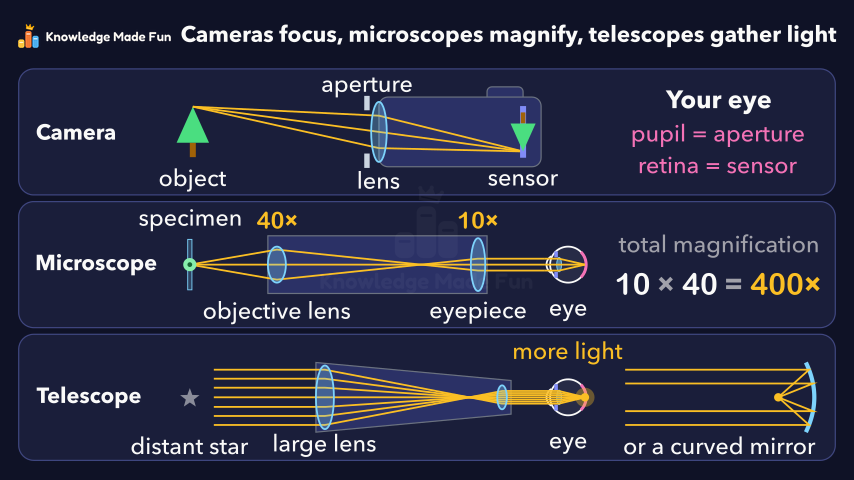
One diagram builds up a row for each tool. A camera's lens focuses an upside-down image on its sensor and its aperture works like the pupil, while a microscope's two convex lenses multiply: a 10× eyepiece with a 40× objective lens gives 400×. A telescope's large lens, or the curved mirror many big telescopes use, gathers far more light than the pupil, so faint distant things become visible, showing that gathering light matters as well as magnification.
Anyone can watch two lessons on the website without an account. Signing in is free, no payment and no card, and opens three a day; Plus has no limit.
Loading
In one sentence
The question this lesson answers
How do cameras, microscopes and telescopes extend our sight?
A camera's lens is a curved piece of glass or plastic that bends light from the object.
Transcript
What the lesson says
How do cameras, microscopes and telescopes extend our sight?
A camera's lens is a curved piece of glass or plastic that bends light from the object.
The lens focuses the light into an upside-down image on the sensor, a grid of tiny light detectors.
The aperture is the opening that lets light in. It can widen or narrow to let in more or less light.
Your eye works the same way: your pupil is its aperture, and your retina is its light sensor.
A microscope is for tiny things close by, such as a specimen, the sample you are looking at.
Its light passes through two convex lenses, thicker in the middle than at the edges, and into your eye.
Magnification is how many times bigger something looks: the objective lens magnifies 40 times, the eyepiece 10 times.
Multiply them: 10 times 40 gives a total magnification of 400 times.
A telescope is for faint things that are far away, like a distant star.
Its light arrives spread over a wide area, but your small pupil catches only a little of it.
A telescope's large lens gathers far more of that light and focuses it into your eye, so faint things look brighter.
Many big telescopes use a curved mirror instead of a lens to gather the light.
So magnification is not all that matters: gathering more light matters too.
Cameras focus an image, microscopes magnify tiny things, and telescopes gather faint light.
Curriculum
Where this fits
The outcomes and strands follow the British Columbia curriculum.
Keep going
 1 min 51 s
A Complete Circuit: Source, Load, Conductors and Switch
Grade 9 · 1 min 51 s 1 min 18 s
A current makes a magnet: the electromagnet
Grade 7 · 1 min 18 s 1 min 12 s
A Moving Magnet Makes a Current
Grade 7 · 1 min 12 s 54 s
A Push or a Pull Makes Things Move
Kindergarten · 54 s 1 min 48 s
AC and DC: Two Ways Current Can Flow
Grade 9 · 1 min 48 s 1 min 3 s
Air Resistance: Why a Flat Sheet Falls Slower
Grade 2 · 1 min 3 s 1 min 40 s
Alpha, Beta and Gamma Radiation
Grade 10 · 1 min 40 s 1 min 6 s
Balanced and Unbalanced Forces in Sport and Play
Grade 6 · 1 min 6 s
- All Grade 8 Science lessons
- Create a free account to watch three lessons a day, no payment and no card.