Lesson · Grade 9 · Science
A Complete Circuit: Source, Load, Conductors and Switch
- Grade 9
- Science
- 1 min 51 s
- British Columbia
- BC9-SC-17
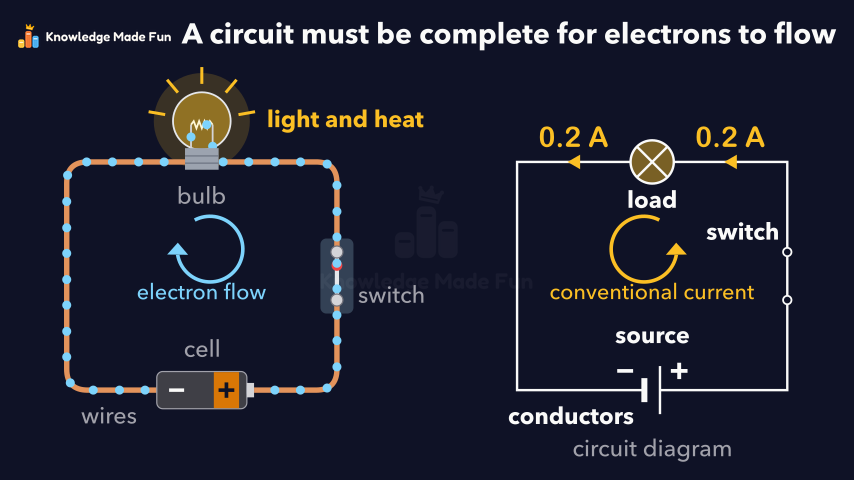
A real circuit with a cell, bulb, wires and switch is built up beside its circuit diagram, naming each part's symbol and job, and electrons flow from the negative terminal round to the positive one only while the switch closes the loop. The diagram shows conventional current going the other way, and the same 0.2 A on both sides of the bulb shows that the bulb transfers energy as light and heat rather than using up current.
Concept: A complete circuit: source, load, conductor and switch
Anyone can watch two lessons on the website without an account. Signing in is free, no payment and no card, and opens three a day; Plus has no limit.
Loading
In one sentence
The question this lesson answers
What does a bulb need to light up?
A complete circuit: an unbroken loop that charge can flow all the way around.
Transcript
What the lesson says
What does a bulb need to light up?
A complete circuit: an unbroken loop that charge can flow all the way around.
On the left is a real circuit; on the right, its circuit diagram.
The source is a cell, or a battery of cells. It gives the charge energy.
The long line is the positive terminal, the short line the negative terminal.
The load transfers that energy. Here it is a bulb, drawn as a circle with a cross.
Metal wires are conductors, with electrons free to move. A diagram draws them as straight lines.
Electrons flow from the negative terminal, through the bulb, back to the positive terminal. This flow is a current.
A switch opens or closes a gap. Open it, and electrons cannot cross the gap, so the current stops everywhere.
Close it again, and the loop is complete. Electrons flow and the bulb lights up.
Diagrams show conventional current, from positive to negative. It was chosen before electrons were discovered.
Current is measured in amperes, symbol capital A. Here, 0.2 amperes flows into the bulb.
A common mistake is to think the bulb uses up some current, so less flows out.
In fact, 0.2 amperes flows out too. The current is the same all the way around this loop.
The bulb does not use up current. It transfers energy from the charge into light and heat.
A circuit must be complete, from the source through the load and back, for electrons to flow.
Curriculum
Where this fits
The outcomes and strands follow the British Columbia curriculum.
Keep going
 1 min 18 s
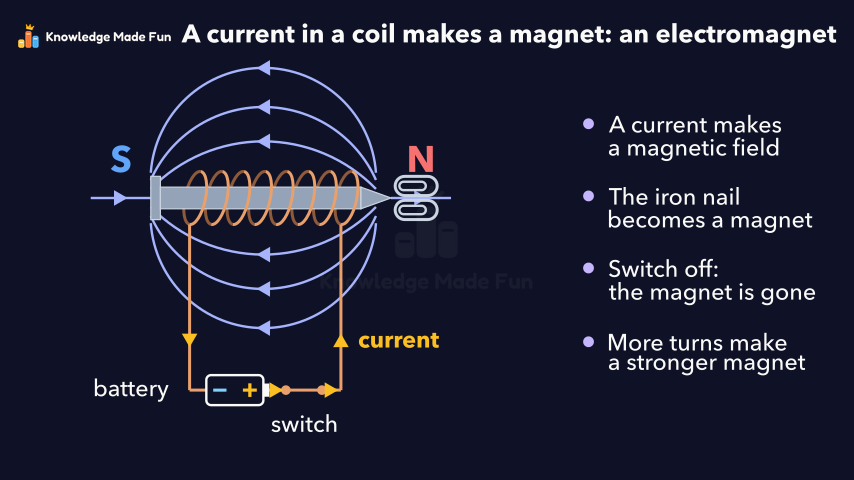
A current makes a magnet: the electromagnet
Grade 7 · 1 min 18 s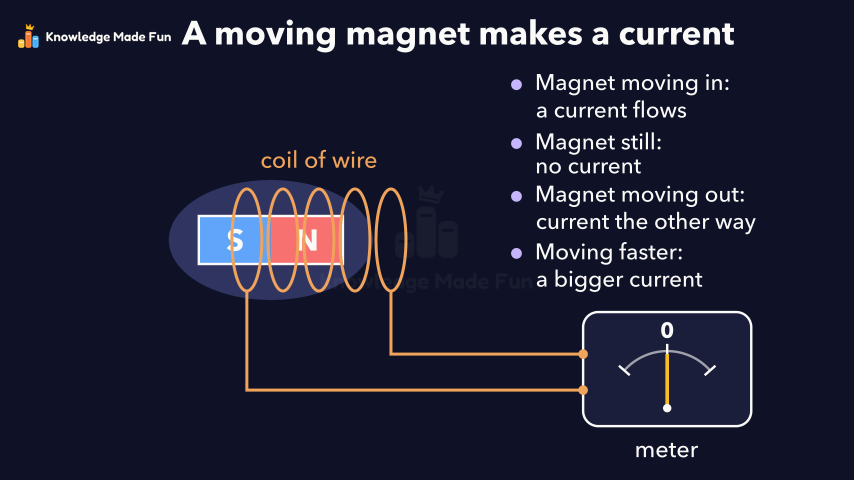 1 min 12 s
A Moving Magnet Makes a Current
Grade 7 · 1 min 12 s 54 s
A Push or a Pull Makes Things Move
Kindergarten · 54 s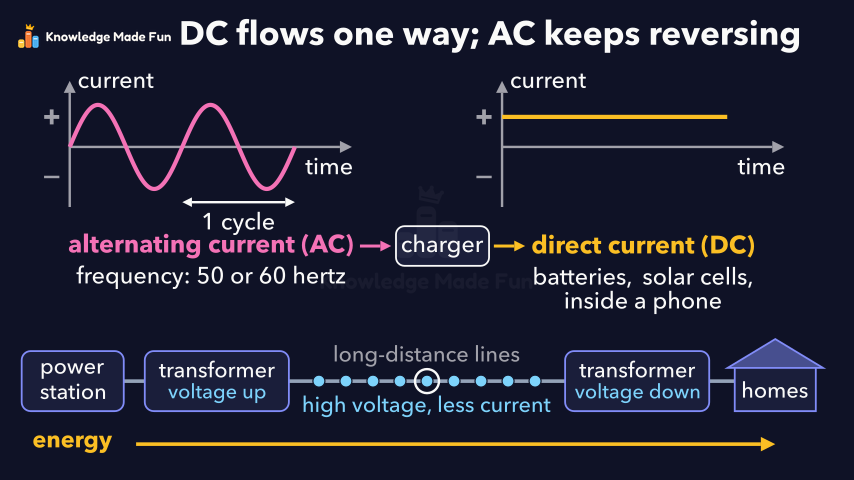 1 min 48 s
AC and DC: Two Ways Current Can Flow
Grade 9 · 1 min 48 s 1 min 3 s
Air Resistance: Why a Flat Sheet Falls Slower
Grade 2 · 1 min 3 s 1 min 40 s
Alpha, Beta and Gamma Radiation
Grade 10 · 1 min 40 s 1 min 6 s
Balanced and Unbalanced Forces in Sport and Play
Grade 6 · 1 min 6 s 1 min 48 s
Cameras, Microscopes and Telescopes: Tools That Extend Our Sight
Grade 8 · 1 min 48 s
- All Grade 9 Science lessons
- Create a free account to watch three lessons a day, no payment and no card.