Lesson · Grade 7 · Science
A current makes a magnet: the electromagnet
- Grade 7
- Science
- 1 min 18 s
- British Columbia
- BC7-SC-23
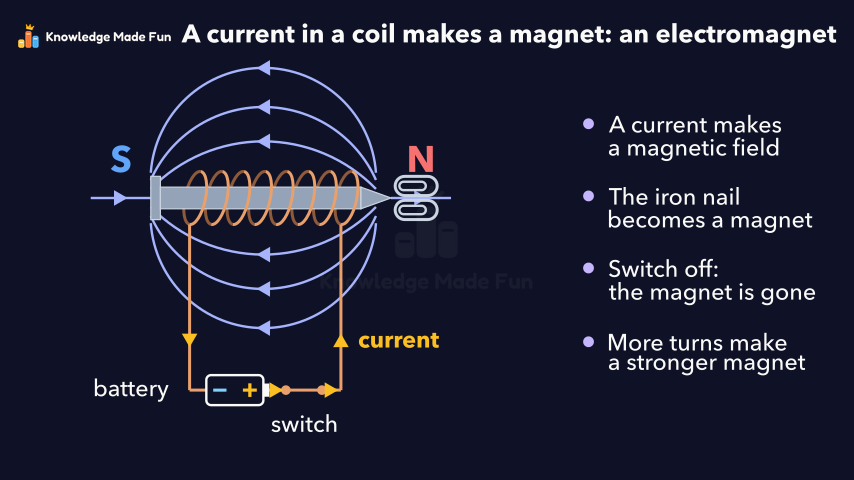
An iron nail is shown not pulling steel clips, then a wire is coiled round it and joined to a battery and a switch. Closing the switch sends a current through the coil, a magnetic field with N and S poles appears and the nail pulls the clips, and opening the switch makes the magnet vanish again, ending on the recap that a current in a coil makes an electromagnet.
Anyone can watch two lessons on the website without an account. Signing in is free, no payment and no card, and opens three a day; Plus has no limit.
Loading
In one sentence
The question this lesson answers
Can an electric current make a magnet? Let us build one and see.
On its own, an iron nail is not a magnet. It does not pull these steel clips.
Transcript
What the lesson says
Can an electric current make a magnet? Let us build one and see.
On its own, an iron nail is not a magnet. It does not pull these steel clips.
Wrap a long wire round the nail many times. This is called a coil.
Join the two ends of the wire to a battery, with a switch in the circuit.
Close the switch. Now an electric current flows through the coil.
Every electric current makes a magnetic field around it. The coil makes a field like a bar magnet.
The field makes the iron nail into a strong magnet, with a north pole and a south pole.
Now it pulls the steel clips, just like any magnet.
A magnet made by an electric current is called an electromagnet.
Open the switch. The current stops, the field is gone, and the nail stops being a magnet.
So an electromagnet can be switched on and off. A bar magnet cannot.
More turns of wire, or a bigger current, make the electromagnet stronger.
So an electric current in a coil round an iron nail makes a magnet. That is an electromagnet.
Curriculum
Where this fits
- British Columbia, Grade 7
Science, Physics: electromagnetismBC7-SC-23
Previous: Magnets and Magnetic FieldsNext: A Moving Magnet Makes a Current
The outcomes and strands follow the British Columbia curriculum.
Keep going
 1 min 51 s
A Complete Circuit: Source, Load, Conductors and Switch
Grade 9 · 1 min 51 s 1 min 12 s
A Moving Magnet Makes a Current
Grade 7 · 1 min 12 s 54 s
A Push or a Pull Makes Things Move
Kindergarten · 54 s 1 min 48 s
AC and DC: Two Ways Current Can Flow
Grade 9 · 1 min 48 s 1 min 3 s
Air Resistance: Why a Flat Sheet Falls Slower
Grade 2 · 1 min 3 s 1 min 40 s
Alpha, Beta and Gamma Radiation
Grade 10 · 1 min 40 s 1 min 6 s
Balanced and Unbalanced Forces in Sport and Play
Grade 6 · 1 min 6 s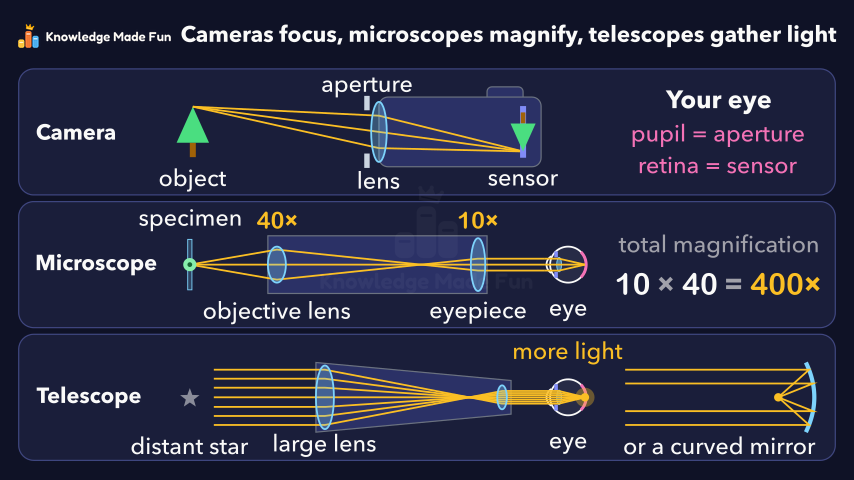 1 min 48 s
Cameras, Microscopes and Telescopes: Tools That Extend Our Sight
Grade 8 · 1 min 48 s
- All Grade 7 Science lessons
- Create a free account to watch three lessons a day, no payment and no card.