Lesson · Grade 8 · Science
Antibiotics kill bacteria, not viruses
- Grade 8
- Science
- 1 min 35 s
- British Columbia
- BC8-SC-17
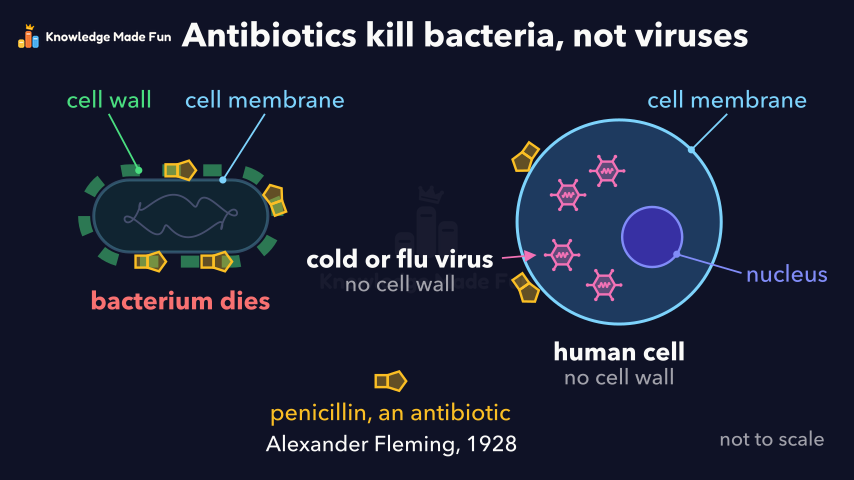
A labelled diagram shows penicillin attacking the cell wall of a bacterium, so the wall weakens, the cell bursts and the bacterium dies, while a human cell, which has no cell wall, is left alone. A virus is not a cell and has no wall, and it copies itself inside our own cells, so the antibiotic has nothing to hit: colds and flu are caused by viruses, and antibiotics cannot cure them.
Concept: Antibiotics work on bacteria, not viruses
Anyone can watch two lessons on the website without an account. Signing in is free, no payment and no card, and opens three a day; Plus has no limit.
Loading
In one sentence
The question this lesson answers
Many people think antibiotics cure a cold. Do they?
An antibiotic is a medicine that kills bacteria or stops them from growing.
Transcript
What the lesson says
Many people think antibiotics cure a cold. Do they?
An antibiotic is a medicine that kills bacteria or stops them from growing.
A bacterium is a tiny living cell. Some bacteria can make us ill.
Like all cells, it has a cell membrane. Most bacteria also have a tough cell wall around it.
Our own cells have a nucleus and a cell membrane, but no cell wall.
One antibiotic, penicillin, was discovered by Alexander Fleming in 1928.
Penicillin attacks something bacteria have and our cells lack: the cell wall.
It stops the bacterium from building its wall, so the wall grows weak, the cell bursts and the bacterium dies.
Our cells have no cell wall, so penicillin has nothing there to attack.
A virus is not a cell, so it has no cell wall. This drawing is not to scale: real viruses are much smaller.
It gets inside one of our cells and makes that cell build copies of the virus.
Penicillin finds no cell wall to attack, and the virus is hidden inside our own cell.
Colds and flu are caused by viruses, so antibiotics cannot cure them.
Antibiotics kill bacteria, but they do not work on viruses, so they cannot cure a cold.
Curriculum
Where this fits
- British Columbia, Grade 8
Science, Biology: the relationship of micro-organisms with living things: vaccination and antibioticsBC8-SC-17
Previous: Community immunity: how vaccination stops a disease spreadingNext: Antibiotic resistance: how superbugs evolve
- British Columbia, Grade 11
Science For Citizens 11, Health: personal and public health practices, including First Peoples traditional health and healing practicesBC11-SC-261
This lesson is also listed in Grade 11.
The outcomes and strands follow the British Columbia curriculum.
Keep going
 1 min 40 s
Acids and bases: the pH scale
Grade 10 · 1 min 40 s 1 min 39 s
Adaptations Are Inherited, Not Earned in a Lifetime
Grade 11 · 1 min 39 s 1 min 48 s
Adaptive radiation: one ancestor, many species
Grade 10 · 1 min 48 s 1 min 39 s
Aerobic and anaerobic organisms
Grade 11 · 1 min 39 s 1 min 37 s
Antibiotic resistance: how superbugs evolve
Grade 8 · 1 min 37 s 1 min 44 s
Antibodies and Memory Cells: The Body's Targeted Defence
Grade 8 · 1 min 44 s 2 min
Are viruses alive? Why scientists disagree
Grade 8 · 2 min 1 min 44 s
Artificial selection: people choose the traits
Grade 10 · 1 min 44 s
- All Grade 8 Science lessons
- Create a free account to watch three lessons a day, no payment and no card.