Lesson · Grade 8 · Science
Community immunity: how vaccination stops a disease spreading
- Grade 8
- Science
- 1 min 40 s
- British Columbia
- BC8-SC-16
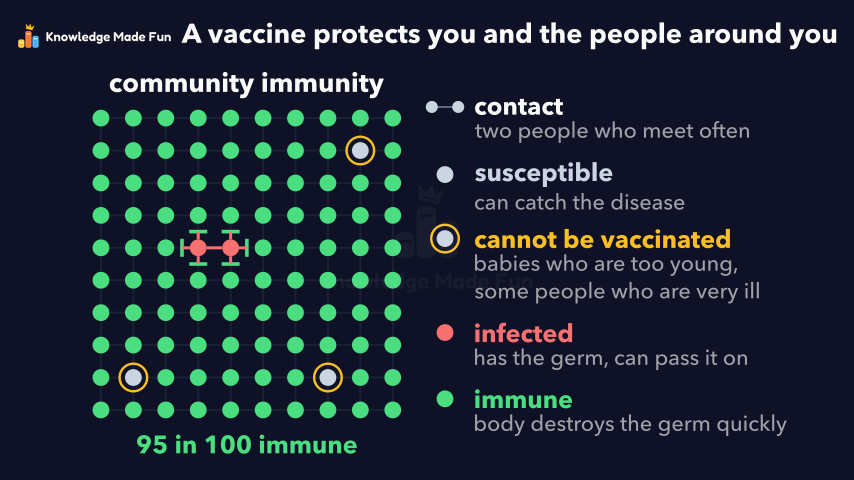
A grid of 100 people joined by contact lines shows a germ passing from one infected person along chains of contacts. First nobody is immune and it reaches everyone. With half the people immune it still finds a chain to someone who cannot be vaccinated. With 95 in 100 immune, the usual figure for measles, it reaches one more person and every chain is broken. The video names this community (herd) immunity and ends on the answer to its opening question: a vaccine protects you and, when enough people are immune, the people around you too.
Concept: Herd immunity: protecting people who cannot be vaccinated
Anyone can watch two lessons on the website without an account. Signing in is free, no payment and no card, and opens three a day; Plus has no limit.
Loading
In one sentence
The question this lesson answers
Does a vaccine protect only the person who gets it?
Each dot is a person. Each line is a contact between two people who meet often.
Transcript
What the lesson says
Does a vaccine protect only the person who gets it?
Each dot is a person. Each line is a contact between two people who meet often.
At first, everyone is susceptible, which means they can catch the disease.
Some people cannot be vaccinated, such as babies who are too young and some people who are very ill.
Now one person is infected. A germ, a micro-organism that causes disease, is in their body, and they can pass it on.
The germ passes from person to person along chains of contacts.
Soon it reaches everyone, even the people who cannot be vaccinated.
Start again, but now half the people get a vaccine. It trains the immune system, the body's defence against germs.
This usually makes them immune: if the germ gets in, the body destroys it quickly, so it is not passed on.
But with only half immune, the germ can still find a chain around them, and reach someone who cannot be vaccinated.
Measles spreads very easily, so about 95 in 100 people need to be immune to stop it spreading.
Now the germ reaches one more person, and then every chain is broken.
The people who cannot be vaccinated are protected.
This is called community immunity, or herd immunity.
So a vaccine protects you, and when enough people are immune, it protects the people around you too.
Curriculum
Where this fits
- British Columbia, Grade 8
Science, Biology: the relationship of micro-organisms with living things: vaccination and antibioticsBC8-SC-16
Previous: How Vaccines Train the Immune SystemNext: Antibiotics kill bacteria, not viruses
- British Columbia, Grade 11
Life Sciences 11, Viruses: virusesBC11-SC-147
Previous: How Vaccines Train the Immune SystemNext: How Viral Diseases Spread and How to Slow Them
- British Columbia, Grade 11
Science For Citizens 11, Health: personal and public health practices, including First Peoples traditional health and healing practicesBC11-SC-257
Previous: How Vaccines Train the Immune SystemNext: Antibiotic resistance: how superbugs evolve
This lesson is also listed in Grade 11.
The outcomes and strands follow the British Columbia curriculum.
Keep going
 2 min
Are viruses alive? Why scientists disagree
Grade 8 · 2 min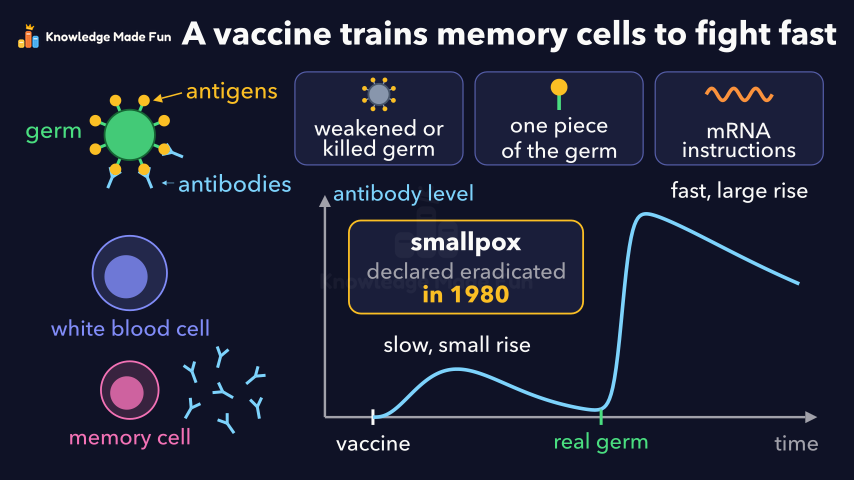 1 min 50 s
How Vaccines Train the Immune System
Grade 8 · 1 min 50 s 1 min 59 s
How Viral Diseases Spread and How to Slow Them
Grade 11 · 1 min 59 s 1 min 49 s
Lytic and lysogenic cycles: how viruses copy themselves
Grade 11 · 1 min 49 s 1 min 40 s
Acids and bases: the pH scale
Grade 10 · 1 min 40 s 1 min 39 s
Adaptations Are Inherited, Not Earned in a Lifetime
Grade 11 · 1 min 39 s 1 min 48 s
Adaptive radiation: one ancestor, many species
Grade 10 · 1 min 48 s 1 min 39 s
Aerobic and anaerobic organisms
Grade 11 · 1 min 39 s
- All Grade 8 Science lessons
- Create a free account to watch three lessons a day, no payment and no card.