Lesson · Grade 11 · Life Sciences
Lytic and lysogenic cycles: how viruses copy themselves
- Grade 11
- Life Sciences
- 1 min 49 s
- British Columbia
- BC11-SC-145
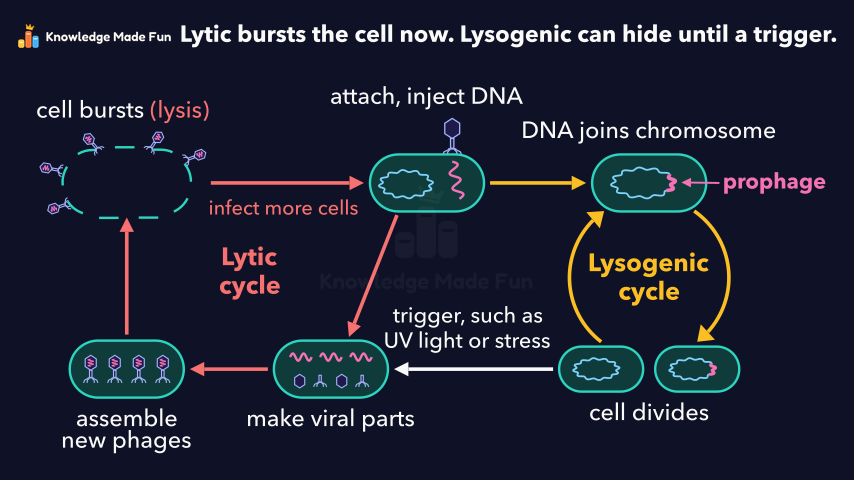
A bacteriophage attaches to a bacterium and injects its DNA. One labelled diagram then builds up two side-by-side loops: in the lytic cycle the cell makes viral parts, new phages assemble and the cell bursts (lysis); in the lysogenic cycle the viral DNA joins the chromosome as a prophage and is copied each time the cell divides. A trigger such as UV light or stress makes the prophage leave the chromosome and switch to the lytic cycle, and the video ends on a one-line recap comparing the two cycles.
Anyone can watch two lessons on the website without an account. Signing in is free, no payment and no card, and opens three a day; Plus has no limit.
Loading
In one sentence
The question this lesson answers
A virus cannot reproduce on its own. So how does it copy itself?
A bacteriophage, or phage, is a virus that infects bacteria. This one has DNA inside a protein coat, and a tail.
Transcript
What the lesson says
A virus cannot reproduce on its own. So how does it copy itself?
A bacteriophage, or phage, is a virus that infects bacteria. This one has DNA inside a protein coat, and a tail.
First, the phage attaches to its host cell, a bacterium.
Second, it injects its DNA into the cell. The empty coat stays outside.
Then the virus takes one of two paths: the lytic cycle or the lysogenic cycle.
In the lytic cycle, the viral DNA takes over, and the cell makes viral DNA and proteins.
These parts assemble into many new phages.
Then a viral enzyme breaks down the cell wall, so the cell bursts and releases the phages.
This bursting is called lysis, which gives the lytic cycle its name. The new phages infect more cells.
In the lysogenic cycle, the viral DNA joins the bacterium's own DNA, its chromosome.
This is now called a prophage. It stays mostly inactive, and the cell lives normally.
Each time the cell divides, it copies its chromosome, so both new cells get the prophage.
This repeats with every division, so many cells carry the prophage.
A trigger, such as ultraviolet light or stress, can make the prophage leave the chromosome.
The virus then switches to the lytic cycle: it makes parts, assembles phages and bursts the cell.
So the lytic cycle bursts the cell right away, while the lysogenic cycle can hide until a trigger.
Curriculum
Where this fits
- British Columbia, Grade 11
Life Sciences 11, Viruses: virusesBC11-SC-145
Previous: Are viruses alive? Why scientists disagreeNext: How Vaccines Train the Immune System
The outcomes and strands follow the British Columbia curriculum.
Keep going
 2 min
Are viruses alive? Why scientists disagree
Grade 8 · 2 min 1 min 40 s
Community immunity: how vaccination stops a disease spreading
Grade 8 · 1 min 40 s 1 min 50 s
How Vaccines Train the Immune System
Grade 8 · 1 min 50 s 1 min 59 s
How Viral Diseases Spread and How to Slow Them
Grade 11 · 1 min 59 s 1 min 40 s
Acids and bases: the pH scale
Grade 10 · 1 min 40 s 1 min 39 s
Adaptations Are Inherited, Not Earned in a Lifetime
Grade 11 · 1 min 39 s 1 min 48 s
Adaptive radiation: one ancestor, many species
Grade 10 · 1 min 48 s 1 min 39 s
Aerobic and anaerobic organisms
Grade 11 · 1 min 39 s
- All Grade 11 Life Sciences lessons
- Create a free account to watch three lessons a day, no payment and no card.