Lesson · Grade 8 · Science
How Vaccines Train the Immune System
- Grade 8
- Science
- 1 min 50 s
- British Columbia
- BC8-SC-15
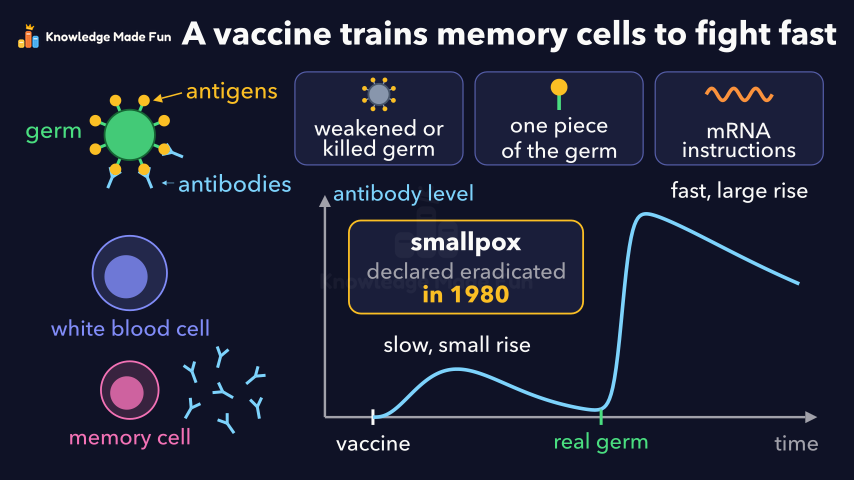
A germ's antigens, the antibodies made by white blood cells, and three common kinds of vaccine (including how mRNA is read outside the nucleus and never changes DNA) build up into one labelled diagram. An antibody graph then shows a slow, small response to the vaccine and a fast, large response from memory cells to the real germ, with smallpox, declared eradicated in 1980, as the real-world result.
Anyone can watch two lessons on the website without an account. Signing in is free, no payment and no card, and opens three a day; Plus has no limit.
Loading
In one sentence
The question this lesson answers
How can a vaccine protect you from a disease you have never had?
Germs are micro-organisms that cause disease. Each kind has its own surface shapes, called antigens.
Transcript
What the lesson says
How can a vaccine protect you from a disease you have never had?
Germs are micro-organisms that cause disease. Each kind has its own surface shapes, called antigens.
Your body's defence against germs, the immune system, uses white blood cells.
Some white blood cells make antibodies, proteins that lock onto the germ's antigens so it can be destroyed.
A vaccine shows your immune system a harmless version of a germ. Common kinds use a weakened or killed germ, one piece of it, or mRNA instructions.
mRNA, or messenger RNA, is a set of instructions: your cells read it and make one piece of the germ.
It never enters the nucleus, where your DNA is kept, so it cannot change your DNA. Your cells soon break it down.
Now follow the level of antibodies in your blood over time.
After the vaccine, antibodies rise slowly and only a little. The vaccine is harmless, so a slow start does not matter.
Some white blood cells become memory cells, which remember the antigens, often for many years.
Later, if the real germ gets in, memory cells recognize its antigens straight away.
Now antibodies come much faster and in far greater numbers, so the germ is usually destroyed before you get ill.
Worldwide vaccination ended smallpox: it was declared eradicated in 1980, so it no longer spreads anywhere.
A vaccine safely trains your immune system, so memory cells can fight the real germ fast.
Curriculum
Where this fits
- British Columbia, Grade 8
Science, Biology: the relationship of micro-organisms with living things: vaccination and antibioticsBC8-SC-15
Previous: Antibodies and Memory Cells: The Body's Targeted DefenceNext: Community immunity: how vaccination stops a disease spreading
- British Columbia, Grade 11
Life Sciences 11, Viruses: virusesBC11-SC-146
Previous: Lytic and lysogenic cycles: how viruses copy themselvesNext: Community immunity: how vaccination stops a disease spreading
- British Columbia, Grade 11
Science For Citizens 11, Health: personal and public health practices, including First Peoples traditional health and healing practicesBC11-SC-256
Next: Community immunity: how vaccination stops a disease spreading
- British Columbia, Grade 12
Anatomy and Physiology 12, Health and disease: lifestyle differences and their effects on human healthBC12-SC-37
This lesson is also listed in Grade 11 and Grade 12.
The outcomes and strands follow the British Columbia curriculum.
Keep going
 2 min
Are viruses alive? Why scientists disagree
Grade 8 · 2 min 1 min 40 s
Community immunity: how vaccination stops a disease spreading
Grade 8 · 1 min 40 s 1 min 59 s
How Viral Diseases Spread and How to Slow Them
Grade 11 · 1 min 59 s 1 min 49 s
Lytic and lysogenic cycles: how viruses copy themselves
Grade 11 · 1 min 49 s 1 min 40 s
Acids and bases: the pH scale
Grade 10 · 1 min 40 s 1 min 39 s
Adaptations Are Inherited, Not Earned in a Lifetime
Grade 11 · 1 min 39 s 1 min 48 s
Adaptive radiation: one ancestor, many species
Grade 10 · 1 min 48 s 1 min 39 s
Aerobic and anaerobic organisms
Grade 11 · 1 min 39 s
- All Grade 8 Science lessons
- Create a free account to watch three lessons a day, no payment and no card.