Lesson · Grade 9 · Science
The Nitrogen Cycle: From Air to Living Things
- Grade 9
- Science
- 1 min 45 s
- British Columbia
- BC9-SC-28
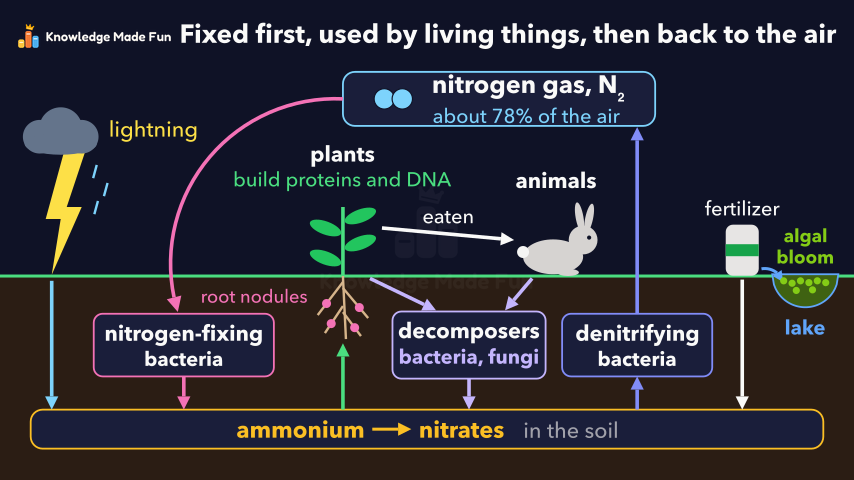
Air is about 78% nitrogen gas, but plants and animals cannot use it directly, so a single labelled diagram shows how nitrogen-fixing bacteria in the soil and in root nodules, and lightning, turn it into ammonium and nitrates. Plants absorb these to build proteins and DNA, animals eat plants, decomposers and denitrifying bacteria send the nitrogen back to the soil and the air, and fertilizer that washes into a lake feeds an algal bloom.
Concept: The nitrogen cycle: how bacteria make nitrogen usable
Anyone can watch two lessons on the website without an account. Signing in is free, no payment and no card, and opens three a day; Plus has no limit.
Loading
In one sentence
The question this lesson answers
Living things need nitrogen. How does it get from the air into plants and animals?
Air is about 78 percent nitrogen gas, made of pairs of tightly bonded nitrogen atoms.
Transcript
What the lesson says
Living things need nitrogen. How does it get from the air into plants and animals?
Air is about 78 percent nitrogen gas, made of pairs of tightly bonded nitrogen atoms.
But plants and animals cannot use nitrogen gas directly: they cannot break that strong bond.
Nitrogen fixation turns nitrogen gas into compounds that living things can use.
Nitrogen-fixing bacteria do most of it, in the soil and in root nodules: swellings on the roots of peas, beans and clover.
Lightning fixes some too, making nitrates that rain carries into the soil.
Bacteria fix it as ammonium, and other soil bacteria change much of that into nitrates.
Plants absorb ammonium and nitrates through their roots and use them to build proteins and DNA.
Animals get their nitrogen from food, by eating plants or other animals.
When living things die or leave waste, decomposers such as bacteria and fungi break it down, returning ammonium to the soil.
Denitrifying bacteria turn nitrates back into nitrogen gas, which returns to the air.
So nitrogen cycles between the air, the soil and living things. This is the nitrogen cycle.
People also add nitrogen to fields as fertilizer.
Rain can wash extra fertilizer into lakes, where it feeds algal blooms: sudden, thick growths of algae.
Nitrogen gas must be fixed first, then it is used by living things and returned to the air.
Curriculum
Where this fits
- British Columbia, Grade 9
Science, Earth science: matter cycles within biotic and abiotic components of ecosystemsBC9-SC-28
Previous: The Carbon Cycle: Sources and SinksNext: The Phosphorus Cycle: From Rock to Life and Back
- British Columbia, Grade 11
Environmental Science 11, Energy and matter cycles: matter cycles through and between living systemsBC11-SC-118
Previous: The Carbon Cycle: Sources and SinksNext: The Phosphorus Cycle: From Rock to Life and Back
This lesson is also listed in Grade 11.
The outcomes and strands follow the British Columbia curriculum.
Keep going
 1 min 47 s
The Phosphorus Cycle: From Rock to Life and Back
Grade 9 · 1 min 47 s 1 min 51 s
A Complete Circuit: Source, Load, Conductors and Switch
Grade 9 · 1 min 51 s 1 min 48 s
AC and DC: Two Ways Current Can Flow
Grade 9 · 1 min 48 s 1 min 40 s
Acids and bases: the pH scale
Grade 10 · 1 min 40 s 1 min 39 s
Adaptations Are Inherited, Not Earned in a Lifetime
Grade 11 · 1 min 39 s 1 min 48 s
Adaptive radiation: one ancestor, many species
Grade 10 · 1 min 48 s 1 min 39 s
Aerobic and anaerobic organisms
Grade 11 · 1 min 39 s 1 min 37 s
Antibiotic resistance: how superbugs evolve
Grade 8 · 1 min 37 s
- All Grade 9 Science lessons
- Create a free account to watch three lessons a day, no payment and no card.