Lesson · Grade 11 · Life Sciences
Evolution as Changing Allele Frequencies
- Grade 11
- Life Sciences
- 2 min
- British Columbia
- BC11-SC-154
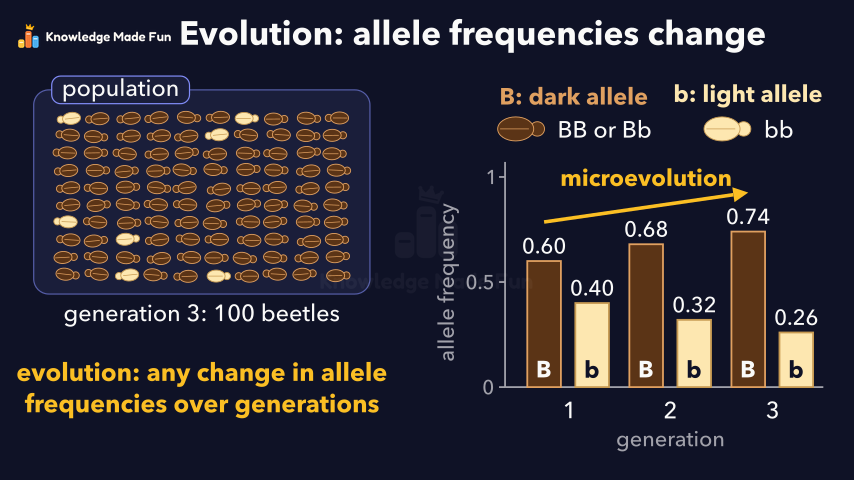
A population of 100 beetles has a gene pool of 200 colour alleles, 120 B and 80 b, which gives allele frequencies of 0.60 and 0.40, shown on a bar chart. As birds eat most of the light beetles, B rises to 0.68 and then 0.74 over three generations, which shows that evolution is any change in a population's allele frequencies over generations, called microevolution at this small scale.
Concept: Population genetics: evolution as changing allele frequencies
Anyone can watch two lessons on the website without an account. Signing in is free, no payment and no card, and opens three a day; Plus has no limit.
Loading
In one sentence
The question this lesson answers
When a population of beetles evolves, what exactly is changing?
Here are 100 beetles. They form a population: one species living in one place.
Transcript
What the lesson says
When a population of beetles evolves, what exactly is changing?
Here are 100 beetles. They form a population: one species living in one place.
Body colour is set by one gene. Its versions, called alleles, differ slightly in their DNA: big B for dark, small b for light.
Each beetle has two of these alleles. Big B is dominant, so one copy makes a beetle dark. Only two small b alleles make it light.
The gene pool is all the alleles in a population. 100 beetles with two each carry 200 colour alleles.
Of these 200 alleles, 120 are big B and 80 are small b.
An allele's frequency is its share of the gene pool. For big B, 120 divided by 200 is 0.60. For small b, 80 divided by 200 is 0.40.
A bar chart shows these two frequencies for generation 1.
Now birds spot light beetles more easily and eat most of them, so fewer small b alleles are passed on.
In generation 2, big B rises to 0.68 and small b falls to 0.32.
The birds keep hunting, so in generation 3, big B rises to 0.74 and small b falls to 0.26.
This is evolution: any change in a population's allele frequencies over generations, whatever the cause.
Each allele is a stretch of DNA, so this is a small change in the population's DNA, called microevolution.
So, evolution is any change in a population's allele frequencies over generations.
Curriculum
Where this fits
- British Columbia, Grade 11
Life Sciences 11, Evolution and genetics: microevolution: changes in DNABC11-SC-154
Previous: Mutations: DNA Changes That Help, Harm or Do NothingNext: Three patterns of natural selection
The outcomes and strands follow the British Columbia curriculum.
Keep going
 1 min 39 s
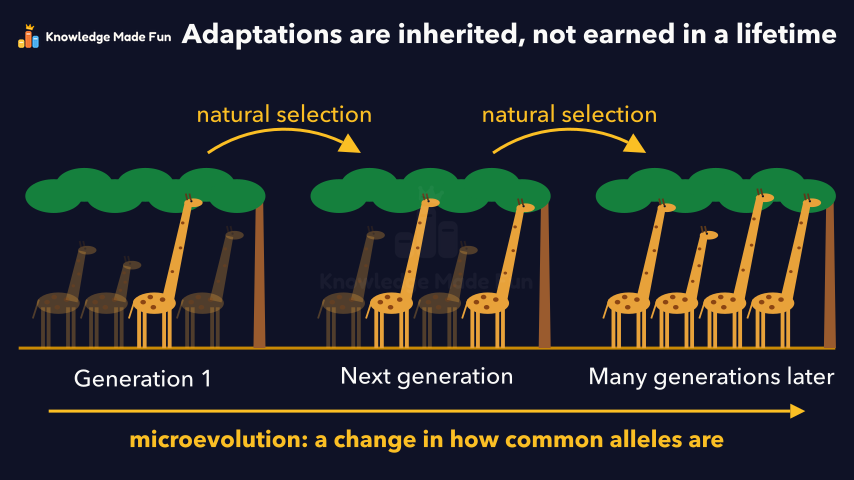
Adaptations Are Inherited, Not Earned in a Lifetime
Grade 11 · 1 min 39 s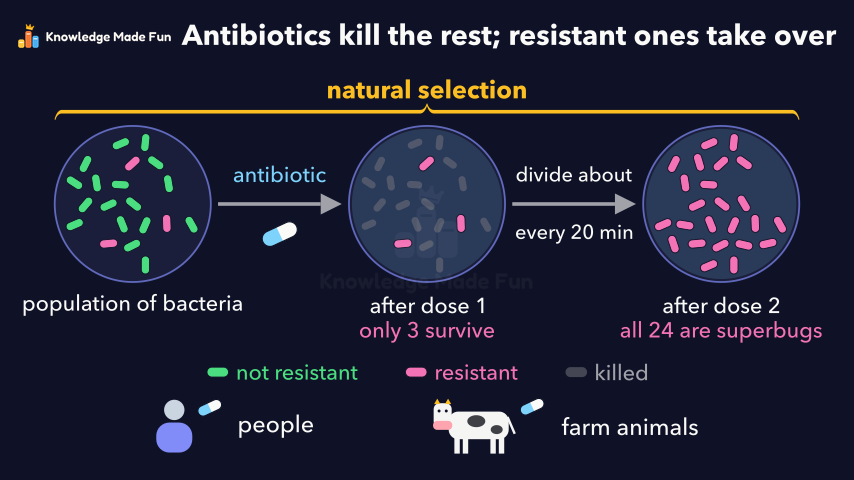 1 min 37 s
Antibiotic resistance: how superbugs evolve
Grade 8 · 1 min 37 s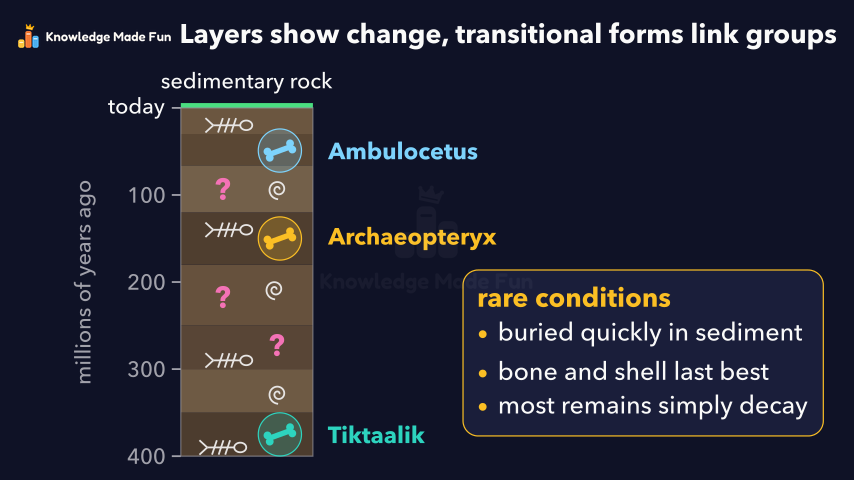 1 min 54 s
Fossils and Transitional Forms: Evidence for Macroevolution
Grade 11 · 1 min 54 s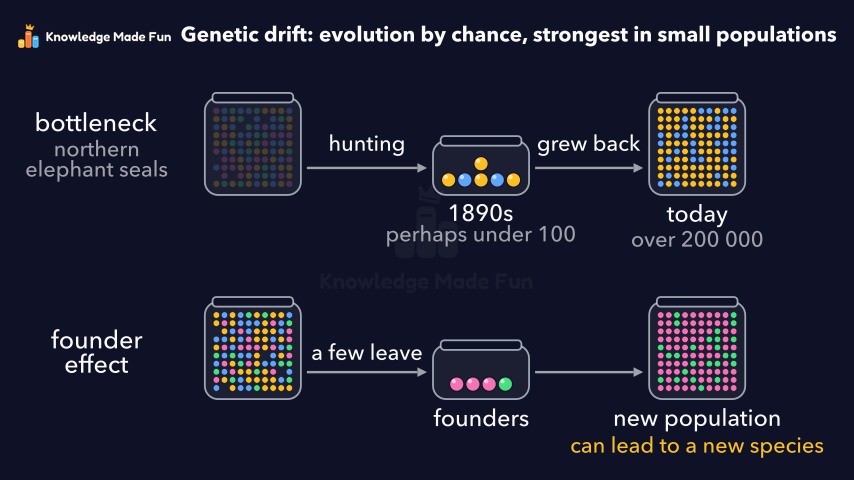 1 min 55 s
Genetic Drift: Evolution by Chance
Grade 11 · 1 min 55 s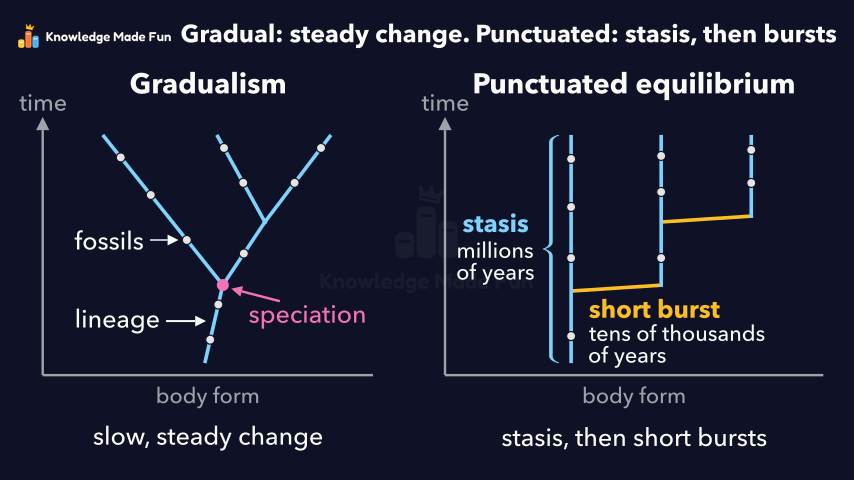 1 min 58 s
Gradualism and Punctuated Equilibrium
Grade 11 · 1 min 58 s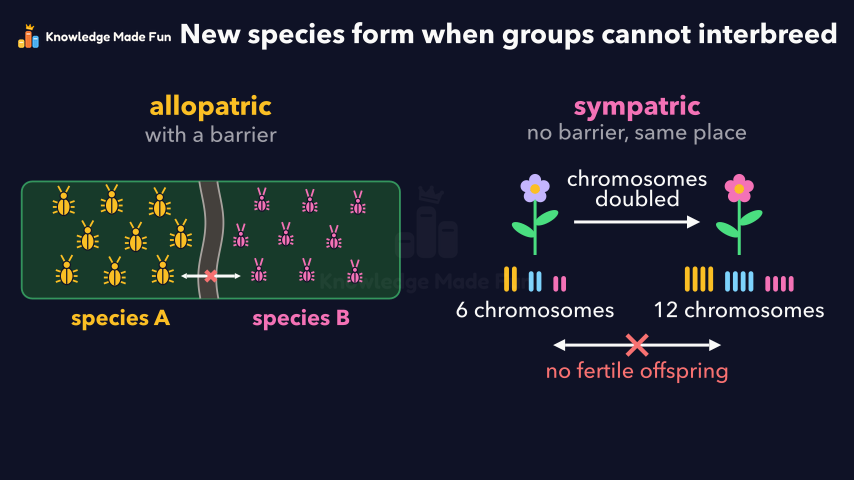 1 min 50 s
How New Species Form: Isolation and Speciation
Grade 11 · 1 min 50 s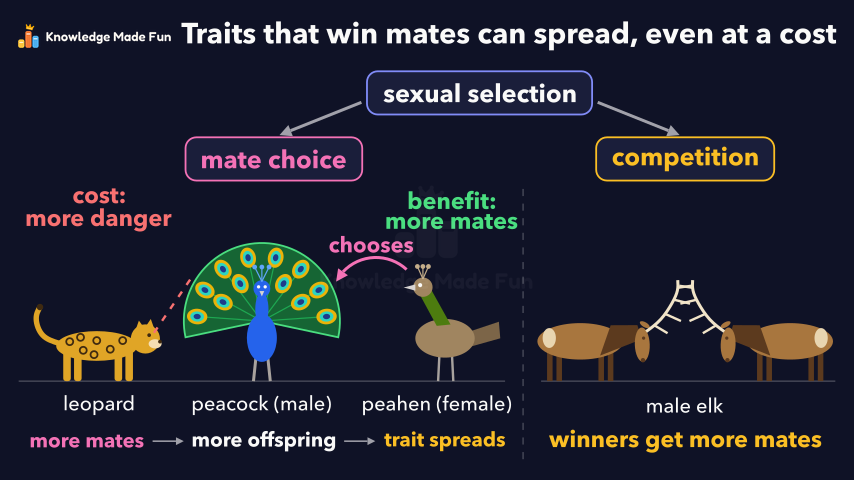 1 min 19 s
Sexual Selection: Traits That Win Mates
Grade 11 · 1 min 19 s 1 min 56 s
Three patterns of natural selection
Grade 11 · 1 min 56 s
- All Grade 11 Life Sciences lessons
- Create a free account to watch three lessons a day, no payment and no card.