Lesson · Grade 11 · Life Sciences
Genetic Drift: Evolution by Chance
- Grade 11
- Life Sciences
- 1 min 55 s
- British Columbia
- BC11-SC-158
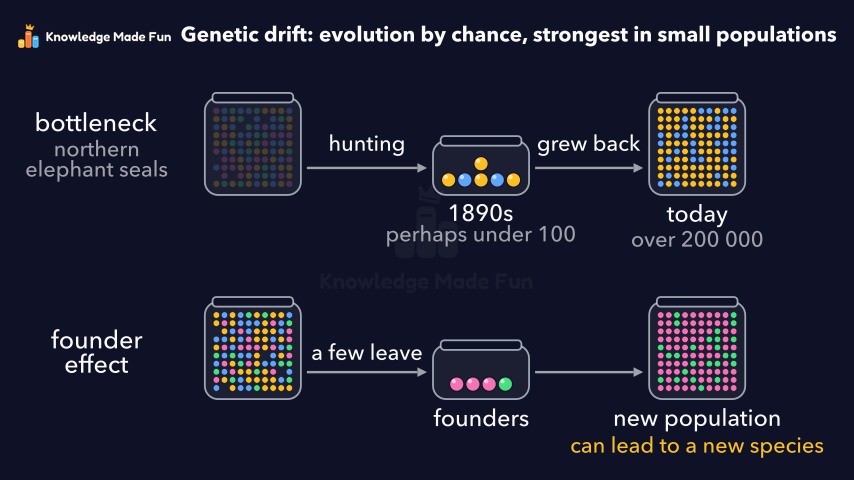
Marbles drawn at random from a small jar and a large jar show how luck changes allele frequencies: the small population swings until one allele is fixed, while the large one stays near half. The same jars then show a bottleneck, using northern elephant seals cut to perhaps fewer than 100 in the 1890s and now over 200 000 with very little genetic variety, and the founder effect, which can lead to a new species.
Anyone can watch two lessons on the website without an account. Signing in is free, no payment and no card, and opens three a day; Plus has no limit.
Loading
In one sentence
The question this lesson answers
Can a population evolve by pure luck?
A small population is a jar of 10 marbles, each one copy of a gene.
Transcript
What the lesson says
Can a population evolve by pure luck?
A small population is a jar of 10 marbles, each one copy of a gene.
Each colour is an allele, one version of the gene: amber or blue.
Amber is 5 of the 10 copies. That share, 50 percent, is its allele frequency.
Each generation gets a random sample of these alleles, like marbles drawn from a jar.
By luck, amber rose to 70 percent. This change by chance is called genetic drift.
Keep drawing, and amber drifts to 50 percent, then 80, then 100 percent.
Blue is lost, and amber is fixed: it is the only allele left.
Now take a large population of 100 copies, half amber. It stays near half: 48 percent, then 53, then 51, then 49.
In a large sample, luck evens out, so drift is strongest in small populations.
A bottleneck is a sudden, sharp drop in population size. Here the gene has four alleles.
Hunting cut northern elephant seals to perhaps fewer than 100 by the 1890s, so only some alleles survived.
They grew back to over 200,000 today, but with very little genetic variety.
In the founder effect, a few leave to start a new population, with a chance sample of alleles.
If it stays isolated, drift adds to its differences, which can lead to a new species.
Genetic drift is evolution by chance, and it is strongest in small populations.
Curriculum
Where this fits
- British Columbia, Grade 11
Life Sciences 11, Evolution and genetics: macroevolution: speciationBC11-SC-158
Previous: Gradualism and Punctuated EquilibriumNext: Sexual Selection: Traits That Win Mates
The outcomes and strands follow the British Columbia curriculum.
Keep going
 1 min 39 s
Adaptations Are Inherited, Not Earned in a Lifetime
Grade 11 · 1 min 39 s 1 min 37 s
Antibiotic resistance: how superbugs evolve
Grade 8 · 1 min 37 s 2 min
Evolution as Changing Allele Frequencies
Grade 11 · 2 min 1 min 54 s
Fossils and Transitional Forms: Evidence for Macroevolution
Grade 11 · 1 min 54 s 1 min 58 s
Gradualism and Punctuated Equilibrium
Grade 11 · 1 min 58 s 1 min 50 s
How New Species Form: Isolation and Speciation
Grade 11 · 1 min 50 s 1 min 19 s
Sexual Selection: Traits That Win Mates
Grade 11 · 1 min 19 s 1 min 56 s
Three patterns of natural selection
Grade 11 · 1 min 56 s
- All Grade 11 Life Sciences lessons
- Create a free account to watch three lessons a day, no payment and no card.