Lesson · Grade 10 · Science
Gene expression: from DNA to protein
- Grade 10
- Science
- 1 min 59 s
- British Columbia
- BC10-SC-03
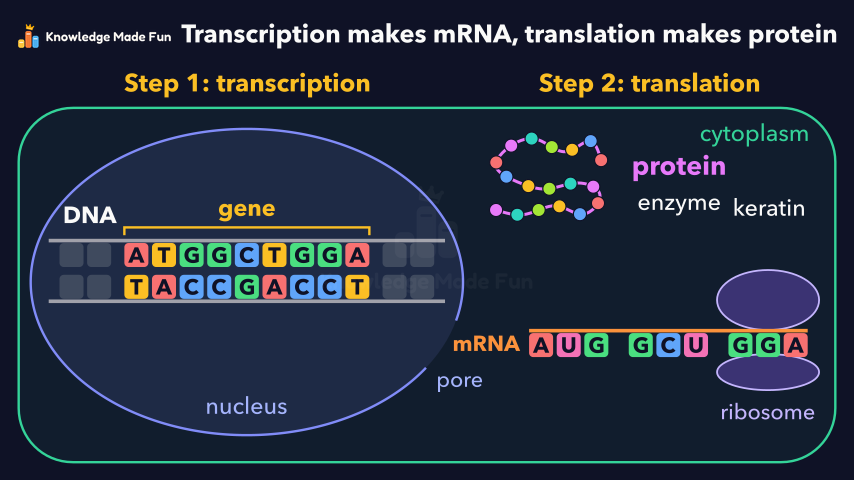
One labelled cell diagram builds up step by step: in the nucleus a short gene (ATG GCT GGA) splits into its two strands, and RNA bases pair with the template strand to make mRNA (AUG GCU GGA), with uracil in place of thymine; the mRNA then leaves through a pore to a ribosome, which reads it one codon at a time, adding methionine, alanine and glycine, and the chain folds into a protein such as an enzyme or keratin. A short table then shows that a muscle cell and a nerve cell carry the same genes but switch on different ones, and the video ends on the recap that transcription makes mRNA and translation makes protein.
Anyone can watch two lessons on the website without an account. Signing in is free, no payment and no card, and opens three a day; Plus has no limit.
Loading
In one sentence
The question this lesson answers
How does the code in a gene become a protein?
In our cells, most DNA is kept in the nucleus, but proteins are made in the cytoplasm.
Transcript
What the lesson says
How does the code in a gene become a protein?
In our cells, most DNA is kept in the nucleus, but proteins are made in the cytoplasm.
A gene is a section of DNA that codes for one protein.
Its code is the order of four bases. Across the strands, A pairs with T, and C with G.
Step one is transcription. The gene's two strands separate, and one acts as a template.
RNA bases pair with it, but RNA has uracil, U, instead of thymine, T, so U pairs with A.
They join into a single strand of messenger RNA, or mRNA, a copy of the gene's code.
The mRNA leaves the nucleus through a small hole called a pore.
Step two, translation, happens at a ribosome, which builds proteins from units called amino acids.
The ribosome reads three bases at a time. Each group of three is a codon.
The first codon, A U G, adds the amino acid methionine.
Then G C U adds alanine, and G G A adds glycine, building a chain.
A real chain usually has hundreds of amino acids. Once finished, it folds into a protein.
It could be an enzyme, which speeds up reactions, or keratin, in hair and nails.
Nearly all your cells have the same genes, but each type switches on only some of them.
That is why a muscle cell is so different from a nerve cell.
Transcription copies a gene into mRNA, then translation reads it, codon by codon, to build a protein.
Curriculum
Where this fits
- British Columbia, Grade 10
Science 10, Biology: DNA structure and functionBC10-SC-03
Previous: Genes and Chromosomes: How DNA Is PackagedNext: Genes and Environment: Traits Come from Both
The outcomes and strands follow the British Columbia curriculum.
Keep going
 1 min 3 s
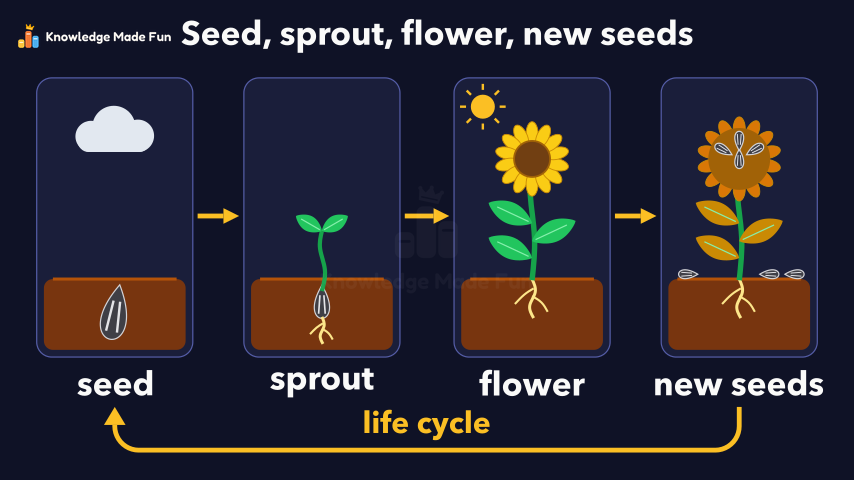
A Sunflower's Life Cycle: Seed, Sprout, Flower, Seed
Kindergarten · 1 min 3 s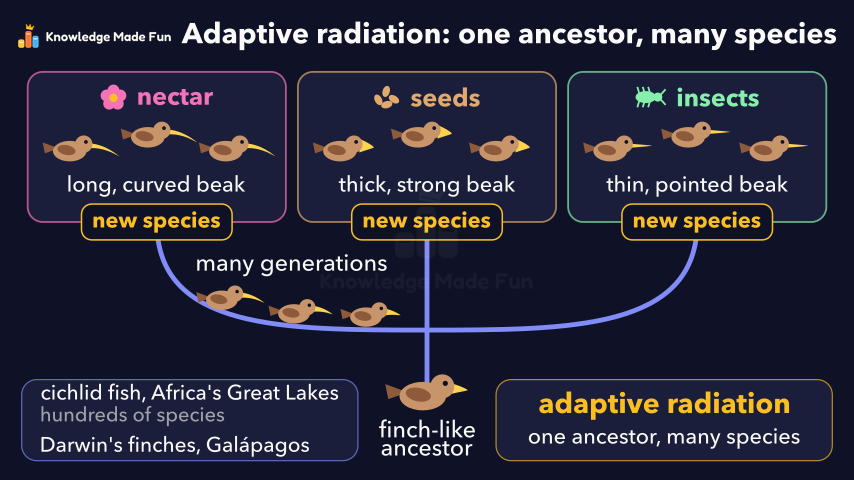 1 min 48 s
Adaptive radiation: one ancestor, many species
Grade 10 · 1 min 48 s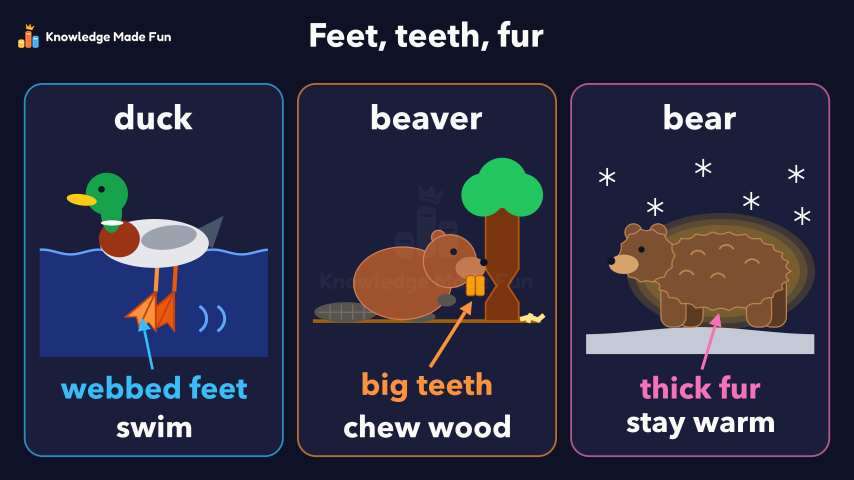 52 s
Animal Bodies That Help Them Live: Feet, Teeth and Fur
Kindergarten · 52 s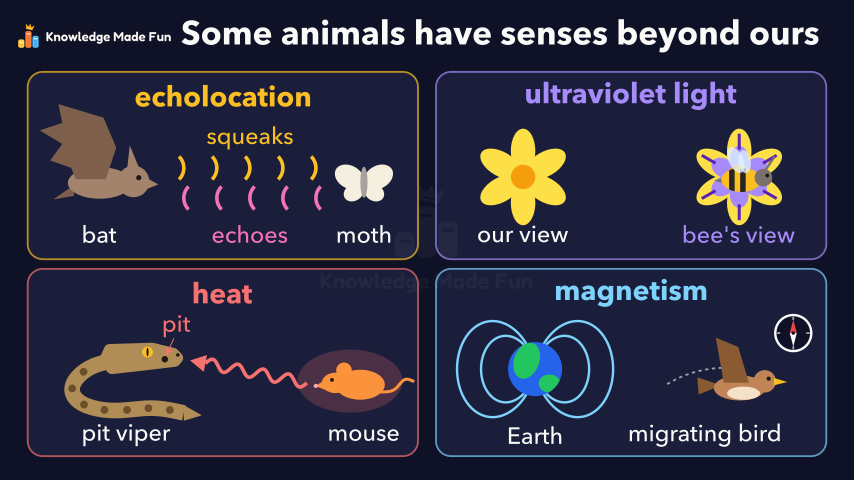 1 min 3 s
Animal senses beyond ours: echolocation, ultraviolet light, heat and magnetism
Grade 4 · 1 min 3 s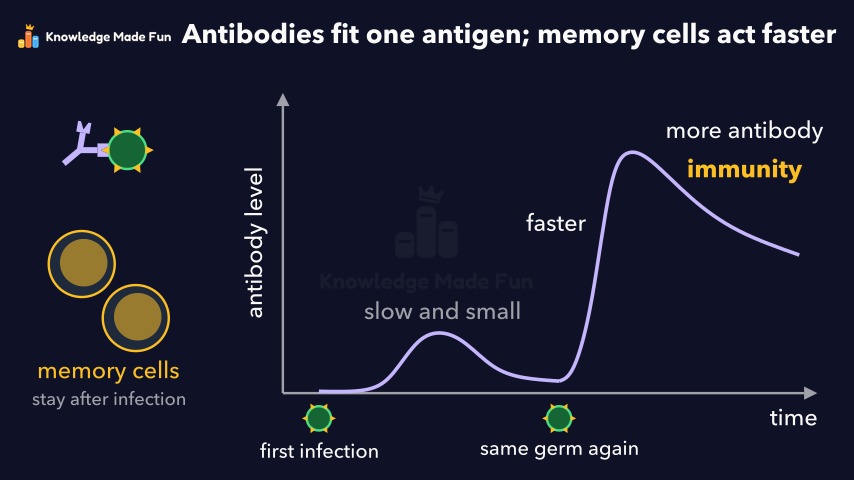 1 min 44 s
Antibodies and Memory Cells: The Body's Targeted Defence
Grade 8 · 1 min 44 s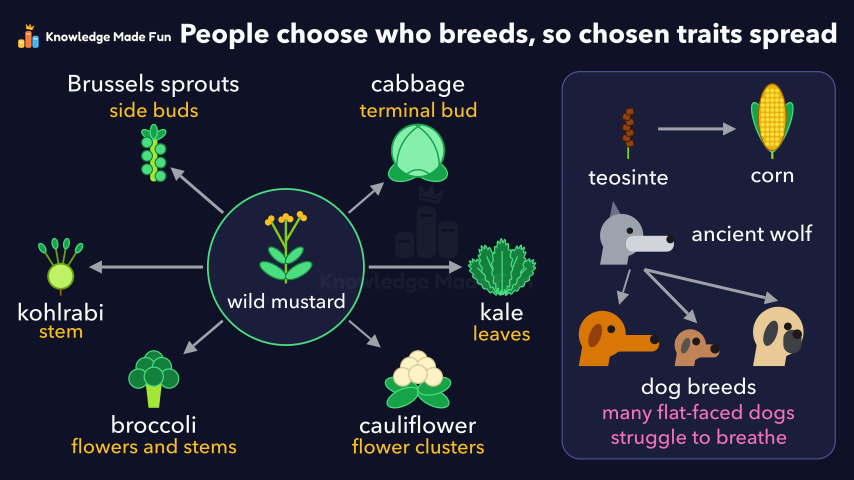 1 min 44 s
Artificial selection: people choose the traits
Grade 10 · 1 min 44 s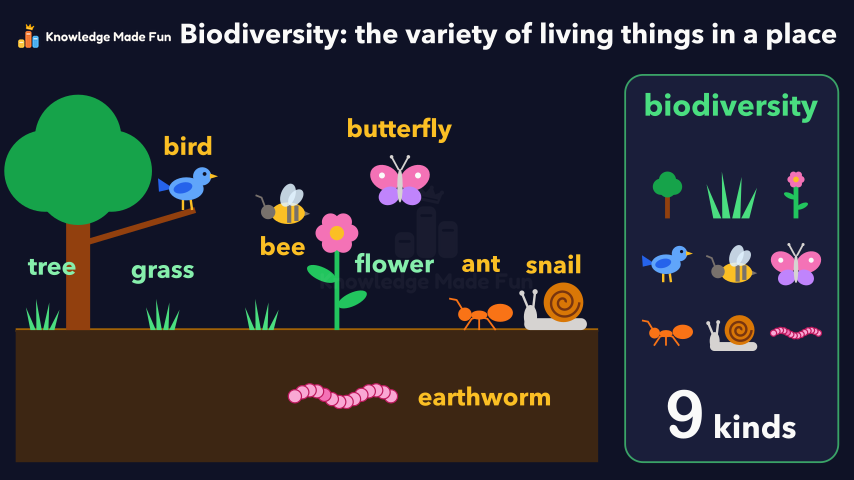 1 min 4 s
Biodiversity: The Variety of Living Things
Grade 3 · 1 min 4 s 1 min 8 s
Biomes: Sorted by Temperature and Precipitation
Grade 4 · 1 min 8 s
- All Grade 10 Science lessons
- Create a free account to watch three lessons a day, no payment and no card.