Lesson · Grade 8 · Science
Epidemics and pandemics: how far a disease spreads
- Grade 8
- Science
- 1 min 49 s
- British Columbia
- BC8-SC-19
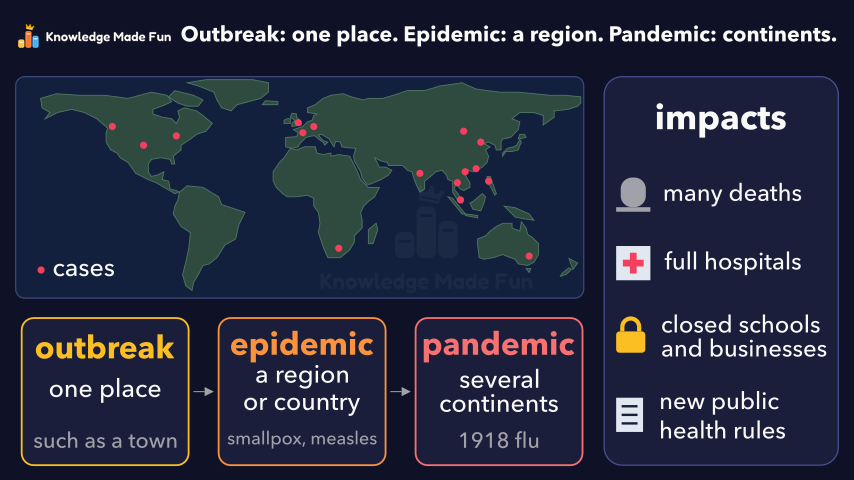
A world map builds up step by step: red dots for cases start in one place (an outbreak), spread across a region (an epidemic, such as smallpox or measles) and travel to other continents (a pandemic), while the three terms fill a labelled row under the map. A side panel explains pathogens, then shows the 1918 flu (about 1 in 3 people infected, at least 50 million deaths, and no evidence it began in Spain), SARS in 2003 (29 countries, about 8,000 cases, stopped by isolating sick people) and the impacts on populations, before a one-line recap.
Anyone can watch two lessons on the website without an account. Signing in is free, no payment and no card, and opens three a day; Plus has no limit.
Loading
In one sentence
The question this lesson answers
How far can a disease spread, and how does it affect people?
Infectious diseases are caused by pathogens, germs such as bacteria and viruses, that pass from person to person.
Transcript
What the lesson says
How far can a disease spread, and how does it affect people?
Infectious diseases are caused by pathogens, germs such as bacteria and viruses, that pass from person to person.
On the map, each red dot marks cases: people who have caught the disease.
When more people than usual catch a disease in one place, such as a town, it is called an outbreak.
If it spreads to many people across a whole region or country, it is called an epidemic.
Smallpox and measles have caused many deadly epidemics.
When infected people travel, they can carry the pathogen to other continents.
A disease that spreads across several continents is called a pandemic.
In 1918, a flu pandemic infected about one in three people in the world.
It killed at least 50 million people.
Its nickname, Spanish flu, is misleading: there is no evidence it began in Spain, and where it began is still unknown.
In 2003, a disease called SARS reached 29 countries, but there were only about 8,000 cases.
Quick action, such as isolating sick people to keep them away from others, stopped it spreading further.
Epidemics and pandemics can cause many deaths, full hospitals, closed schools and businesses, and new public health rules.
An outbreak is in one place, an epidemic covers a region, and a pandemic spreads across several continents.
Curriculum
Where this fits
- British Columbia, Grade 8
Science, Biology: the relationship of micro-organisms with living things: impacts of epidemics and pandemics on human populationsBC8-SC-19
Previous: Antibiotic resistance: how superbugs evolveNext: How one case becomes thousands: the reproduction number
The outcomes and strands follow the British Columbia curriculum.
Keep going
 1 min 3 s
A Sunflower's Life Cycle: Seed, Sprout, Flower, Seed
Kindergarten · 1 min 3 s 1 min 48 s
Adaptive radiation: one ancestor, many species
Grade 10 · 1 min 48 s 52 s
Animal Bodies That Help Them Live: Feet, Teeth and Fur
Kindergarten · 52 s 1 min 3 s
Animal senses beyond ours: echolocation, ultraviolet light, heat and magnetism
Grade 4 · 1 min 3 s 1 min 44 s
Antibodies and Memory Cells: The Body's Targeted Defence
Grade 8 · 1 min 44 s 1 min 44 s
Artificial selection: people choose the traits
Grade 10 · 1 min 44 s 1 min 4 s
Biodiversity: The Variety of Living Things
Grade 3 · 1 min 4 s 1 min 8 s
Biomes: Sorted by Temperature and Precipitation
Grade 4 · 1 min 8 s
- All Grade 8 Science lessons
- Create a free account to watch three lessons a day, no payment and no card.