Lesson · Grade 9 · Science
Covalent bonds: when atoms share electrons
- Grade 9
- Science
- 1 min 55 s
- British Columbia
- BC9-SC-15
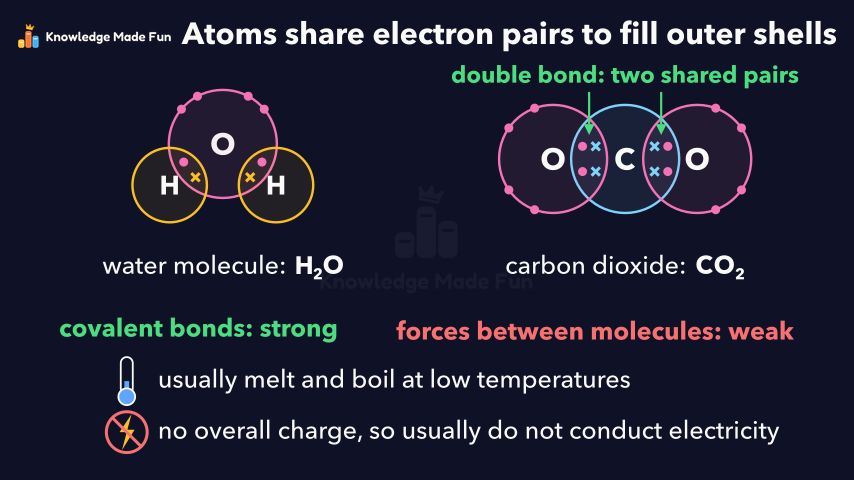
One dot and cross diagram builds up step by step. Oxygen's outer shell needs two more electrons, so it shares one pair with each hydrogen to make water, and carbon shares two pairs (a double bond) with each oxygen to make carbon dioxide, so every outer shell ends up full. The video then shows that a molecule can be made of one element (O2), lists the seven diatomic elements, and explains that substances made of small molecules usually melt and boil at low temperatures and do not conduct electricity, before a one-line recap.
Anyone can watch two lessons on the website without an account. Signing in is free, no payment and no card, and opens three a day; Plus has no limit.
Loading
In one sentence
The question this lesson answers
Water is made of two non-metals, oxygen and hydrogen. How do their atoms join?
An oxygen atom has two electrons in its inner shell and six in its outer shell.
Transcript
What the lesson says
Water is made of two non-metals, oxygen and hydrogen. How do their atoms join?
An oxygen atom has two electrons in its inner shell and six in its outer shell.
Only the outer shell takes part in bonding. It is full with eight, so oxygen needs two more.
A hydrogen atom has one electron. Its shell is full with two, so it needs one more.
Each hydrogen shares its electron with oxygen, and oxygen shares one back.
A shared pair of electrons is called a covalent bond.
Now oxygen has eight outer electrons and each hydrogen has two, so every shell is full.
Atoms joined by covalent bonds form a molecule. This is a water molecule, H2O.
In carbon dioxide, carbon has four outer electrons, so it needs four more.
Carbon shares two pairs with each oxygen. Two shared pairs make a double bond.
Now all three atoms have eight outer electrons. This is carbon dioxide, CO2.
A molecule does not need two different elements: in O2, two oxygen atoms share two pairs.
Seven elements are diatomic, made of two-atom molecules: hydrogen, nitrogen, oxygen, fluorine, chlorine, bromine and iodine.
Covalent bonds are strong, but forces between molecules are weak, so these substances usually melt and boil at low temperatures.
Their molecules have no overall charge, so they usually do not conduct electricity.
Non-metal atoms share pairs of electrons to fill their outer shells, forming molecules.
Curriculum
Where this fits
- British Columbia, Grade 9
Science, Chemistry: The arrangement of electrons determines the compounds formed by elementsBC9-SC-15
Previous: Ionic bonds: when atoms give and take electronsNext: Naming Compounds and Writing Their Formulas
The outcomes and strands follow the British Columbia curriculum.
Keep going
 1 min 40 s
Acids and bases: the pH scale
Grade 10 · 1 min 40 s 1 min 39 s
Activation energy: the push a reaction needs to start
Grade 10 · 1 min 39 s 1 min 54 s
Atomic Size: Bigger Down a Group, Smaller Across a Period
Grade 9 · 1 min 54 s 1 min 18 s
Atoms rearrange: vinegar and baking soda
Grade 7 · 1 min 18 s 1 min 16 s
Atoms: What Everything Is Made Of
Grade 7 · 1 min 16 s 2 min 3 s
Balancing Chemical Equations
Grade 10 · 2 min 3 s 1 min 54 s
Bohr Diagrams: Electrons in Shells and Valence Electrons
Grade 9 · 1 min 54 s 1 min 45 s
Brownian motion: evidence that molecules exist
Grade 8 · 1 min 45 s
- All Grade 9 Science lessons
- Create a free account to watch three lessons a day, no payment and no card.