Lesson · Grade 9 · Science
Naming Compounds and Writing Their Formulas
- Grade 9
- Science
- 2 min 5 s
- British Columbia
- BC9-SC-16
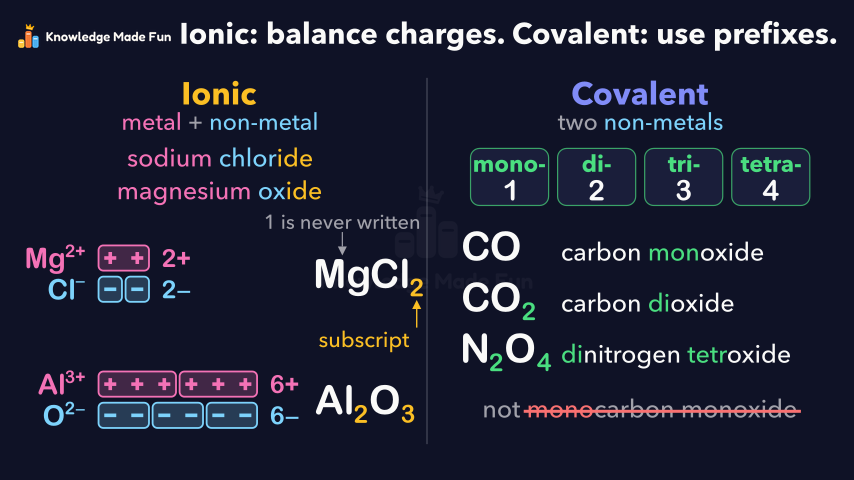
A two-column chart builds up step by step: the ionic side names sodium chloride and magnesium oxide (metal first, non-metal ending in -ide), then balances the charges with + and − tiles, crossing out a "one of each" MgCl before correcting it to MgCl₂ (with the subscript labelled) and then writing Al₂O₃. The covalent side shows the mono-, di-, tri- and tetra- prefixes on cards and uses them to name CO, CO₂ and N₂O₄, crosses out "monocarbon monoxide", and ends on a one-line recap.
Anyone can watch two lessons on the website without an account. Signing in is free, no payment and no card, and opens three a day; Plus has no limit.
Loading
In one sentence
The question this lesson answers
How do we name a compound and write its formula?
First, is the compound ionic or covalent?
Transcript
What the lesson says
How do we name a compound and write its formula?
First, is the compound ionic or covalent?
In an ionic compound, a metal gives electrons to a non-metal, and both become ions: charged atoms.
Name the metal first, then the non-metal ending in ide: sodium and chlorine make sodium chloride.
Magnesium and oxygen make magnesium oxide.
Magnesium loses two electrons to become two plus. Chlorine gains one to become one minus.
Writing one of each is a common mistake: two plus and one minus do not cancel.
A compound has no overall charge, so one magnesium ion needs two chloride ions: M g C l 2.
The small 2 is a subscript: it counts the ions. A 1 is never written.
Aluminum loses three electrons to become three plus. Oxygen gains two to become two minus.
Two aluminum ions make six plus and three oxide ions make six minus, so aluminum oxide is A l 2 O 3.
In a covalent compound, two non-metals share electrons, so no charges need balancing.
Prefixes count the atoms: mono is one, di is two, tri is three, tetra is four.
C O has one carbon and one oxygen: carbon monoxide.
C O 2 has two oxygens: carbon dioxide.
N 2 O 4 has two nitrogens and four oxygens: dinitrogen tetroxide.
Mono is never used on the first element: not monocarbon monoxide.
For a metal and a non-metal, balance the charges; for two non-metals, use prefixes to count the atoms.
Curriculum
Where this fits
The outcomes and strands follow the British Columbia curriculum.
Keep going
 1 min 40 s
Acids and bases: the pH scale
Grade 10 · 1 min 40 s 1 min 39 s
Activation energy: the push a reaction needs to start
Grade 10 · 1 min 39 s 1 min 54 s
Atomic Size: Bigger Down a Group, Smaller Across a Period
Grade 9 · 1 min 54 s 1 min 18 s
Atoms rearrange: vinegar and baking soda
Grade 7 · 1 min 18 s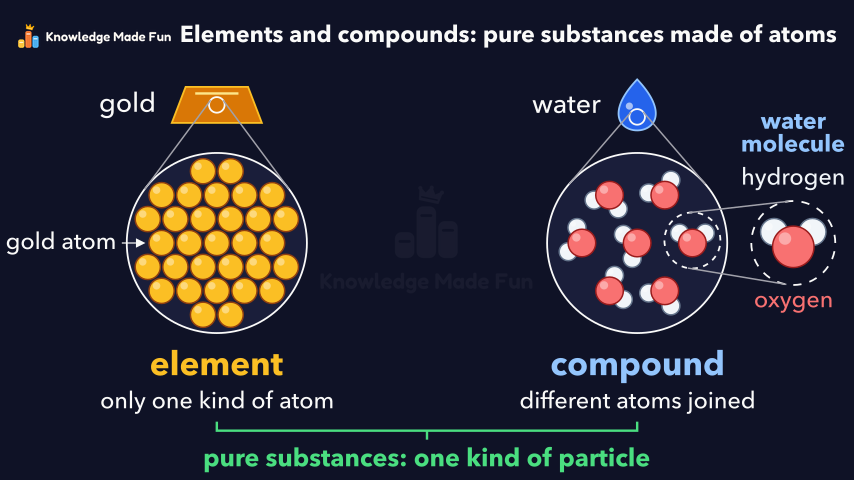 1 min 16 s
Atoms: What Everything Is Made Of
Grade 7 · 1 min 16 s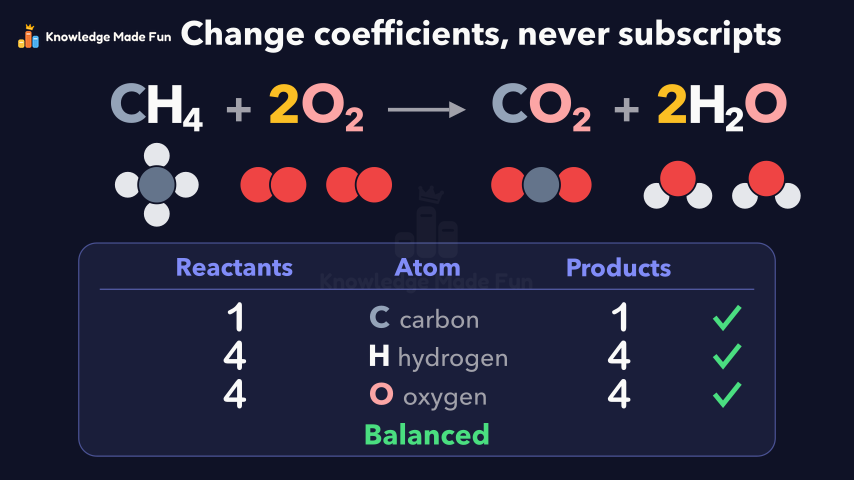 2 min 3 s
Balancing Chemical Equations
Grade 10 · 2 min 3 s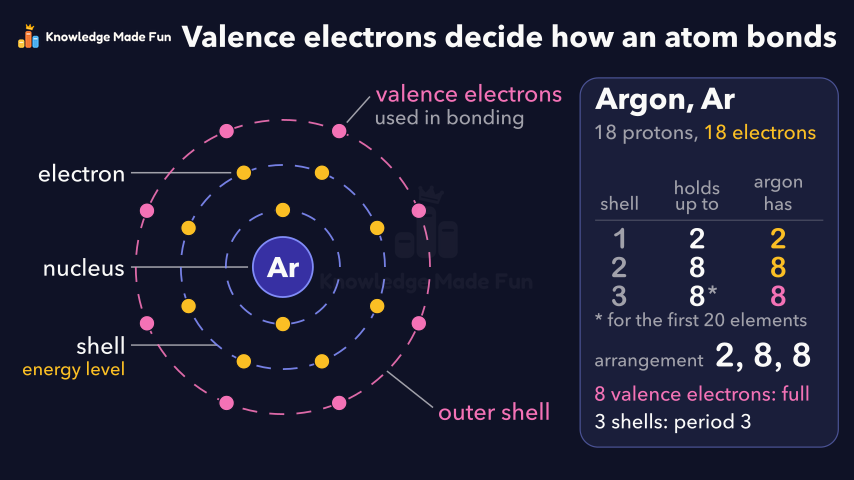 1 min 54 s
Bohr Diagrams: Electrons in Shells and Valence Electrons
Grade 9 · 1 min 54 s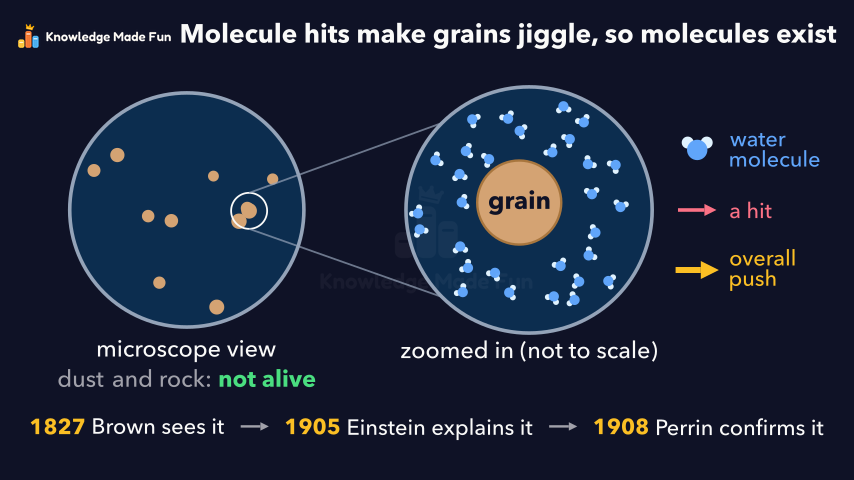 1 min 45 s
Brownian motion: evidence that molecules exist
Grade 8 · 1 min 45 s
- All Grade 9 Science lessons
- Create a free account to watch three lessons a day, no payment and no card.