Lesson · Grade 7 · Social Studies
Why Civilizations Rise and Fall
- Grade 7
- Social Studies
- 1 min 58 s
- British Columbia
- BC7-SS-08
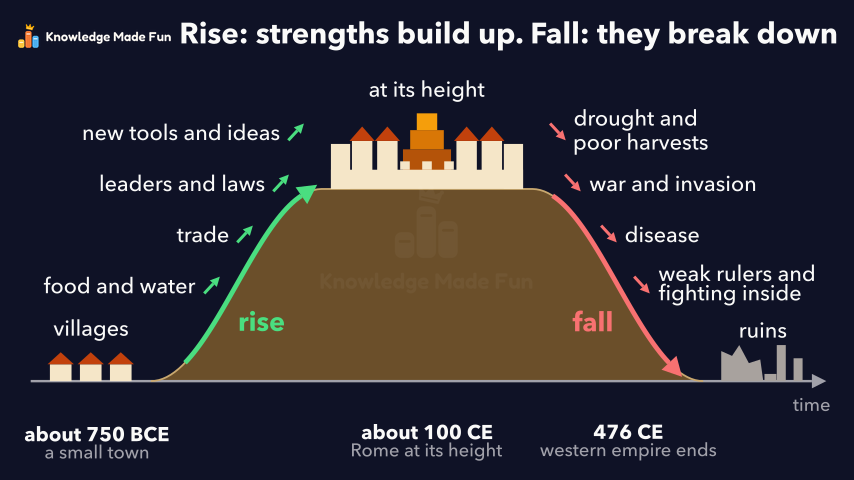
A hill on a timeline tells the story: farming villages at the left foot, a walled city with a temple at the top labelled "at its height", and ruins at the right foot. A green arrow climbs the left slope with four rise factors stepping up beside it (food and water, trade, leaders and laws, new tools and ideas), a red arrow descends the right slope with four fall factors (drought and poor harvests, war and invasion, disease, weak rulers and fighting inside), and Rome's rounded dates (about 750 BCE, about 100 CE, 476 CE) are stamped under the timeline before the one-line recap.
Anyone can watch two lessons on the website without an account. Signing in is free, no payment and no card, and opens three a day; Plus has no limit.
Loading
In one sentence
The question this lesson answers
Why do great civilizations rise, and why do they later fall?
Every civilization began with small farming villages.
Transcript
What the lesson says
Why do great civilizations rise, and why do they later fall?
Every civilization began with small farming villages.
Over hundreds of years, some villages grew into cities and empires, and we call this the rise.
At its height, a civilization had cities, a government, writing, and people with special jobs.
First, rich farmland and fresh water gave extra food, so more people could live together.
Trade brought wealth and new ideas from other lands.
Strong leaders and laws kept order and organized big projects, like canals and walls.
New tools and ideas, such as metal tools and writing, helped people do more.
But no civilization lasted forever, and sooner or later each one weakened, which we call the fall.
Drought, floods or worn-out soil led to poor harvests and hunger.
War and invasion by outsiders destroyed cities and cut off trade.
Disease spread quickly through crowded cities and killed many people.
Weak rulers and fighting inside split the civilization apart.
Often several of these struck at once, and cities emptied until only ruins were left.
Rome grew from a small town, about 750 BCE, into a huge empire by about 100 CE, and its western empire ended in 476 CE.
Trade and strong laws helped Rome grow.
Later, invasions and fighting inside weakened its western empire.
Civilizations rise when food, trade, leaders and ideas build up, and fall when those things break down.
Curriculum
Where this fits
- British Columbia, Grade 7
Social Studies, Ancient world to the 7th century: features and characteristics of civilizations and factors that led to their rise and fallBC7-SS-08
Previous: What Makes a CivilizationNext: Mesopotamia: the land between two rivers
The outcomes and strands follow the British Columbia curriculum.
Keep going
 1 min 23 s
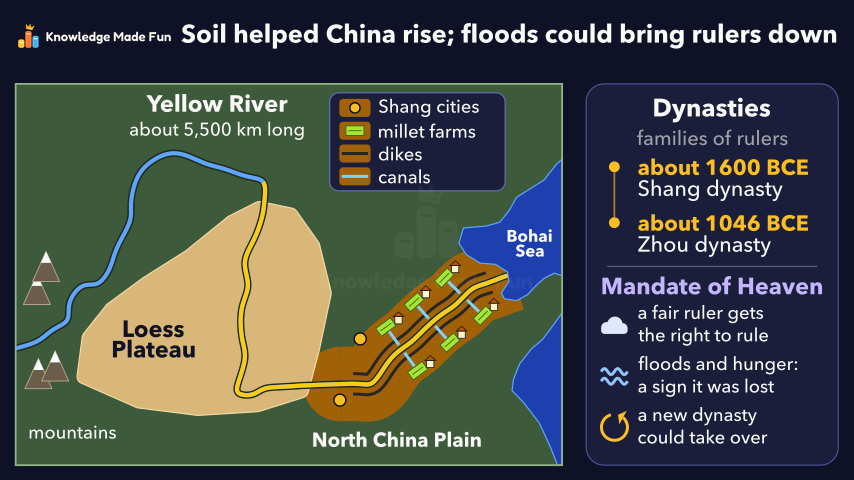
Ancient China and the Yellow River
Grade 7 · 1 min 23 s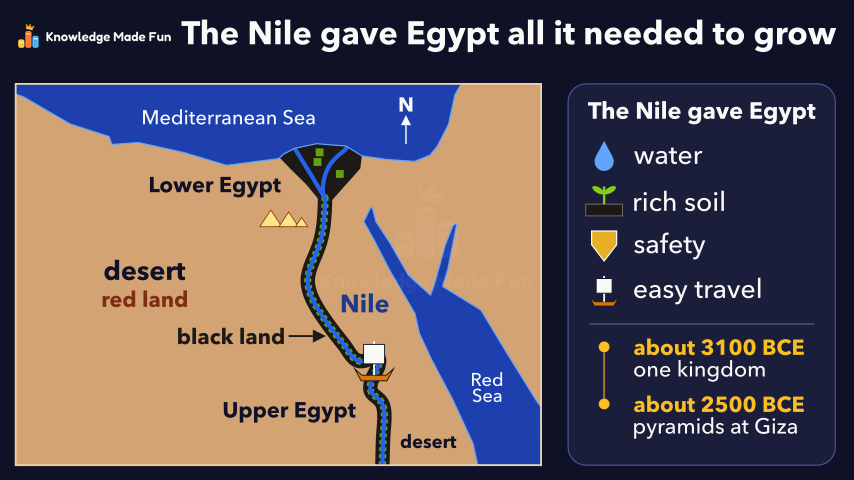 1 min 28 s
Ancient Egypt and the Nile
Grade 7 · 1 min 28 s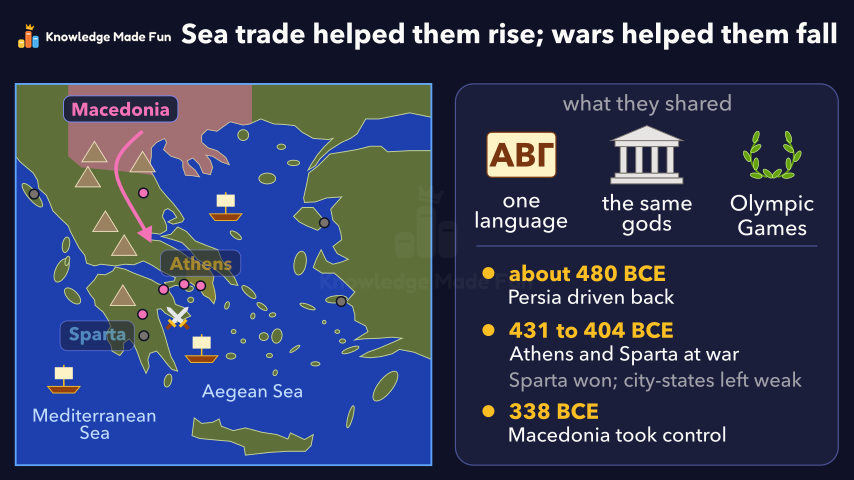 1 min 27 s
Ancient Greece: How the City-States Rose and Fell
Grade 7 · 1 min 27 s 1 min 13 s
Ancient Inventions We Still Use
Grade 7 · 1 min 13 s 1 min 28 s
Ancient Rome: How It Rose and Why the West Fell
Grade 7 · 1 min 28 s 1 min 31 s
Early humans and Neanderthals: our close relatives
Grade 7 · 1 min 31 s 1 min 9 s
From Barter to Money
Grade 7 · 1 min 9 s 1 min 33 s
From Hunting and Gathering to Farming
Grade 7 · 1 min 33 s
- All Grade 7 Social Studies lessons
- Create a free account to watch three lessons a day, no payment and no card.