Lesson · Grade 7 · Social Studies
Ancient Egypt and the Nile
- Grade 7
- Social Studies
- 1 min 28 s
- British Columbia
- BC7-SS-10
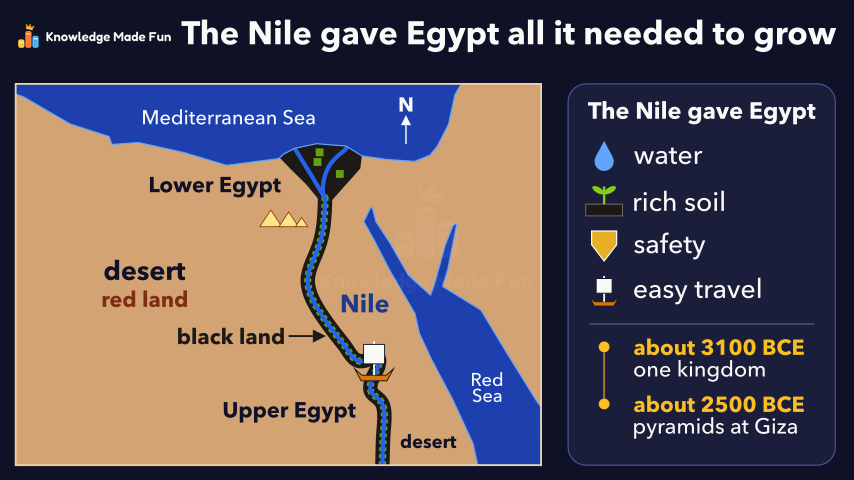
A map of Egypt, drawn from real coordinates, builds up one step at a time: the Nile flows north through the desert, floods every summer and leaves a strip of black soil where farmers grow more food than they need, while the deserts keep enemies out and boats float north with the current and sail south with the wind. Upper and Lower Egypt are united about 3100 BCE, the pyramids at Giza go up about 2500 BCE, a low flood shows how the same river could bring hard times, and the video ends on the recap that the Nile gave Egypt all it needed to grow.
Anyone can watch two lessons on the website without an account. Signing in is free, no payment and no card, and opens three a day; Plus has no limit.
Loading
In one sentence
The question this lesson answers
How did one river help a great civilization grow in a desert?
Egypt, in the northeast corner of Africa, is mostly hot, dry desert.
Transcript
What the lesson says
How did one river help a great civilization grow in a desert?
Egypt, in the northeast corner of Africa, is mostly hot, dry desert.
The Nile River flows north across the desert to the Mediterranean Sea.
Every summer, rains far to the south made the Nile flood its banks.
When the water went down, it left rich black soil on both banks.
Egyptians called this farmland the black land, and the desert the red land.
Farmers grew wheat and barley, and often had more food than they needed.
The deserts on both sides made it hard for enemies to attack.
Boats floated north with the current and sailed south with the wind.
The south was called Upper Egypt because it is upriver, and the north was Lower Egypt.
About 3100 BCE, a king united Upper and Lower Egypt into one kingdom.
Extra food fed the workers who built the pyramids at Giza, about 2500 BCE.
But when the flood was too low, crops failed and people went hungry.
The Nile gave Egypt water, rich soil, safety and easy travel, so a great civilization could grow.
Curriculum
Where this fits
- British Columbia, Grade 7
Social Studies, Ancient world to the 7th century: features and characteristics of civilizations and factors that led to their rise and fallBC7-SS-10
Previous: Mesopotamia: the land between two riversNext: The Indus Valley: How Water Helped Cities Rise and Fall
The outcomes and strands follow the British Columbia curriculum.
Keep going
 1 min 23 s
Ancient China and the Yellow River
Grade 7 · 1 min 23 s 1 min 27 s
Ancient Greece: How the City-States Rose and Fell
Grade 7 · 1 min 27 s 1 min 13 s
Ancient Inventions We Still Use
Grade 7 · 1 min 13 s 1 min 28 s
Ancient Rome: How It Rose and Why the West Fell
Grade 7 · 1 min 28 s 1 min 31 s
Early humans and Neanderthals: our close relatives
Grade 7 · 1 min 31 s 1 min 9 s
From Barter to Money
Grade 7 · 1 min 9 s 1 min 33 s
From Hunting and Gathering to Farming
Grade 7 · 1 min 33 s 1 min 21 s
From Stone Tools to Metal
Grade 7 · 1 min 21 s
- All Grade 7 Social Studies lessons
- Create a free account to watch three lessons a day, no payment and no card.