Lesson · Grade 7 · Social Studies
From Hunting and Gathering to Farming
- Grade 7
- Social Studies
- 1 min 33 s
- British Columbia
- BC7-SS-04
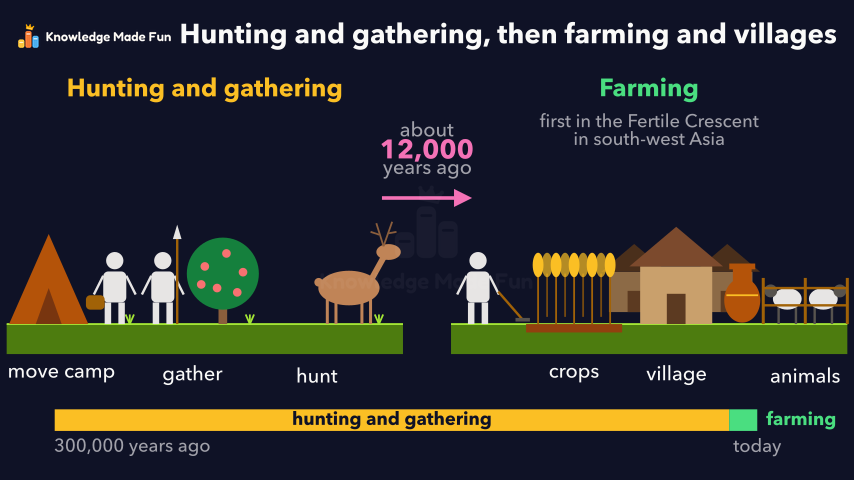
One split picture shows a hunting and gathering camp on the left (a hunter with a spear near a deer, a gatherer at a berry bush, and a tent that moves on) and a farm on the right (a farmer with a hoe, rows of wheat, sheep in a pen, a house, a grain jar, and then a village), joined by an arrow dated about 12,000 years ago. A to-scale bar along the bottom shows farming as a thin sliver at the end of about 300,000 years of modern humans, and the video ends on the recap that people hunted and gathered for almost all of human history, then some began to farm and settle down.
Anyone can watch two lessons on the website without an account. Signing in is free, no payment and no card, and opens three a day; Plus has no limit.
Loading
In one sentence
The question this lesson answers
Long before there were farms or shops, how did people get their food?
For a very long time, people hunted wild animals and gathered wild plants, nuts and fruit.
Transcript
What the lesson says
Long before there were farms or shops, how did people get their food?
For a very long time, people hunted wild animals and gathered wild plants, nuts and fruit.
They moved from place to place, following the animals and the seasons, and carried only what they could.
Modern humans have been around for about 300,000 years, and for almost all of that time, this was how everyone lived.
Then, about 12,000 years ago, as the last ice age ended, a big change began in a few places.
People began to plant seeds and grow their own crops, like wheat and barley.
They also began to keep animals, like sheep and goats, instead of only hunting them.
Farming began first in the Fertile Crescent, in south-west Asia, and later on its own in other parts of the world.
Farmers had to stay near their fields all year, so they built homes that lasted.
Extra grain could be stored in jars and pits, so there was food for the months ahead.
With more food, more people could live together, and the first villages grew.
This change was so big that it is called the Agricultural Revolution, or the Neolithic Revolution.
People hunted and gathered for almost all of human history, then about 12,000 years ago some began to farm and settle down.
Curriculum
Where this fits
- British Columbia, Grade 7
Social Studies, Ancient world to the 7th century: anthropological origins of humansBC7-SS-04
Previous: From Stone Tools to MetalNext: Why the First Civilizations Grew Beside Rivers
The outcomes and strands follow the British Columbia curriculum.
Keep going
 1 min 23 s
Ancient China and the Yellow River
Grade 7 · 1 min 23 s 1 min 28 s
Ancient Egypt and the Nile
Grade 7 · 1 min 28 s 1 min 27 s
Ancient Greece: How the City-States Rose and Fell
Grade 7 · 1 min 27 s 1 min 13 s
Ancient Inventions We Still Use
Grade 7 · 1 min 13 s 1 min 28 s
Ancient Rome: How It Rose and Why the West Fell
Grade 7 · 1 min 28 s 1 min 31 s
Early humans and Neanderthals: our close relatives
Grade 7 · 1 min 31 s 1 min 9 s
From Barter to Money
Grade 7 · 1 min 9 s 1 min 21 s
From Stone Tools to Metal
Grade 7 · 1 min 21 s
- All Grade 7 Social Studies lessons
- Create a free account to watch three lessons a day, no payment and no card.