Lesson · Grade 7 · Social Studies
Mesopotamia: the land between two rivers
- Grade 7
- Social Studies
- 1 min 31 s
- British Columbia
- BC7-SS-09
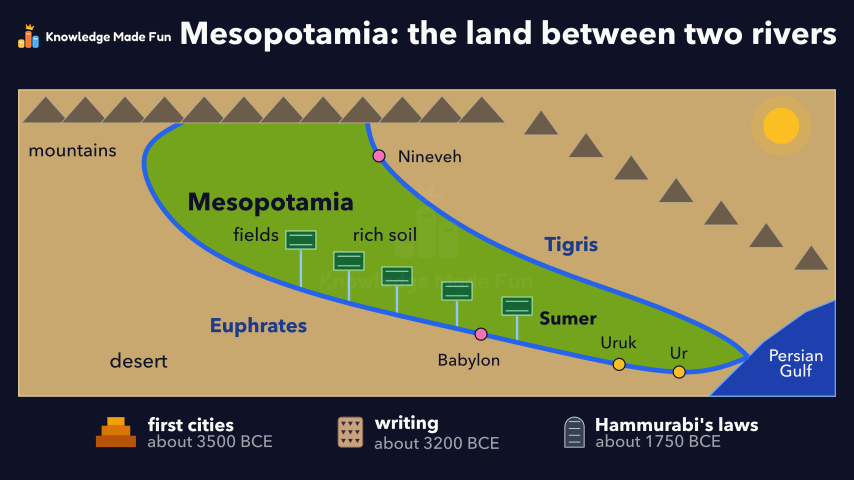
A schematic map builds up step by step: mountains in the north, the Tigris and Euphrates flowing south-east to the Persian Gulf, the land between them shaded and named Mesopotamia, then spring floods, rich soil, canals and fields, the first cities of Sumer at Uruk and Ur, and later Babylon and Nineveh. A strip under the map records three things that began here (first cities about 3500 BCE, writing about 3200 BCE, Hammurabi's written laws about 1750 BCE), and the video ends on the recap that Mesopotamia, the land between two rivers, was home to some of the world's first cities.
Anyone can watch two lessons on the website without an account. Signing in is free, no payment and no card, and opens three a day; Plus has no limit.
Loading
In one sentence
The question this lesson answers
Where in the world did some of the very first cities grow?
Two great rivers flow from the mountains in the north down to the Persian Gulf.
Transcript
What the lesson says
Where in the world did some of the very first cities grow?
Two great rivers flow from the mountains in the north down to the Persian Gulf.
They are the Tigris in the east and the Euphrates in the west.
The land between them is Mesopotamia, a Greek word meaning 'between the rivers'.
Today most of this land is in the country of Iraq.
The southern plain was hot and flat, with very little rain.
But each spring, melting snow in the mountains made the rivers flood.
The floods left behind rich mud called silt, which made the soil perfect for farming.
Farmers dug canals to carry river water to their fields during the dry months.
Big harvests fed many people, and by about 3500 BCE villages in the south, in Sumer, had grown into the first cities.
Here people also invented one of the first writing systems, cuneiform, about 3200 BCE.
Later, other peoples ruled here too, such as the Babylonians at Babylon and the Assyrians at Nineveh.
A king of Babylon, Hammurabi, had his laws carved in stone about 1750 BCE, one of the oldest law codes we know.
Mesopotamia, the land between the Tigris and the Euphrates, was home to some of the world's first cities.
Curriculum
Where this fits
- British Columbia, Grade 7
Social Studies, Ancient world to the 7th century: features and characteristics of civilizations and factors that led to their rise and fallBC7-SS-09
Previous: Why Civilizations Rise and FallNext: Ancient Egypt and the Nile
The outcomes and strands follow the British Columbia curriculum.
Keep going
 1 min 23 s
Ancient China and the Yellow River
Grade 7 · 1 min 23 s 1 min 28 s
Ancient Egypt and the Nile
Grade 7 · 1 min 28 s 1 min 27 s
Ancient Greece: How the City-States Rose and Fell
Grade 7 · 1 min 27 s 1 min 13 s
Ancient Inventions We Still Use
Grade 7 · 1 min 13 s 1 min 28 s
Ancient Rome: How It Rose and Why the West Fell
Grade 7 · 1 min 28 s 1 min 31 s
Early humans and Neanderthals: our close relatives
Grade 7 · 1 min 31 s 1 min 9 s
From Barter to Money
Grade 7 · 1 min 9 s 1 min 33 s
From Hunting and Gathering to Farming
Grade 7 · 1 min 33 s
- All Grade 7 Social Studies lessons
- Create a free account to watch three lessons a day, no payment and no card.