Lesson · Grade 7 · Social Studies
The Code of Hammurabi: Laws Carved in Stone
- Grade 7
- Social Studies
- 1 min 30 s
- British Columbia
- BC7-SS-21
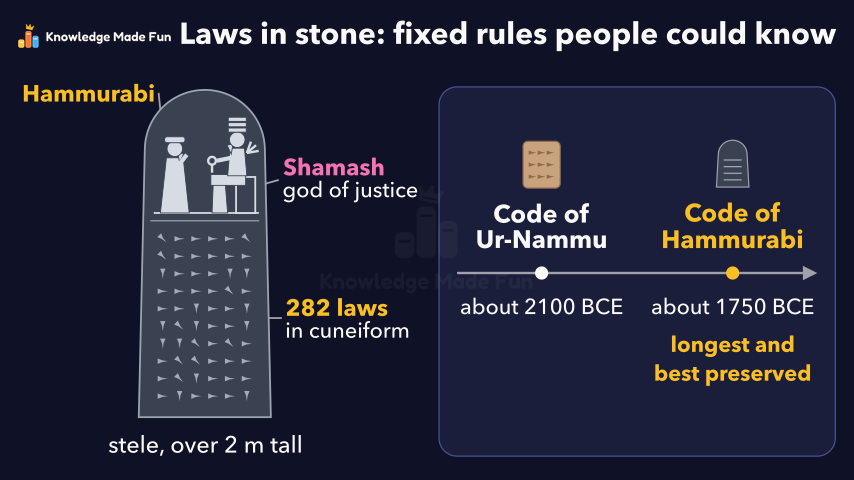
A stele is built up from shapes: Hammurabi before Shamash at the top and 282 laws in cuneiform below, while a card beside it explains who Hammurabi was, what the laws covered, the "if... then" pattern (a flooded field paid for in grain), and how punishments depended on rank (an eye for an eye between nobles, but silver for a commoner's eye). It ends by placing the code on a timeline after the older Code of Ur-Nammu, as the longest and best preserved early code, and recaps that carving laws in stone kept them fixed and knowable.
Concept: The Code of Hammurabi: the first written laws
Anyone can watch two lessons on the website without an account. Signing in is free, no payment and no card, and opens three a day; Plus has no limit.
Loading
In one sentence
The question this lesson answers
Why would a king carve his laws into stone?
Hammurabi was king of Babylon, in Mesopotamia, from about 1792 to 1750 BCE.
Transcript
What the lesson says
Why would a king carve his laws into stone?
Hammurabi was king of Babylon, in Mesopotamia, from about 1792 to 1750 BCE.
He had his laws carved on a stele, a stone slab over 2 metres tall.
At the top, Hammurabi stands before Shamash, the Babylonian god of justice.
Below, the code's 282 laws are written in cuneiform.
The laws covered everyday life: trade, farming, family, work and crime.
Each law describes a case: if someone does this, then this must happen.
If a farmer carelessly floods a neighbour's field, the farmer must pay the neighbour in grain.
If a noble put out another noble's eye, he lost an eye too: an eye for an eye.
But for a commoner's eye, he paid silver: punishments depended on rank.
Carved in stone, the laws stayed the same and could be read aloud.
The Code of Ur-Nammu, from about 2100 BCE, is older than Hammurabi's, from about 1750 BCE.
But Hammurabi's is the longest and best preserved of the early law codes.
Hammurabi had his laws carved in stone, so the rules stayed fixed and people could know them.
Curriculum
Where this fits
- British Columbia, Grade 7
Social Studies, Ancient world to the 7th century: social, political, legal, governmental, and economic systems and structuresBC7-SS-21
Previous: How Ideas Spread Between CivilizationsNext: Where Our Ideas of Government Come From: Athens and Rome
The outcomes and strands follow the British Columbia curriculum.
Keep going
 1 min 23 s
Ancient China and the Yellow River
Grade 7 · 1 min 23 s 1 min 28 s
Ancient Egypt and the Nile
Grade 7 · 1 min 28 s 1 min 27 s
Ancient Greece: How the City-States Rose and Fell
Grade 7 · 1 min 27 s 1 min 13 s
Ancient Inventions We Still Use
Grade 7 · 1 min 13 s 1 min 28 s
Ancient Rome: How It Rose and Why the West Fell
Grade 7 · 1 min 28 s 1 min 31 s
Early humans and Neanderthals: our close relatives
Grade 7 · 1 min 31 s 1 min 9 s
From Barter to Money
Grade 7 · 1 min 9 s 1 min 33 s
From Hunting and Gathering to Farming
Grade 7 · 1 min 33 s
- All Grade 7 Social Studies lessons
- Create a free account to watch three lessons a day, no payment and no card.