Lesson · Grade 7 · Social Studies
How Ideas Spread Between Civilizations
- Grade 7
- Social Studies
- 1 min 6 s
- British Columbia
- BC7-SS-20
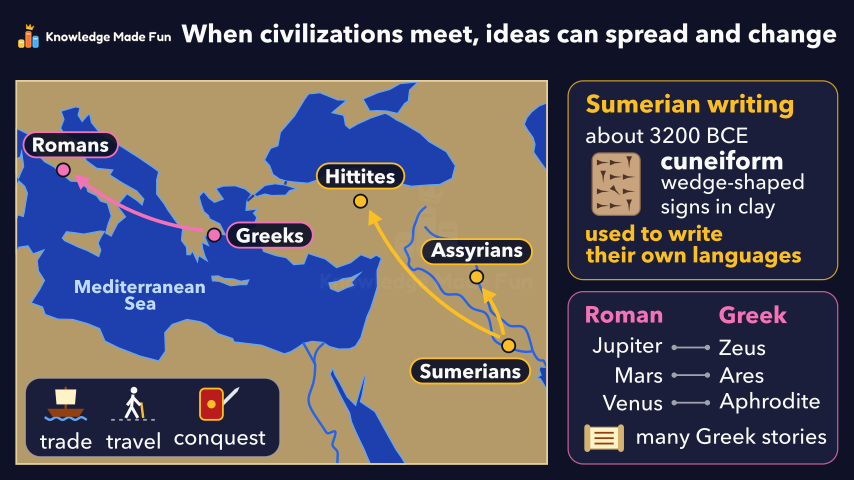
On one map of the ancient Mediterranean and Middle East, the video shows that ideas often spread when people met through trade, travel and conquest. It follows two examples: Sumerian cuneiform borrowed by the Assyrians and Hittites for their own languages, and Roman gods matched with Greek gods, ending on how each people changed what it borrowed.
Anyone can watch two lessons on the website without an account. Signing in is free, no payment and no card, and opens three a day; Plus has no limit.
Loading
In one sentence
The question this lesson answers
How did ideas travel from one civilization to another?
Ideas often spread when people met through trade, travel and conquest.
Transcript
What the lesson says
How did ideas travel from one civilization to another?
Ideas often spread when people met through trade, travel and conquest.
The Sumerians made some of the earliest writing, about 3200 BCE.
They pressed wedge-shaped signs into clay, and this writing is called cuneiform.
Later, other peoples, like the Assyrians and the Hittites, borrowed cuneiform.
They used its wedge signs to write their own languages.
Much later, the Romans met the Greeks through trade and conquest.
The Romans matched their own gods with Greek gods.
Jupiter was matched with Zeus, Mars with Ares, and Venus with Aphrodite.
The Romans also borrowed many Greek stories about these gods.
In both examples, people changed what they borrowed to fit their own culture.
When civilizations meet, ideas can spread, and people change them to fit their own culture.
Curriculum
Where this fits
- British Columbia, Grade 7
Social Studies, Ancient world to the 7th century: interactions and exchanges between past civilizations and culturesBC7-SS-20
Previous: The Silk Road: How Goods and Ideas TravelledNext: The Code of Hammurabi: Laws Carved in Stone
The outcomes and strands follow the British Columbia curriculum.
Keep going
 1 min 23 s
Ancient China and the Yellow River
Grade 7 · 1 min 23 s 1 min 28 s
Ancient Egypt and the Nile
Grade 7 · 1 min 28 s 1 min 27 s
Ancient Greece: How the City-States Rose and Fell
Grade 7 · 1 min 27 s 1 min 13 s
Ancient Inventions We Still Use
Grade 7 · 1 min 13 s 1 min 28 s
Ancient Rome: How It Rose and Why the West Fell
Grade 7 · 1 min 28 s 1 min 31 s
Early humans and Neanderthals: our close relatives
Grade 7 · 1 min 31 s 1 min 9 s
From Barter to Money
Grade 7 · 1 min 9 s 1 min 33 s
From Hunting and Gathering to Farming
Grade 7 · 1 min 33 s
- All Grade 7 Social Studies lessons
- Create a free account to watch three lessons a day, no payment and no card.