Lesson · Grade 6 · Social Studies
Democracy, Monarchy and Dictatorship: Who Holds the Power?
- Grade 6
- Social Studies
- 1 min 9 s
- British Columbia
- BC6-SS-09
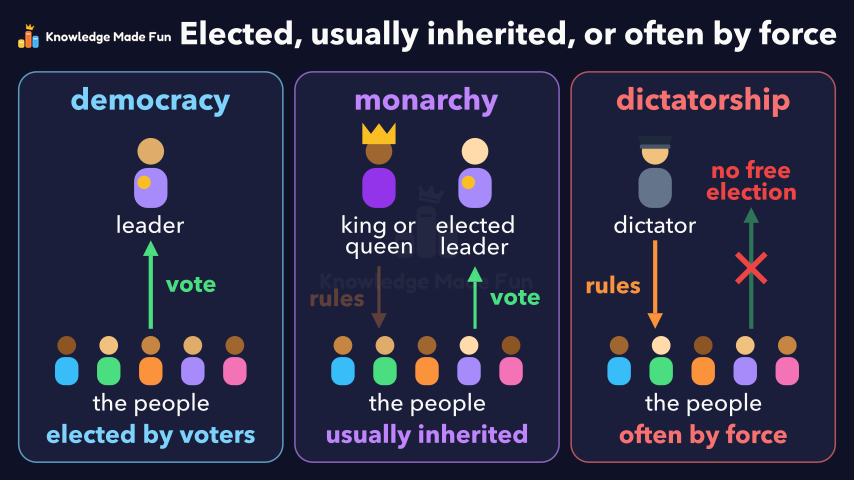
Three cards side by side compare democracy, monarchy and dictatorship. Each one shows who holds the power over the same row of people, using vote arrows, a crown passed to an heir, a ruling arrow and a crossed-out vote. The video ends on how each gets its power: elected by voters, usually inherited, or often taken by force.
Concept: Forms of government: democracy, monarchy and dictatorship
Anyone can watch two lessons on the website without an account. Signing in is free, no payment and no card, and opens three a day; Plus has no limit.
Loading
In one sentence
The question this lesson answers
Who holds the power in a country, and how do they get it?
Here are three common forms of government: democracy, monarchy and dictatorship.
Transcript
What the lesson says
Who holds the power in a country, and how do they get it?
Here are three common forms of government: democracy, monarchy and dictatorship.
In a democracy, the power belongs to the people.
The people vote in elections to choose their leaders.
At the next election, the people can choose someone new.
In a monarchy, a king or queen is the head of the country.
The crown is usually inherited by an heir in the same family.
Some kings and queens hold real power and rule the country.
But in many monarchies today, the people elect leaders who make the laws.
In a dictatorship, usually one ruler, called a dictator, holds all the power.
A dictator often takes power by force.
The people have no free election to vote a dictator out.
So leaders are elected, monarchs usually inherit the crown, and dictators often take power by force.
Curriculum
Where this fits
- British Columbia, Grade 6
Social Studies, Governance: different systems of governmentBC6-SS-09
Previous: Governments, NGOs and Aid Groups: Who Does WhatNext: Parliament or president: two kinds of democracy
The outcomes and strands follow the British Columbia curriculum.
Keep going
 1 min 3 s
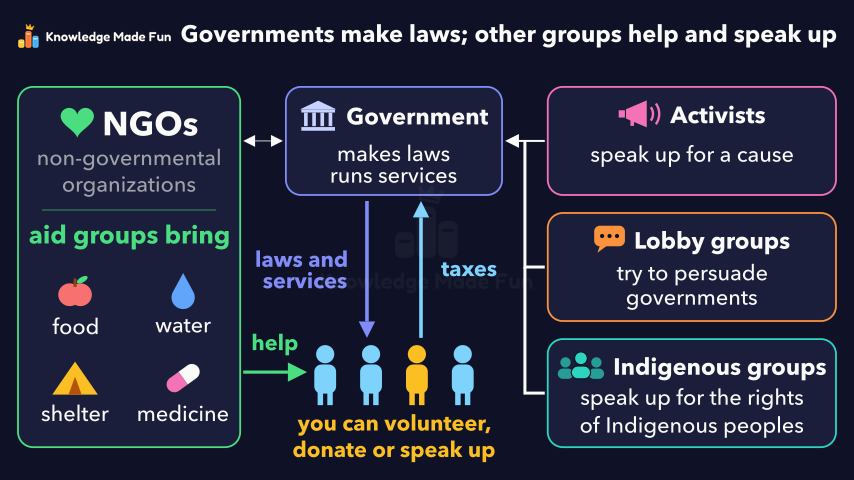
Governments, NGOs and Aid Groups: Who Does What
Grade 6 · 1 min 3 s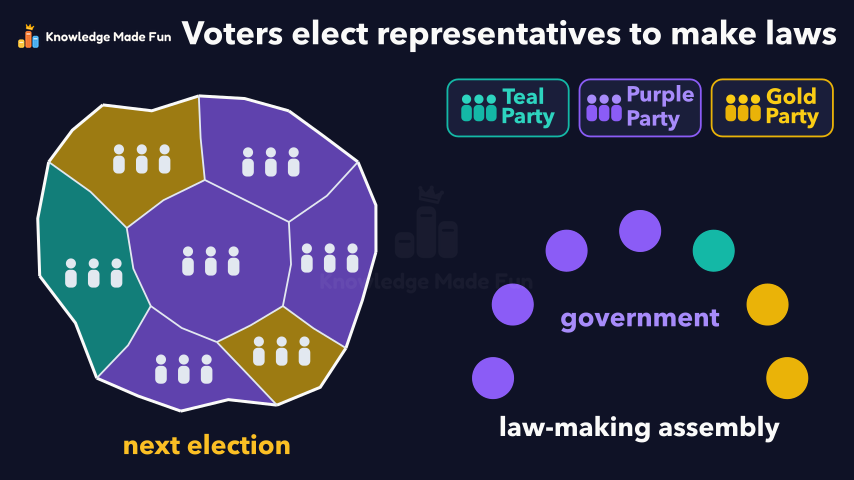 1 min 16 s
How Elections Work: Parties, Voting and Representation
Grade 6 · 1 min 16 s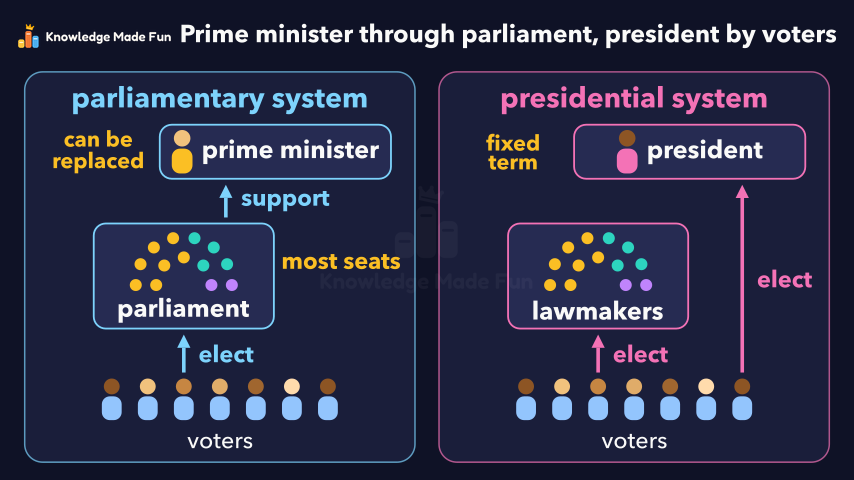 1 min 4 s
Parliament or president: two kinds of democracy
Grade 6 · 1 min 4 s 1 min 15 s
The United Nations: what it is and what it does
Grade 6 · 1 min 15 s 1 min 9 s
Bias and Sensationalism: One Story, Three Headlines
Grade 6 · 1 min 9 s 1 min 20 s
Countries Working Together on Global Problems
Grade 6 · 1 min 20 s 1 min 15 s
Globalization: How Countries Depend on Each Other
Grade 6 · 1 min 15 s 1 min 11 s
How News and Rumours Spread on Social Media
Grade 6 · 1 min 11 s
- All Grade 6 Social Studies lessons
- Create a free account to watch three lessons a day, no payment and no card.