Lesson · Grade 8 · Science
Why Earthquakes and Volcanoes Happen at Plate Edges
- Grade 8
- Science
- 2 min
- British Columbia
- BC8-SC-41
A world map shows strong earthquakes and volcanoes lining up along the edges of tectonic plates, most of all around the Pacific's Ring of Fire. One labelled slice through a plate edge, where an ocean plate sinks under a continent, then builds up step by step. It shows plates sticking and snapping to cause earthquakes (seismic waves, focus and epicentre), about 32 times more energy for each step of magnitude, water helping mantle rock melt into magma that erupts at a volcano, and Hawaii's hot spot as the exception.
Concept: Why earthquakes and volcanoes happen at plate boundaries
Anyone can watch two lessons on the website without an account. Signing in is free, no payment and no card, and opens three a day; Plus has no limit.
Loading
In one sentence
The question this lesson answers
Why do earthquakes and volcanoes happen where they do?
Each yellow dot is a strong earthquake. Each red triangle is a volcano.
Transcript
What the lesson says
Why do earthquakes and volcanoes happen where they do?
Each yellow dot is a strong earthquake. Each red triangle is a volcano.
Most line up along the edges of tectonic plates, the giant slabs of rock that form Earth's outer shell.
The busiest edge circles the Pacific Ocean: the Ring of Fire.
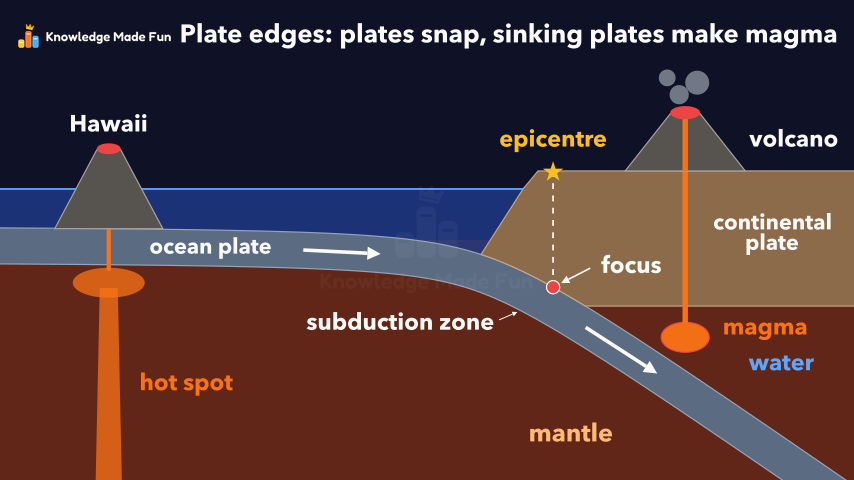
Slice through one edge: an ocean plate moves toward a continental plate, a few centimetres a year.
The plates don't slide smoothly. They stick, and stress builds up.
When the stress gets too great, the rock snaps. That is an earthquake.
The energy spreads as seismic waves, vibrations through the rock.
The rock breaks at the focus, underground. The point on the surface right above it is the epicentre.
Magnitude measures earthquake size. Is magnitude 6 only a little stronger than 5?
No. Each step up the scale releases about 32 times more energy.
So magnitude 7 releases about 1000 times more energy than 5.
Here the ocean plate sinks into the mantle, the hot rock below the plates: a subduction zone.
The sinking plate carries water down. Water lowers the melting point of mantle rock, so some melts into magma.
Magma is less dense than the rock around it, so it rises and erupts at a volcano.
A few volcanoes, like Hawaii, sit far from plate edges, above hot spots where hot mantle rock rises.
So most earthquakes and volcanoes happen at plate edges, where plates snap and sinking plates make magma.
Curriculum
Where this fits
- British Columbia, Grade 8
Science, Earth science: plate tectonic movementBC8-SC-41
Previous: Plate Boundaries: Apart, Together or Sliding PastNext: Megathrust Earthquakes and Tsunamis: How Cascadia Snapped in 1700
The outcomes and strands follow the British Columbia curriculum.
Keep going
 1 min 43 s
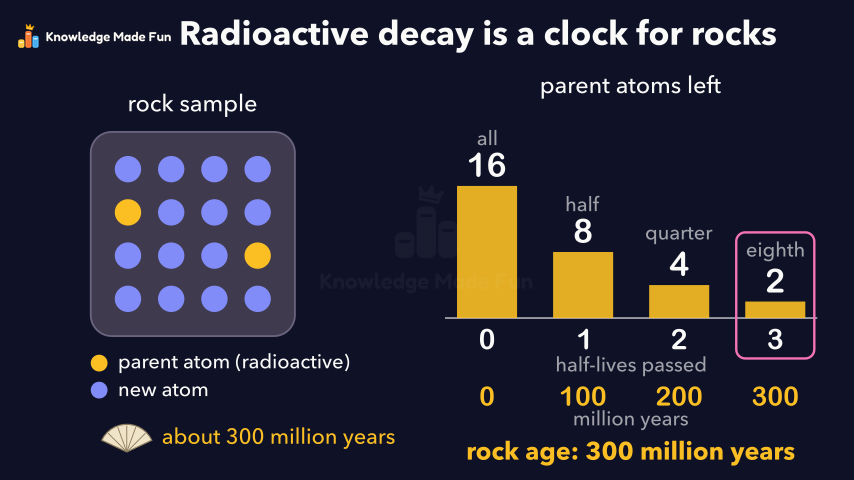
Absolute dating: radioactive decay is a clock for rocks
Grade 7 · 1 min 43 s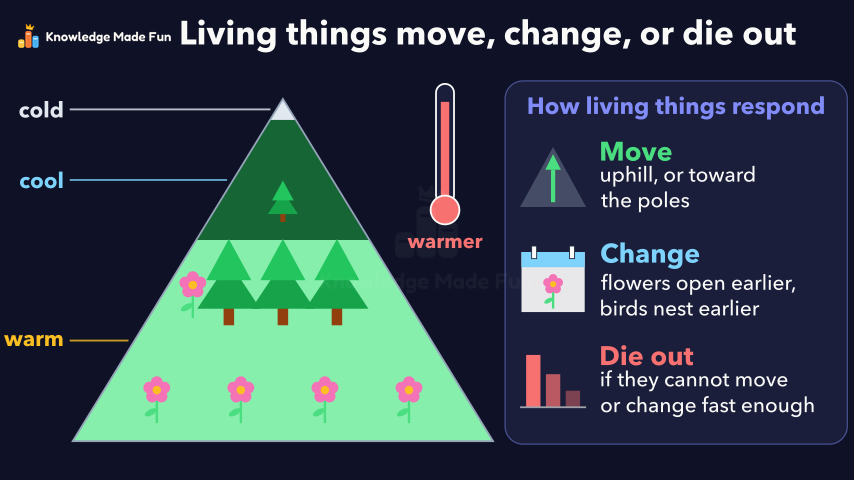 1 min 19 s
Climate Change and Living Things: Move, Change, or Die Out
Grade 7 · 1 min 19 s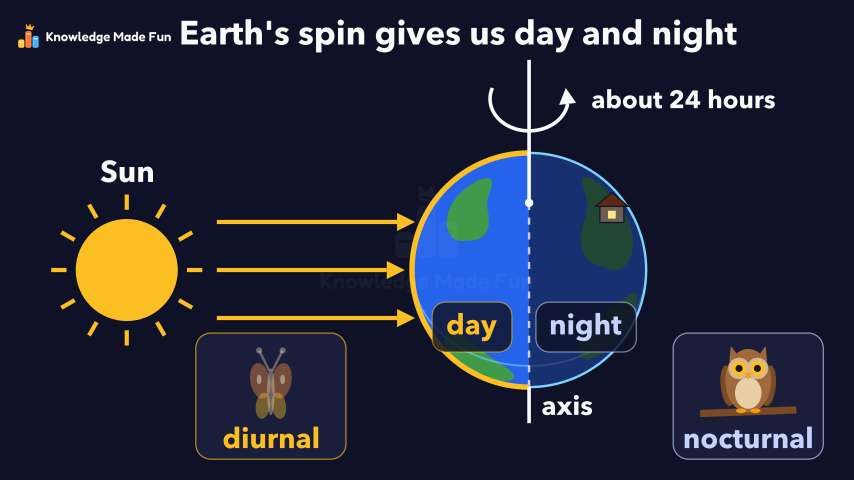 1 min 14 s
Day and Night: Earth Spins on Its Axis
Grade 4 · 1 min 14 s 1 min 50 s
Dynamic equilibrium: balanced but always changing
Grade 9 · 1 min 50 s 1 min 11 s
Earth Materials: From Boulders to Clay
Grade 5 · 1 min 11 s 1 min 11 s
Erosion and Deposition: How Wind, Water and Ice Move Land
Grade 3 · 1 min 11 s 1 min 53 s
From quarks to galaxies: how the universe's matter formed
Grade 10 · 1 min 53 s 47 s
Hot, Warm, Cool and Cold: What Do We Wear?
Kindergarten · 47 s
- All Grade 8 Science lessons
- Create a free account to watch three lessons a day, no payment and no card.