Lesson · Grade 10 · Science
From quarks to galaxies: how the universe's matter formed
- Grade 10
- Science
- 1 min 53 s
- British Columbia
- BC10-SC-44
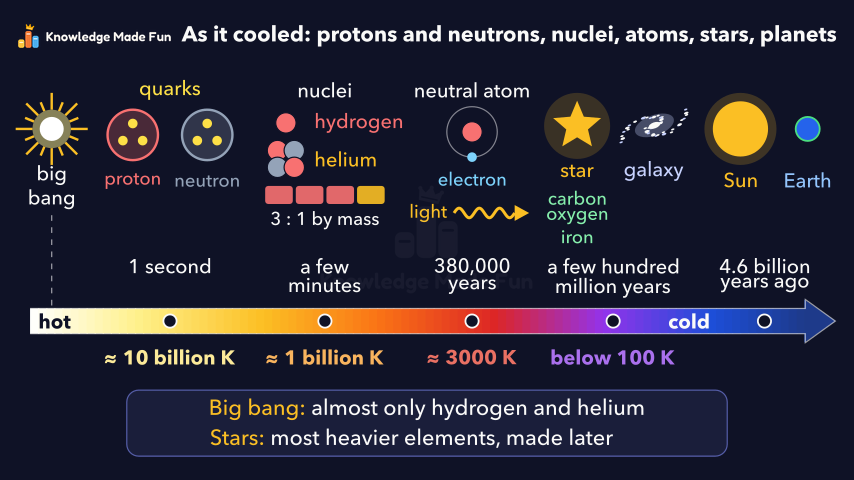
A timeline that doubles as a temperature bar, coloured from hot to cold, runs from the big bang to the Sun and Earth, and each stop adds the new kind of matter: quarks joining into protons and neutrons, hydrogen and helium nuclei in a 3 to 1 mass ratio, neutral atoms that let light travel freely, the first stars and galaxies making carbon, oxygen and iron, and the Sun and Earth forming from that gas and dust. It then crosses out the common mistake that every element came from the big bang, showing that the big bang made almost only hydrogen and helium and stars made the heavier elements later, and ends on a one-line recap.
Anyone can watch two lessons on the website without an account. Signing in is free, no payment and no card, and opens three a day; Plus has no limit.
Loading
In one sentence
The question this lesson answers
How did the matter in our universe form?
It began with the big bang, about 13.8 billion years ago, extremely hot and dense.
Transcript
What the lesson says
How did the matter in our universe form?
It began with the big bang, about 13.8 billion years ago, extremely hot and dense.
Since then, it has expanded and cooled; this bar runs from hot to cold.
In the first second, particles called quarks joined in threes to make protons and neutrons.
At one second it was about 10 billion kelvin. Zero kelvin is the coldest possible.
In the first few minutes, at about 1 billion kelvin, some protons and neutrons fused, or joined, into helium nuclei, the centres of atoms.
Lone protons are hydrogen nuclei. By mass, there was about 3 parts hydrogen to 1 part helium.
At about 380,000 years and 3000 kelvin, electrons joined nuclei to make neutral atoms, with no overall charge.
Light stopped bouncing off free electrons and could travel freely.
Within a few hundred million years, below 100 kelvin, gravity pulled gas into the first stars and galaxies, huge groups of stars.
Inside stars, fusion makes heavier elements, like carbon, oxygen and iron.
Big stars explode and scatter these elements. About 4.6 billion years ago, the Sun and Earth formed from that gas and dust.
A common mistake is thinking every element came from the big bang.
It made almost only hydrogen and helium; heavier elements came later, mostly from stars.
As it cooled, matter built up: protons and neutrons, nuclei, atoms, stars and planets.
Curriculum
Where this fits
- British Columbia, Grade 10
Science 10, Earth science: formation of the universe: components of the universe over timeBC10-SC-44
Previous: The Big Bang: Space Itself Is ExpandingNext: Redshift and Blueshift: What Light Tells Us About Motion
The outcomes and strands follow the British Columbia curriculum.
Keep going
 1 min 43 s
Absolute dating: radioactive decay is a clock for rocks
Grade 7 · 1 min 43 s 1 min 19 s
Climate Change and Living Things: Move, Change, or Die Out
Grade 7 · 1 min 19 s 1 min 14 s
Day and Night: Earth Spins on Its Axis
Grade 4 · 1 min 14 s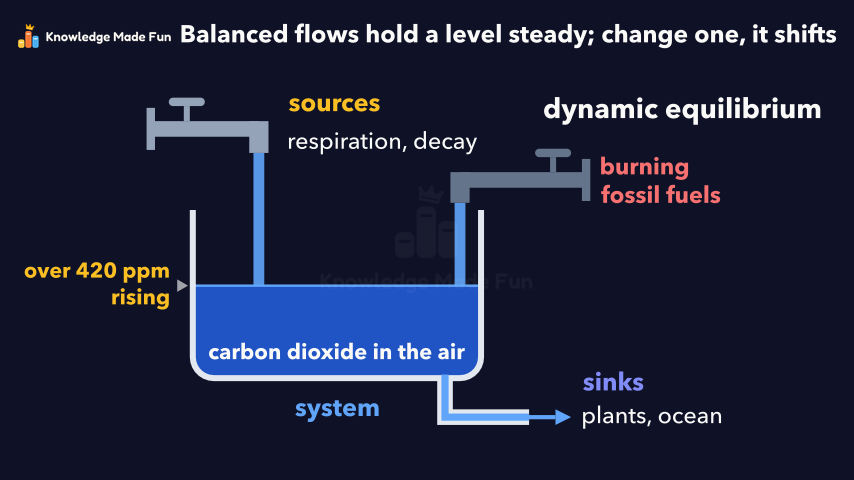 1 min 50 s
Dynamic equilibrium: balanced but always changing
Grade 9 · 1 min 50 s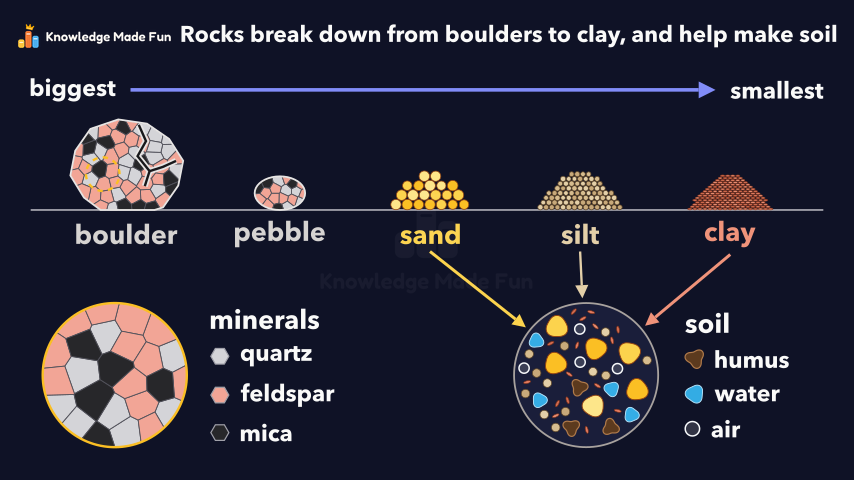 1 min 11 s
Earth Materials: From Boulders to Clay
Grade 5 · 1 min 11 s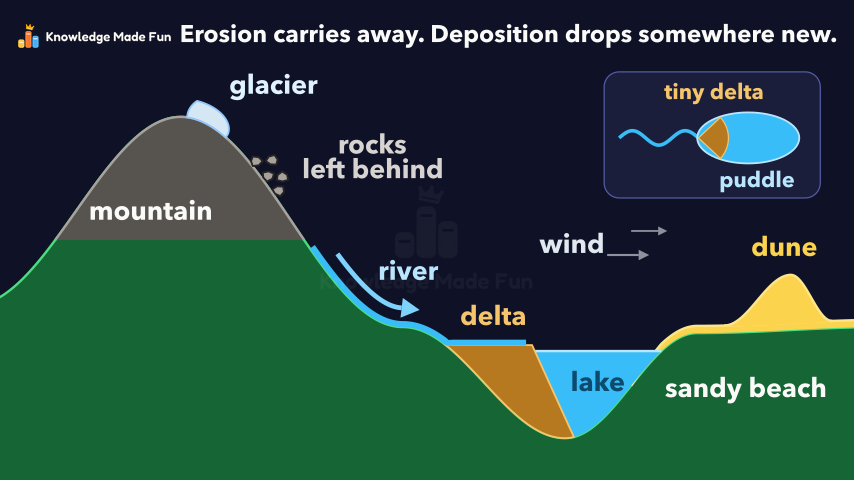 1 min 11 s
Erosion and Deposition: How Wind, Water and Ice Move Land
Grade 3 · 1 min 11 s 47 s
Hot, Warm, Cool and Cold: What Do We Wear?
Kindergarten · 47 s 1 min 25 s
How Fossils Form
Grade 7 · 1 min 25 s
- All Grade 10 Science lessons
- Create a free account to watch three lessons a day, no payment and no card.